CROP CIRCLES
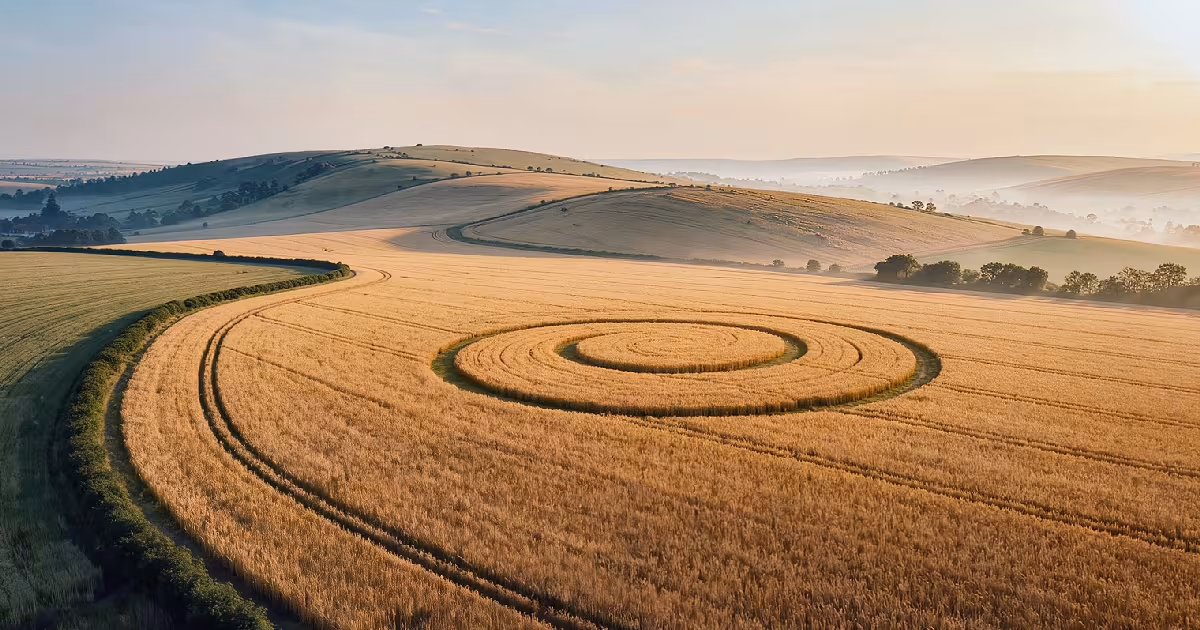
A large circular pattern pressed into a wheat field at dawn.
Illustration, not a photograph.

Opening
In September 1991 two men in their sixties from Southampton, Doug Bower and Dave Chorley, told a British newspaper that they had been making crop circles in the fields of southern England since 1978. Their tools were a wooden plank, some rope and a baseball cap with a loop of wire on the peak to sight a straight line. To prove it, they made one in front of journalists. A leading crop circle researcher, Pat Delgado, was taken to see it and declared it genuine before he was told who had made it.
By then the circles had become a national mystery, explained as whirlwinds, ball lightning, earth energies or messages from somewhere else. The confession did not stop them. Teams of artists went on making ever more elaborate designs, and by 2001 about 10,000 had been reported around the world.
Timeline
1678A pamphlet, The Mowing-Devil: or, Strange News Out of Hartfordshire, tells of a field of oats cut overnight by the Devil after a farmer refused to pay a mower. It is often cited as the first crop circle, though the crop in it was cut, not flattened, and researchers doubt the link.
1966At Tully, in Queensland, Australia, a farmer reports a saucer-shaped craft rising from a swamp and leaving a flattened circle of reeds about ten metres across. Officials think a whirlwind is the likeliest cause. The "saucer nest" story travels widely.
1978According to their own account, Bower and Chorley, inspired by the Tully story over a pint, make their first circle near Cheesefoot Head in Hampshire.
1980Meteorologist Terence Meaden proposes that the circles are made by whirlwinds trapped by the hills of southern England. He later suggests a "plasma vortex".
The 1980sCircles multiply, especially in Wiltshire and Hampshire. Pat Delgado and Colin Andrews publish Circular Evidence, arguing for an unknown force. The word "cereology" is coined.
July 1990Colin Andrews leads Operation Blackbird, a night watch on fields near Westbury in Wiltshire, funded mainly by the BBC and Japan's Nippon TV, with help from the British Army and thermal and night-vision cameras. When a formation appears, Andrews tells the press that something significant has happened. In the flattened crop, investigators find a wooden cross and a board game. It is a hoax, and the makers are never identified.
September 1991Bower and Chorley go public in the Today newspaper, claiming more than 200 circles, including every one made before 1987. Delgado's endorsement of their demonstration circle is reported around the world.
End of 1991Meaden concedes that the complex designs are made by people.
11 to 12 July 1992A crop circle making competition is held in Berkshire. A £3,000 prize goes to a team of three engineers from Westland Helicopters, whose kit is rope, plastic pipe, a plank, string, a telescopic sighting device and two stepladders.
1994The biophysicist William Levengood publishes a paper in Physiologia Plantarum reporting changes in the grain inside circles. The investigator Joe Nickell later criticises his methods and his reasoning, which assumes the circles he sampled were genuine.
7 July 1996A spiral of about 150 circles, the "Julia Set", appears in a field opposite Stonehenge, by a busy road. Believers say a pilot saw the field empty minutes earlier. Accounts of how long the gap was vary widely, and members of a known circle-making team later claim it as theirs.
The 1990sThe art collective Circlemakers, founded by Rod Dickinson and John Lundberg, begins making large designs, some commissioned for advertising.
2000Matthew Williams becomes the first person in Britain prosecuted for making a crop circle. He is fined £100 with £40 costs.
2001A formation of 409 circles in a six-armed spiral, about 238 metres across, appears at Milk Hill in Wiltshire, one of the largest ever recorded.
2002After a two-year study of hoaxing, Colin Andrews estimates that about 80 per cent of crop circles are made by people. He holds that the rest cannot all be explained that way.
Key figures
Doug Bower and Dave Chorley started the modern wave and confessed to it. Pat Delgado and Colin Andrews were its best-known researchers. Terence Meaden offered the most serious natural explanation and abandoned it when the evidence turned. Rod Dickinson and John Lundberg turned circle making into an art form, openly.
Physical and documentary trail
The record: the circles themselves, photographed from the air every summer; the 1991 newspaper confession and the demonstration that fooled Delgado; the 1992 competition; the work of known human makers; and court cases over crop damage. Surveys show that circles cluster near roads, towns and ancient monuments, with nearly half the British circles of 2003 within 15 kilometres of Avebury in Wiltshire. What has never appeared is a circle formed under observation by anything other than people.
Things you might not know
- The sighting device was a cap. Bower and Chorley kept their lines straight with a loop of wire fixed to the peak of a baseball cap.
- Visitors did most of the damage. When two teenagers made a circle in Hungary in 1992, a court held them liable only for the circle itself, about 6,000 forints, and blamed 99 per cent of the crop damage on the crowds who came to see it.
- There was a prize for it. The 1992 Berkshire competition paid £3,000 to the best human-made circle.
- They follow the roads. Circles appear mostly where they can be reached on foot at night and seen from a road or a hill.
- The shapes kept growing. From simple rings in the 1980s, designs grew to complex fractals and patterns of hundreds of circles by the late 1990s and 2000s.
- A TV stakeout caught a board game. The 1990 Operation Blackbird watch, with army night-vision cameras, ended with a wooden cross and a board game left in the flattened crop.
- One had 409 circles. The 2001 Milk Hill formation stretched about 238 metres.
- Advertisers took them up. Circles have promoted everything from the 2012 Olympics to Star Wars, and by 2009 makers often preferred paid commissions to anonymous night work.
Competing explanations
People. The confession, the demonstrations, the competition, the art teams and the geography all point to human makers, with simple tools and a night's work.
Weather. Meaden's whirlwind theory was a serious attempt to explain simple circles. It could not explain complex designs, and its author gave it up.
Something unknown. Some researchers argue that certain circles show changes to plant stems or soil that people could not produce. None of these claims has been confirmed independently, and no circle has been seen forming by any other means.
Later life of the case
Crop circles became a summer tourist trade in Wiltshire and an art form in their own right. The confession of 1991 is now part of the story every guide tells. For the famous 1990 pictogram that drew the world's press to Wiltshire, see Alton Barnes; for the 1999 circle made openly to test the experts, see Avebury. For another classic mystery that turned out to be people, see the Piltdown Man.
Finding
The modern crop circle was invented by two men with a plank in 1978, and they said so in 1991 and showed how. Every later circle that has been traced has had human makers. Some believers still hold that a few are different, but none has ever been seen forming without people.
What still will not resolve: who made many of the most elaborate designs, since most circle makers work anonymously and never claim them.
Evidence signature
6/9 Solid
- Witnesses
- trained, independent witnesses
- Instruments
- photo, film or physical traces
- Paper
- official records at the time
How well documented the case is, not whether it's true. A strong record can still have an ordinary answer, and a thin one can still be real.
You decide · CROP CIRCLES
What do you think happened?
One vote per case, anonymous. You'll see how other readers voted once you've voted.