MARY CELESTE
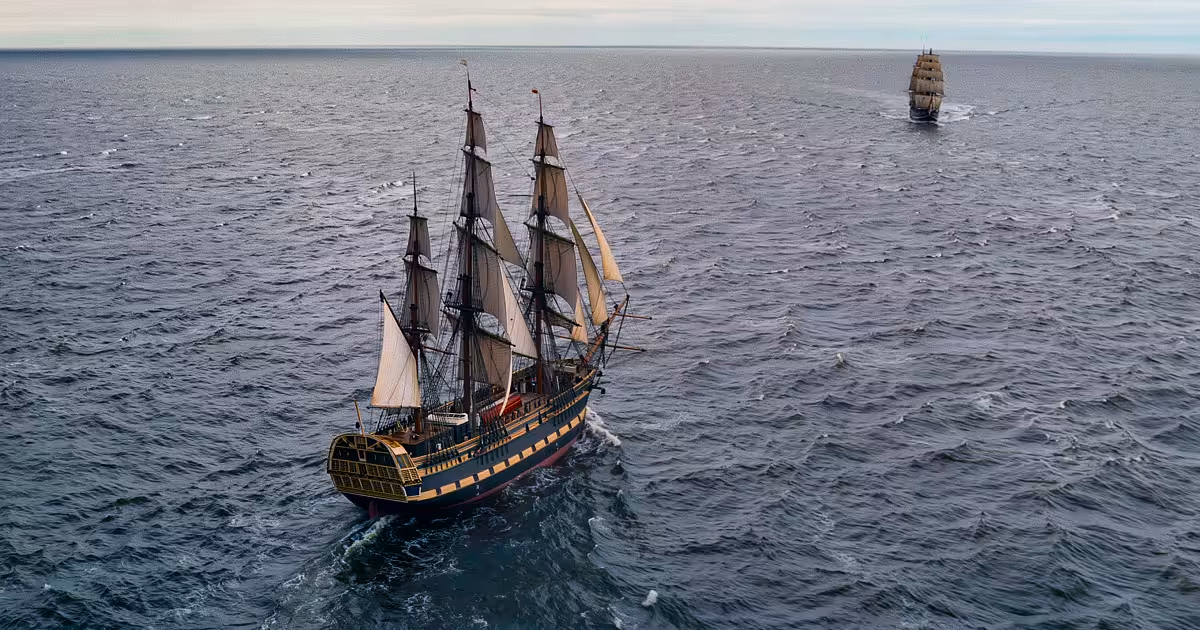
Brigantine under partial sail. Empty deck.
Illustration, not a period photograph.
Opening
On 4 December 1872 the Canadian brig Dei Gratia, Captain David Morehouse, came up on a ship sailing badly in the Atlantic east of the Azores. She was the Mary Celeste, which had left New York on 7 November for Genoa with Captain Benjamin Briggs, his wife Sarah, their small daughter Sophia, and seven crew. Morehouse hailed. No answer. Oliver Deveau boarded. Ten people were gone. The ship was not.
Cargo of alcohol was largely intact. Personal gear was still in the berths. The lifeboat was missing. One pump was in pieces. The last log slate sat at the morning of 25 November, Santa Maria in sight. Food and water for months remained. Deveau sailed her into Gibraltar for salvage. The Vice-Admiralty court spent the winter on the empty deck.
The spine of the file is a seaworthy brig with nobody at the wheel. Mary Celeste is ten names and a ship that kept going. It is not a found boat with those ten in it.
Timeline
7 November 1872. Mary Celeste leaves New York. Briggs knows his first mate. The child is two.
25 November, morning. Last slate: near Santa Maria. After that the written ship is silent.
4 or 5 December, depending on the deck clock you trust. Dei Gratia finds her east of the islands, hundreds of miles from that last fix, sails set in a sloppy way, no boat.
13 December. Deveau brings her to Gibraltar. Hearings through 1873. Salvage is paid short. Briggs and the ten are never walked off another deck. Later fiction fills the cabin. The court paper does not.
Key figures
Benjamin Briggs is the captain who left a sound ship. Sarah and Sophia are why the file is not only a crew list. They packed for Genoa, not for a mystery.
David Morehouse and Oliver Deveau are the finders. Deveau's boarding notes are the first inventory. Salvage made them look interested. It does not invent an empty cabin.
The seven crew are named and gone with the family. No body in the lane of the search.
The Gibraltar court is the official reader. It was suspicious, unpaid in full, and still could not put a living person back on the brig.
Physical and documentary trail
On the paper, November-December 1872 give you four hard objects and no boat with ten in it.
One: the Dei Gratia boarding, Deveau's description of an abandoned but living ship, cargo mostly sound, boat gone.
Two: the last log slate of 25 November and the gap to the sighting.
Three: the ship's papers and instruments that were missing against the personal gear that was not.
Four: the Gibraltar salvage proceedings. Vice-Admiralty Court papers on Mary Celeste, Gibraltar, 1873, are the state's inventory of an empty deck.
There is no message in a bottle that the court accepted. There is no identified lifeboat ashore. There is no confession from a boarding pirate that fits the untouched alcohol.
The Mary Celeste was completely deserted.
Competing explanations
A feared explosion from the alcohol cargo, boat away, ship sailing on. This is the reading that respects an experienced captain and a missing boat. It needs the ten to miss the return and the sea to keep them.
Weather, a bad pump, a moment of panic. Possible. The ship was still afloat and provisioned.
Crime: mutiny, Morehouse as plotter, pirates who took people and left barrels. The court sniffed at salvage. It did not prove a murder.
Hybrid caution. Ten people left a ship that did not need leaving in any obvious way. The Atlantic kept the reason.
Later life of the case
Doyle and a century of cabin fiction. I keep those on the later-life shelf. The slate, the boat, and Deveau's inventory stay first.
Finding
Dei Gratia found Mary Celeste under sail with ten people gone, the boat missing, the cargo mostly still in the hold, and a last slate dated 25 November. Believe Deveau's deck. A salvage crew does not empty a brig for a story when the alcohol is still there to be counted.
What still will not resolve: the boat, located and tied to those ten, or a paper from 25-4 December that explains why Briggs left a living ship. Either one would end the empty-cabin argument. The proving object is still the missing yawl, or the hour they climbed into it.