SERGEANT ALKEMADE
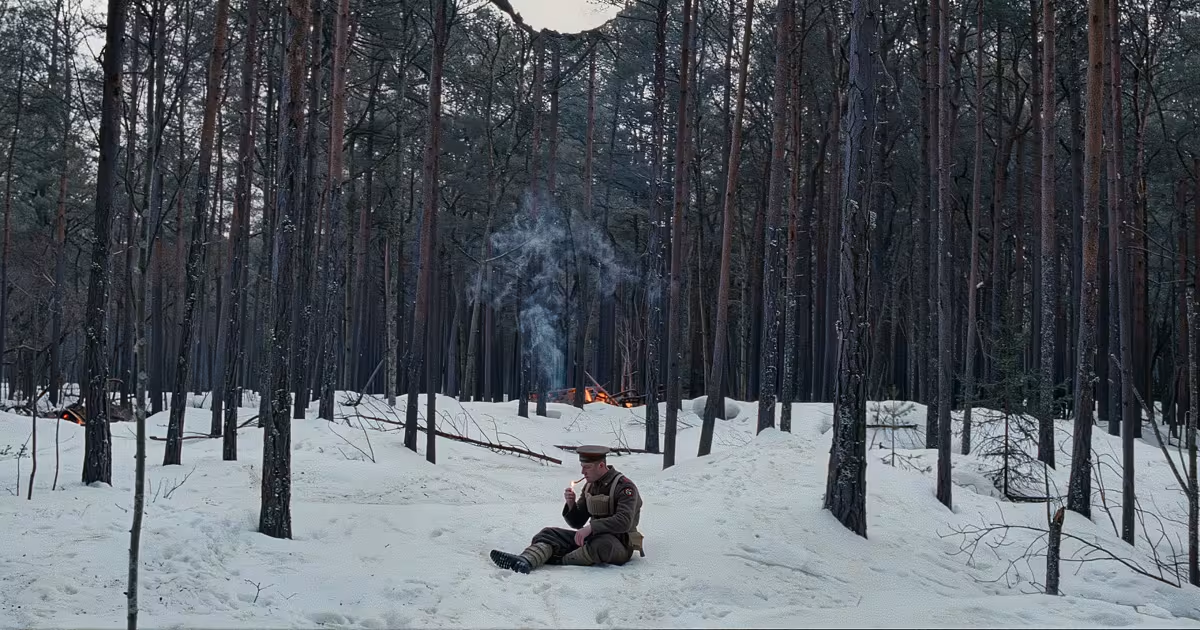
Night forest snow. Hole in the fir canopy.
Illustration, not a period photograph.
Opening
On the night of 24-25 March 1944 Flight Sergeant Nicholas Alkemade sat in the rear turret of Lancaster DS664, Werewolf, outbound from Witchford with 115 Squadron for Berlin. Over Germany the aircraft was hit and caught fire. His parachute, stowed forward of the turret, was already burning. He rotated the turret, went out backwards into the dark at about eighteen thousand feet, and did not expect to open his eyes again.
Three hours later he was on snow under young pines. Eighteen inches of it, in cover the open field twenty yards away did not have. His watch said 03:25. He blew a whistle and smoked what cigarettes he had left until a German patrol found him. They did not believe the fall until they found the burnt straps and no usable canopy.
The spine of the file is a gunner who chose the air over the fire and lived. Alkemade is a turret, a pine wood, and a German note that the claim was true. It is not a trick harness.
Timeline
24 March 1944, 18:48. DS664 leaves Witchford. Berlin is the target. Alkemade is twenty-one and on his mid-teens operation depending on how the crew counted.
After midnight, over Germany. Fire in the airframe. Turret isolated from the stowed pack. He decides the burn in the aircraft is worse than the fall. Out, on his back, helmet still on. Quiet except distant engines. Then nothing.
About 03:25. Snow, pines, a body that will move. Patrol. Interrogation. The wreck of Werewolf is found enough to match the story.
German authorities write that the descent without a parachute is corroborated. He sits out the rest of the war as a prisoner. After 1945 the story is told in squadron rooms and then in public print. The pines are the whole mechanism.
Key figures
Nicholas Alkemade is the only man who made the choice. His 1944 account is the exhibit. Later retellings add polish. The turret and the snow do not need it.
The rest of Werewolf's crew are the men who did not get that particular door. Some did not come home. They are not a control group. They are the reason the aircraft is in the file at all.
The German patrol and the officer who signed the corroboration are the official second pair of eyes. Without them the fall is only a POW tale.
115 Squadron and Witchford own the takeoff board. Berlin that night was a large raid. One rear gunner on snow is a small object in a large loss.
Physical and documentary trail
On the paper, 24-25 March 1944 give you four hard objects and no canopy that worked.
One: the squadron record of DS664, A4-K, leaving Witchford for Berlin and not coming back as an aircraft.
Two: Alkemade's same-week account of fire, a burning pack he could not reach, the back-flip from the turret, and the pine wood.
Three: the burnt remnants of harness and the absence of a serviceable parachute when he was found.
Four: the German written corroboration that the claim was investigated and held. German authorities' note on Flight Sergeant Alkemade, No. 1431537, 1944, is the official second voice.
There is no film of the fall. There is no British board that watched him leave the turret. There is no medical series that makes the snow optional.
It has been investigated and corroborated by the German authorities that the claim of Flight Sergeant Alkemade, No. 1431537, is true in all respects, namely, that he has made a descent from 18,000 feet without a parachute and made a safe landing without injuries, the parachute having been on fire in the aircraft.
Competing explanations
Pines and snow did the work. This is the reading the file can live on. Young flexible branches, eighteen inches of sheltered snow, a body that happened to miss the bare ground twenty yards off. No miracle required beyond luck and timber.
A lower height than he thought. Possible in a burning aircraft. The German note still grants the figure. A lower jump would still be a jump nobody trains for without silk.
Embroidery after capture. Weaker once the burnt pack and the wreck are in the same week. A POW can enlarge a fall. He cannot invent a German signature.
Hybrid caution. He left a burning turret. He woke under pines. Those two sentences are enough.
Later life of the case
Squadron talks, newspaper features, museum cards. I keep the later interviews on the later-life shelf. The 1944 note and the pine wood stay first.
Finding
Nicholas Alkemade went out of a burning Lancaster turret without a parachute on the night of 24-25 March 1944 and woke under pines in snow. German officers looked at the burnt harness and wrote that the claim was true. Believe the gunner. A rear turret is not a place you leave for a story.
What still will not resolve: an altimeter reading from the moment he left the aircraft, or a British wreck report that fixes the exact height. The German page is strong. A second instrument on that jump would lock the eighteen thousand feet as more than a gunner's estimate. The proving object is still a number written while he was in the air.