TUNGUSKA
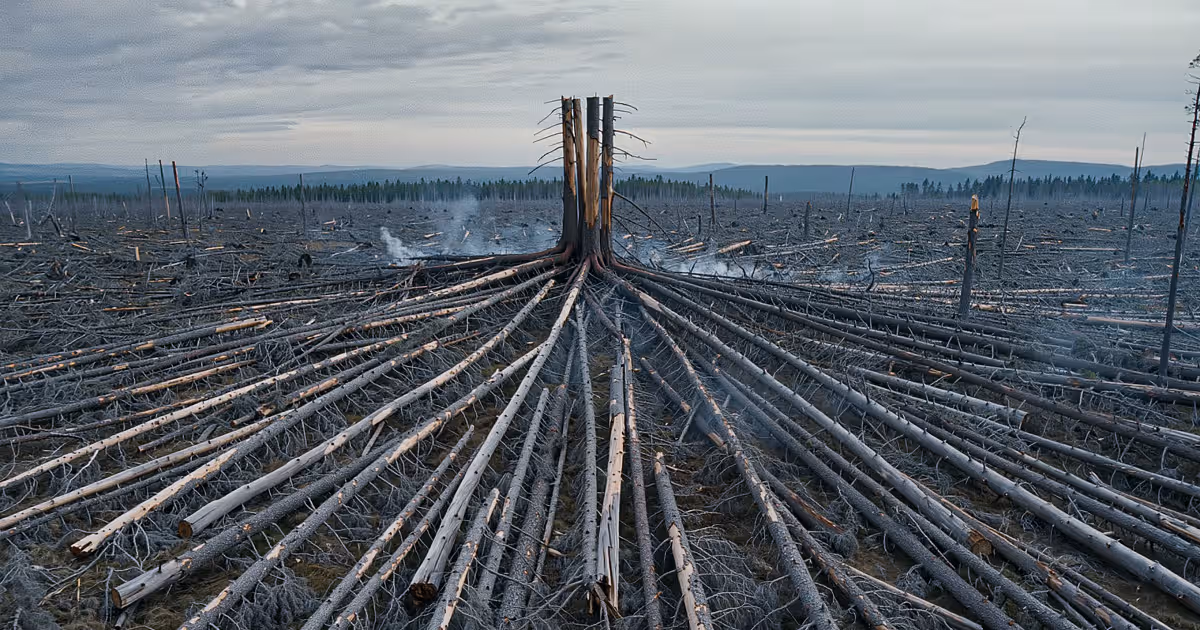
Radial flattened taiga. Standing dead trees at centre.
Illustration, not a period photograph.
Opening
On the morning of 30 June 1908 something exploded over the basin of the Podkamennaya Tunguska in Siberia. Trees went down across two thousand square kilometres. People hundreds of kilometres off saw a fireball and felt a hot wind. Seismographs in Europe recorded the wave. Nights over Siberia and parts of Europe stayed pale. No crater was found that a meteorite hunter could drain and own.
Leonid Kulik reached the fallen forest in 1927 for the Soviet Academy. He had come for iron. He found a radial blowdown, a stand of stripped trunks at the centre still on their feet, and pothole bogs that were not craters. He photographed the scythe-pattern of the taiga. He did not lift a mass that would pay for the trek.
The spine of the file is an airburst written in timber and instruments, and an empty hole where a crater was supposed to be. Tunguska is a forest on its side. It is not a tagged stone in a Moscow case.
Timeline
30 June 1908, about 07:13 local. A fireball, a column, a blast. Evenki and Russian settlers at Vanavara and on the rivers take the shock. Ground jumps. A man is knocked down. Chimneys fail at distance. The sky stays wrong after sunset.
1908-1921. Word travels slowly. Kulik, on a mineral survey, hears the stories and argues for an expedition to salvage meteoric iron.
1927. First successful walk to the epicentre. No crater. Standing poles at the centre, fallen trunks pointing out. Kulik drains a bog he hopes is a pit and finds an old stump. Further seasons in 1928, 1929-30, and aerial plates in 1938 map the blowdown and still do not produce a parent mass.
Later chemistry on resin and tiny grains argues for a stony body that came apart in air. Those papers are after Kulik. They explain the missing crater better than they produce a museum stone.
Key figures
The 1908 ground witnesses are the first layer. They give fire, wind, and light. They do not give a rock in the hand.
Leonid Kulik is the man who turns a rumour into a mapped forest. He wants a meteorite. The forest refuses him a pit. That refusal is the scientific gift of the case.
Evenki guides take him in. Without them the 1927 photographs do not exist. The Academy pays. The iron does not arrive.
Later atmospheric and asteroid workers own the airburst reading. They are not 1908 handlers. They belong with the resin papers, not with the first blast.
Physical and documentary trail
On the paper, 1908 and 1927 give you four hard objects and no parent mass.
One: the 30 June 1908 event itself, timed, seen, felt, and recorded on distant seismographs, with bright nights after.
Two: the blowdown, about two thousand square kilometres, radial, with a central stand of branchless trunks still upright.
Three: Kulik's 1927-1938 expeditions, photographs, and the drained bog that was not a crater.
Four: the absence of a recoverable iron body, and later micro-fragment and resin work that supports a high-altitude disintegration. Leonid Kulik expedition records, Soviet Academy of Sciences, 1927 and after, are the first scientific tray.
There is no museum meteorite that closes the forest. There is no impact bowl a visitor can stand in. There is no 1908 photograph of the fireball itself.
There was no impact crater.
Competing explanations
Stony asteroid airburst. This is the reading that best fits no crater, standing poles, and later grains. A body of tens of metres coming apart five to ten kilometres up. Type still argued. Iron versus stone versus comet ice has all had a season.
Comet. Ice would vanish. That helps the empty pit. It has a harder time with some of the later residue claims.
Other. Gas blow, early nuclear fantasy, Tesla talk. These live outside the timber pattern and the seismographs. They do not map the scythe.
Hybrid caution. Something from the sky dumped its energy in air. The forest kept the pattern. The ground did not keep the stone.
Later life of the case
Every anniversary grows a new parent body and a new documentary. I keep the Tesla and spaceship shelves for later life. Kulik's photographs and the missing crater stay first.
Finding
On the morning of 30 June 1908 the sky over the Tunguska basin came apart. Trees went down for miles, people were knocked off their feet, and the nights that followed would not go properly dark. Believe the forest. Kulik walked into a blowdown that still had no crater, which is how you learn the thing never reached the ground as a stone you could pocket.
What still will not resolve: the parent body in a tray. A recovered mass with a lab number, or a settled stone-versus-ice reading that the resin and the grains will all accept, would finish the only scientific task the taiga left unfinished. The explosion is not in doubt. The name of the visitor still is.