DEVIL’S FOOTPRINTS
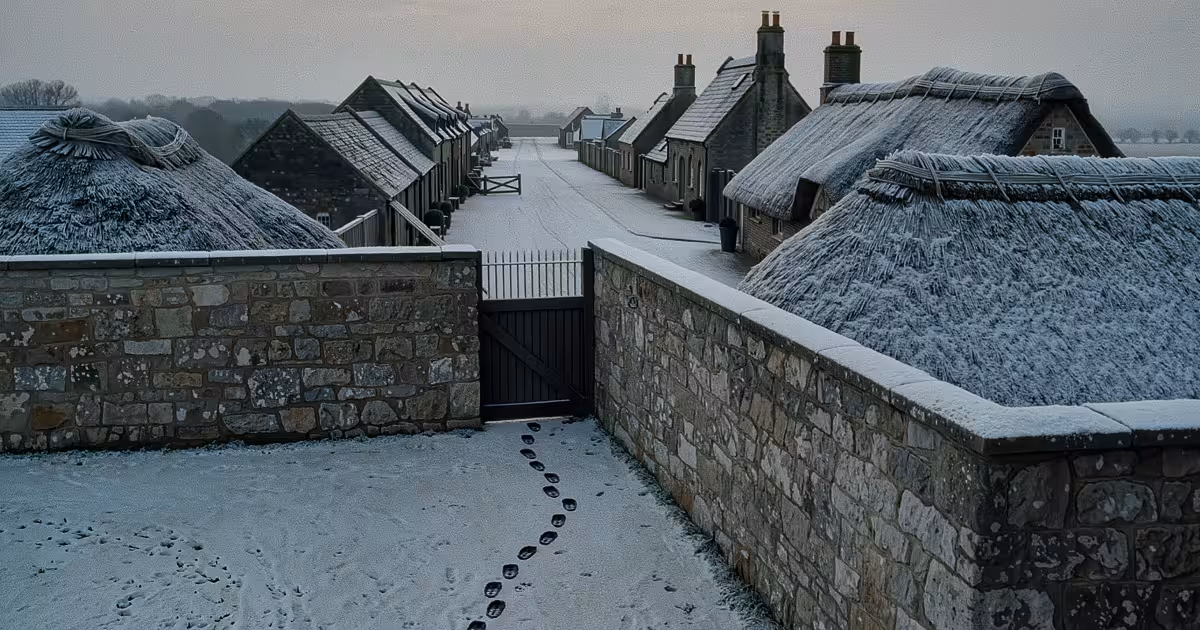
Victorian village snow. Single-file hoof marks over a wall.
Illustration, not a period photograph.
Opening
On the morning of 9 February 1855, after a heavy night of snow, people across east and south Devon found marks in the white that looked like small hooves. Four inches by three in the papers that liked a clean number, closer together or farther apart depending on the parish. Mostly a single file. Reported on roofs, on walls, in yards shut by paling, and in open fields. More than thirty places if you count every letter.
The Times of 16 February printed EXTRAORDINARY OCCURRENCE and gave the country a Satan it had not asked the clergy to bless. The Illustrated London News later drew one perfect cloven shoe and a hundred-mile walk. Local notes from the first days are messier: donkey-shoe here, toes there, not always straight, not always the same size.
The spine of the file is a snow morning and a London paper that turned many tracks into one beast. The Devil's Footprints are marks in February slush. They are not a captured animal.
Timeline
Night of 8-9 February 1855. Snow on the Exe towns. Morning of the 9th. Householders in Exmouth, Topsham, Lympstone, Dawlish, Teignmouth and further inland see the marks and start comparing.
13-16 February. Local gazettes run letters. On the 16th The Times lifts the story to national type. Superstition is named in the same column as the tracks.
24 February to 3 March. A "South Devon" letter to the Illustrated London News, later tied to young William D'Urban, claims a uniform print, a hundred miles, roofs, a fourteen-foot wall, the Exe itself. On 3 March the News prints the tidy hoof that later books reprint as if it were a field photograph.
March. The Times goes quiet on Devon and notes similar talk from Congress Poland. The snow melts. The marks go with it. No plaster series from the first morning survives as a public set.
Key figures
The householders of the Exe parishes are the first layer. They have marks by the door and no agreement on the shoe.
Parish clergy and local editors collect the messy sizes. H. T. Ellacombe and the gazette correspondents are more use than the London drawing.
The Times desk of 16 February is the national hinge. "South Devon" / D'Urban is the man who writes the hundred-mile single animal into being. The Illustrated London News artist is the man who draws the hoof the file now wears.
No policeman produces a beast. No gamekeeper bags a traveller. The Devil is a headline, not a witness.
Physical and documentary trail
On the paper, February 1855 gives you four hard objects and no foot.
One: the 9 February marks in snow across many Devon points, described that week in local letters with varying length, width, and step.
Two: reports of prints on roofs and inside shut yards, which is the part that will not sit on an ordinary donkey walking a lane.
Three: The Times, 16 February 1855, "Extraordinary Occurrence", the sheet that makes a county morning into a national devil.
Four: the Illustrated London News drawing of 3 March 1855, a uniform cloven hoof that discards the mixed local measurements.
There is no plaster series with parish labels from the 9th. There is no animal in a barn. There is no official zoological close that the towns kept.
The inhabitants of the above towns were surprised at discovering the footmarks of some strange and mysterious animal endowed with the power of ubiquity.
Competing explanations
One unknown biped. This is the London reading: one walker, one shoe, roofs and all. It needs a body that was never bagged and a stride that local letters do not all share.
Many animals, one thaw. Badgers, cats, donkeys, mice, hopping birds, the snow slumping into hoof shapes. This reading loves the messy first measurements. It has more work to do on the high walls and the drainpipes.
Balloon drag or a hoax line. Offered. Not demonstrated across thirty points in one night of weather.
Hybrid caution. Marks were in the snow. London drew one beast. The melt took the evidence before a single tray could hold it.
Later life of the case
Fort, Forteans, and every February reprint keep the hundred miles and the perfect hoof. I keep D'Urban's letter and the News engraving on the later-life shelf as how the story was built. The gazette sizes stay first.
Finding
Devon woke on 9 February 1855 to marks in new snow that looked like small hooves, on lanes and also on roofs and inside yards that a donkey does not casually visit. Householders were not staging a London feature. They were looking at their own steps. Believe the morning. Something walked, or many things did, and the white held it long enough to frighten a county.
What still will not resolve: a plaster series from that first morning, labelled by parish, or an animal taken in the act. The Illustrated London News drew one perfect hoof and a hundred miles. A tray of messy local casts would have been worth more than that engraving, and we do not have them.