LADY BE GOOD
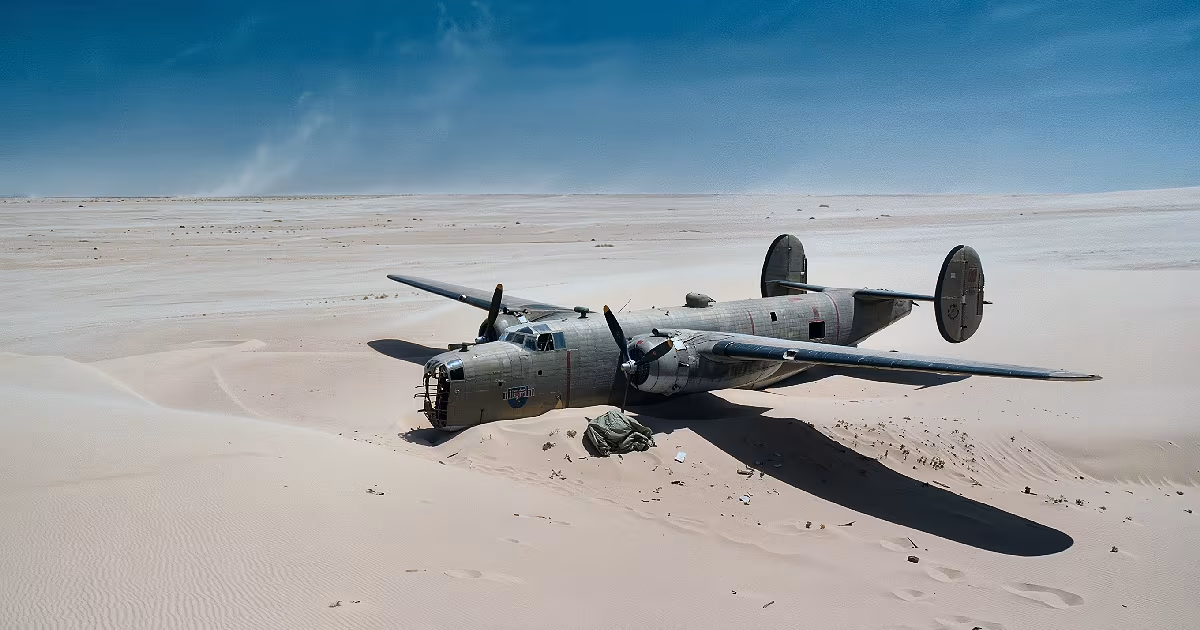
A broken B-24 bomber lying in pale sand in the Libyan desert.
Illustration, not a period photograph.
Opening
On 4 April 1943 a new B-24D Liberator called Lady Be Good, named after the Gershwin song, took off from Soluch, Libya, on a raid against Naples and never came back. The Army assumed she went down in the Mediterranean. Fifteen years later oil surveyors spotted her in the Libyan desert, about 440 miles inland, broken in two but almost intact. Her crew was not aboard.
Timeline
18 to 25 March 1943. Lt. William Hatton’s crew arrives in Libya. Serial 41-24301 joins the 514th Bomb Squadron, 376th Bomb Group, a week later.
4 April 1943, afternoon. Twenty-five B-24s set out for Naples in two waves. Lady Be Good is in the second, on her crew’s first combat mission. A sandstorm sends eight aircraft back to Soluch. She is one of only four that press on.
7:50 p.m. She reaches Naples at 25,000 feet, finds the target hidden, and drops her bombs in the sea to save fuel on the long flight home alone.
5 April, 12:12 a.m. Hatton radios that his automatic direction finder isn’t working and asks for a bearing. The station at Benina gives 330 degrees. The bearing is correct, but a single loop antenna can’t say whether the aircraft is north or south of the station.
After midnight. The bomber passes over or near its base. Flares are fired to catch the crew’s attention. They don’t see them and fly on south for about two more hours, believing they are still over the sea.
About 2 a.m. Low on fuel, all nine bail out into the dark. The empty aircraft flies on for about 16 miles and belly-lands on the gravel plain.
5 to 12 April. Eight men find each other by firing revolvers and flares into the air, then walk north-west with one canteen of water. The bombardier, John Woravka, is not with them: his parachute failed to open.
9 April. Guy Shelley, Harold Ripslinger and Vernon Moore go ahead to look for help. The other five stop.
12 April. Robert Toner makes his last diary entry.
16 May 1958. A Silver City Airways Dakota flying for an oil company spots the wreck. On 9 November a BP team reaches it, and in February 1959 surveyor Gordon Bowerman and geologists Donald Sheridan and John Martin confirm what it is.
May to August 1959. A search from Wheelus Air Base near Tripoli finds boots and parachute markers but no men, and is called off.
February to August 1960. A BP team finds five men together on a ridge. The Army and Air Force follow with Operation Climax, which finds Shelley and Ripslinger far to the north. In August another BP crew finds Woravka.
Key figures
Lt. William J. Hatton, pilot. 2nd Lt. Robert F. Toner, co-pilot, whose diary records the walk. 2nd Lt. D. P. Hays, navigator. 2nd Lt. John S. Woravka, bombardier. Samuel Adams, Harold Ripslinger, Robert LaMotte, Guy Shelley and Vernon Moore, the rest of the crew. Ripslinger also kept a diary.
Physical and documentary trail
On the paper: the Graves Registration Service investigation, the diaries of Toner and Ripslinger, and the aircraft itself. Early visitors found machine guns that still fired, a radio that still worked, and a thermos of tea that was still drinkable. The crew had marked their route with parachute strips, flying boots and arrows, which let searchers follow it. The eight walked about 78 miles together. Shelley went on alone for roughly 38 more, into the Calanscio Sand Sea, and Ripslinger nearly as far. Toner’s diary was found rolled up in a flight suit, a sign the men used the clothing of those who died to stay warm through the cold desert nights.
No help yet, very cold nite.
Competing explanations
A reciprocal bearing. The Army’s conclusion: the navigator probably took the reading off the back of the loop antenna from a position already south of Benina. Following it took them further from the coast with every minute. In the dark, over a flat desert, the ground looked like sea.
A navigation error earlier in the flight. Flying home alone at night without a working direction finder, the crew may have misjudged the wind and passed the coast without seeing it. The two explanations fit together: a crew already off course asked for a bearing that couldn’t tell them which way to turn.
Later writers point out that the men might have lived by staying with the aircraft, which had water and supplies, or by walking south to the oasis at Wadi Zighen. The crew didn’t know where the aircraft was, and walking north toward the sea was the obvious choice.
Later life of the case
Parts were salvaged from the wreck and fitted to other aircraft, and a story grew that they carried a curse. A C-54 with her autosyn transmitters had to dump cargo after propeller trouble. A C-47 fitted with her radio receiver went into the Mediterranean. An Army Otter carrying one of her armrests crashed in the Gulf of Sidra. The crashes are reported, but I haven’t found an investigation that links them to anything but bad luck.
In 2001 it emerged that a British Army patrol crossing the desert in 1953 had found human remains in the same general area as Shelley and Ripslinger and buried them where they lay. Nobody reported it, because no one then knew an American bomber had come down in the desert. They may have been Vernon Moore.
Pieces are now spread out. The National Museum of the US Air Force holds wreckage and the stained-glass memorial window from the Wheelus chapel. The March Field Air Museum has the altimeter, the Army Quartermaster Museum has personal effects, and a propeller stands outside the village hall in Lake Linden, Michigan, Robert LaMotte’s home town. The rest of the aircraft was moved in August 1994 to Jamal Abdelnasser Air Base near Tobruk.
Finding
This is one of the best-documented disappearances of the war. The aircraft, two diaries and the remains together show nine men who flew past their base in the dark, bailed out over open desert and died walking toward a sea that was hundreds of miles away. The mystery lasted fifteen years only because nobody thought to look for them on land.
What still will not resolve: whether the grave dug by a British patrol in 1953 belongs to Vernon Moore, and whether anyone can still find it.