BERMUDA TRIANGLE
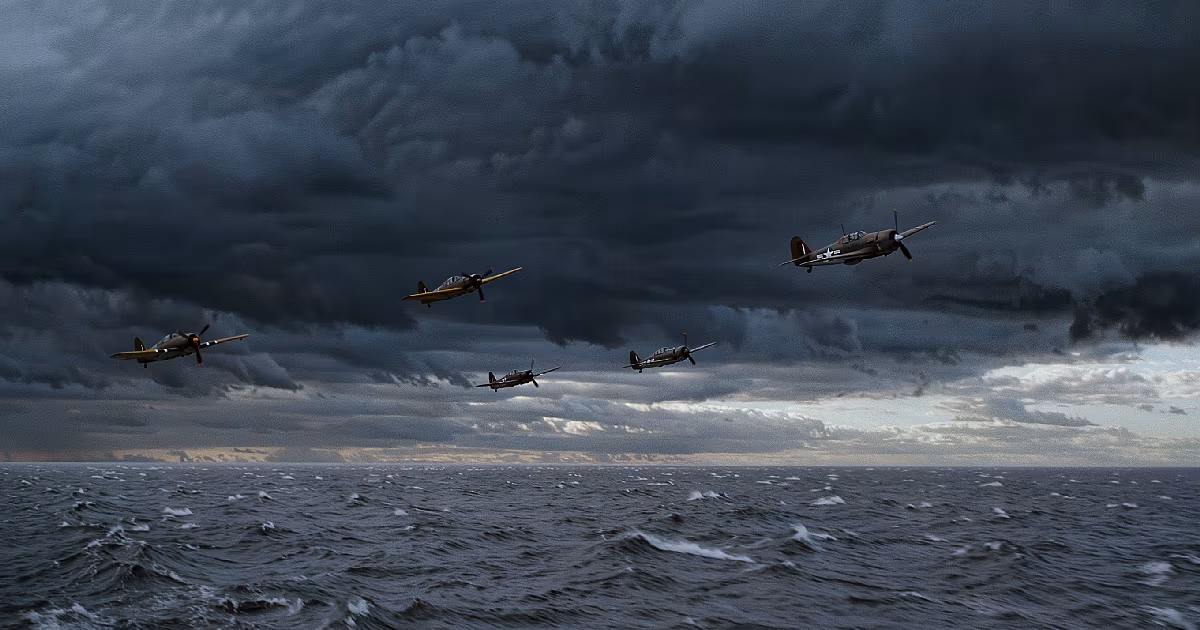
Open Atlantic at dusk. Storm clouds, empty sea.
Illustration, not a period photograph.
Opening
The Bermuda Triangle is a stretch of the western Atlantic, roughly between Miami, Bermuda, and Puerto Rico, said to swallow ships and aircraft without trace. Its most famous case is Flight 19: five US Navy Avenger torpedo bombers that vanished on a training flight on 5 December 1945, followed the same night by a flying boat sent to search for them. The name was coined in 1964, and a bestselling 1974 book made it a global legend. Investigators who went back to the original records found that the mystery mostly came from how the stories were retold.
Timeline
March 1918. The US Navy collier USS Cyclops disappears with 306 people on board, somewhere between Barbados and Baltimore. It's the largest single loss of life in US naval history not involving combat.
5 December 1945. Flight 19, five TBM Avengers from Naval Air Station Fort Lauderdale, led by Lieutenant Charles Taylor, loses its way on a training flight. Taylor believes his compasses have failed and that the flight is over the Florida Keys. The planes fly on until they run out of fuel. All 14 men are lost.
The same night. A PBM Mariner flying boat sent to search disappears with its 13 crew. A passing tanker reports flames on the sea at about the time it would have been in the area. Mariners were known for fuel vapour leaks and were nicknamed "flying gas tanks."
February 1964. Writer Vincent Gaddis uses the phrase "the deadly Bermuda Triangle" in Argosy magazine.
1974. Charles Berlitz's The Bermuda Triangle becomes an international bestseller, linking the losses to Atlantis and other forces.
1975. Librarian Larry Kusche publishes The Bermuda Triangle Mystery: Solved, after checking the original records of dozens of cases.
Key figures
Lieutenant Charles Taylor led Flight 19. The Navy's investigation first blamed him, then changed the finding to "causes or reasons unknown" after his family appealed.
Vincent Gaddis named the Triangle.
Charles Berlitz turned it into a global phenomenon.
Larry Kusche checked the sources and found many cases misreported, exaggerated, or invented. Some ships said to have vanished in calm seas were lost in storms, and some losses happened nowhere near the Triangle.
Physical and documentary trail
On the paper: the Navy's Flight 19 investigation, radio transcripts from the flight, US Coast Guard records, and insurance records. The Coast Guard and Lloyd's of London have both said the area is not unusually dangerous given its heavy traffic.
Competing explanations
Unknown forces. Theories include magnetic anomalies, Atlantis, rogue waves, methane eruptions, and UFOs. None is supported by evidence that the area has more losses than expected.
A busy, stormy sea and good storytelling. The area has heavy shipping and air traffic, strong currents including the Gulf Stream, which can carry wreckage away fast, and sudden storms. Flight 19 is explained by navigation error, bad weather, and fuel exhaustion.
Later life of the case
The Triangle remains one of the best-known mysteries in the world and a staple of documentaries. The documentary record hasn't changed since Kusche.
Finding
Not a mystery zone. The Triangle is a busy, weather-prone stretch of ocean with an ordinary loss rate, turned into a legend by writers who didn't check the records. Flight 19 was a tragedy of navigation and weather. The Cyclops is a real open case, as some losses at sea always are.
What still will not resolve: what happened to the Cyclops, which went down with no distress call and has never been found.