KENTUCKY MEAT SHOWER
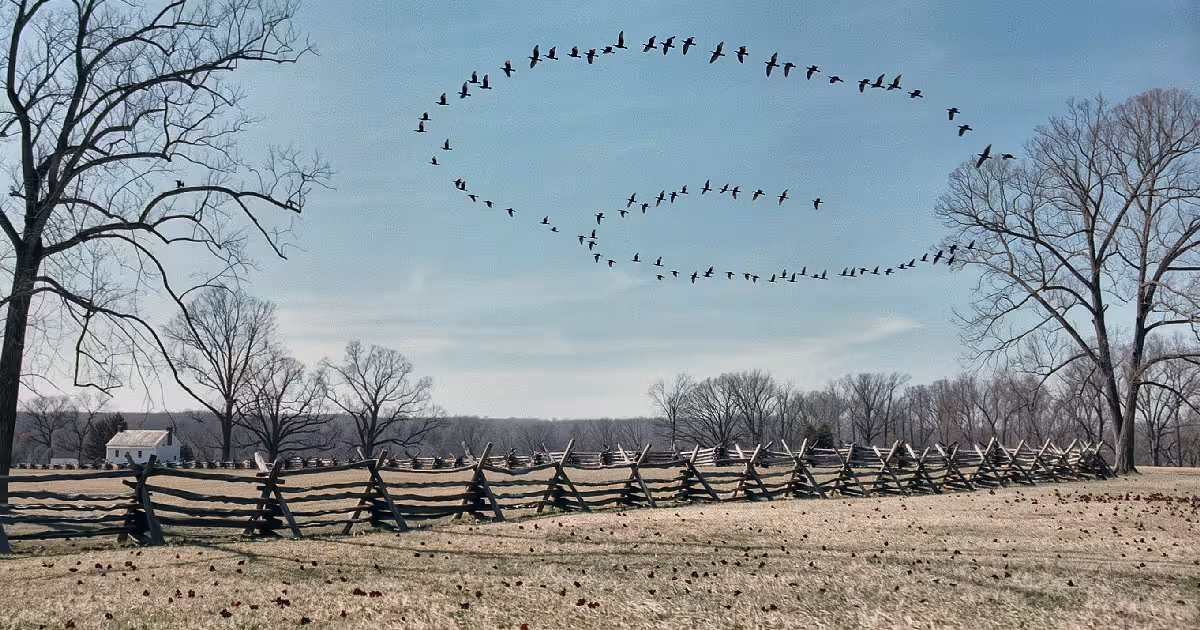
A split-rail fence and a field scattered with small red flakes on a Kentucky farm, with birds circling overhead.
Illustration, not a period photograph.
Opening
Between about 11 a.m. and noon on Friday 3 March 1876, flakes of raw meat fell out of a clear sky onto a farm near Olympia Springs in Bath County, Kentucky. Rebecca Crouch was outside making soap when it began. The pieces covered a strip of ground roughly 100 yards long and 50 wide, stuck to fences and lay in the grass. Within weeks the “Kentucky meat shower” was in the New York Times and Scientific American, and samples were under microscopes on the East Coast.
Timeline
3 March 1876, late morning. Meat falls around the Crouch farm under a sunny sky with a light westerly wind. Most pieces are about two inches square. The largest is about four inches across.
Same day and after. Neighbours come to look. Local men taste it and, according to press reports, compare it to mutton, venison or bear. A family cat eats some without ill effects.
10 March 1876. The New York Times reports the fall.
Spring 1876. Leopold Brandeis, a water analyst, tells Scientific American the “meat” is nostoc, a gelatinous blue-green alga that swells up after rain.
1876. Specimens go to microscopists in New York and Newark. Allan McLane Hamilton and A. Mead Edwards report animal tissue, including lung. In the Louisville Medical News, Dr. L. D. Kastenbine proposes vultures.
22 July 1876. Scientific American Supplement carries a follow-up.
Key figures
Rebecca Crouch, the main witness, and her young grandson Allen. The neighbours who collected, tasted and sent off samples. Leopold Brandeis, Allan McLane Hamilton, A. Mead Edwards and L. D. Kastenbine, the four men whose explanations shaped the case.
Physical and documentary trail
On the paper: the 1876 newspaper coverage, the Scientific American reports and the medical journal pieces. Unusually for a “strange fall”, there is also physical evidence. Seven samples examined by the microscopists broke down as two of lung tissue, three of muscle and two of cartilage. Edwards wrote that every specimen he examined proved to be of animal origin. One sample survives: in 2004 an art professor, Kurt Gohde, found a jar labelled “Olympia Springs” in the collections of Transylvania University in Lexington. It is now in the university’s Monroe Moosnick Medical and Science Museum. Attempts to get DNA from it have failed because of its age and the preserving fluid.
Competing explanations
Nostoc. The first scientific answer, and the one that made the papers. Against it: nostoc swells after rain, and it was a dry, sunny day. The later microscope work found animal tissue, not algae.
Vultures. Kastenbine’s answer: black and turkey vultures gorge on carrion and, when one of a flying group is startled and vomits, the others often do the same. A flock high overhead could spread half-digested meat over a field without anyone looking up in time. It explains the mix of lung, muscle and cartilage. It is the explanation most people accept today.
A hoax or a prank. Someone scattering offal is possible, but no one was named and the witnesses said they saw it falling.
Something stranger. Charles Fort collected the case in The Book of the Damned (1919) as evidence that the sky holds more than science admits. There is no evidence for that here beyond the fall itself.
Later life of the case
Bath County has adopted its meat shower. The county history museum put on an exhibit in 2024, and a festival in Owingsville drew hundreds of visitors, with the 150th anniversary marked in early 2026. The jar in Lexington is still the only piece of the meat anyone can point to.
Finding
The fall itself is well attested: named witnesses, samples collected the same day, and tissue identified by microscopists within months. The best explanation is vultures disgorging a meal overhead, which fits the mix of tissues found. Nobody saw the birds, though, and nobody reported seeing where the meat came from.
What still will not resolve: whose meat it was. The one surviving sample has so far refused to say.