CHARLES FORT
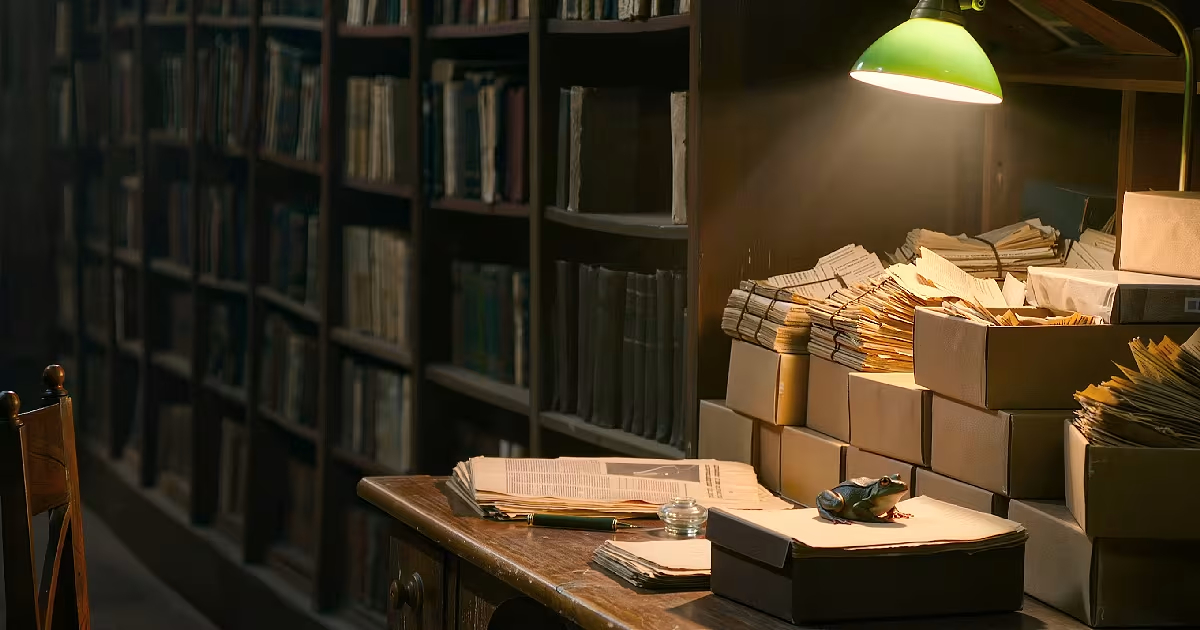
A library desk piled with boxes of notes, and a frog.
Illustration, not a photograph.

Opening
Charles Hoy Fort spent most of his adult life in libraries, copying out newspaper and journal reports that science had no place for: frogs and fish falling from the sky, red rain, strange lights, mysterious disappearances, things that should not have been where they were found. He kept his notes on slips of paper in shoeboxes, and turned them into four books between 1919 and 1932.
He did not claim to explain any of it. His point was that scientists explained away whatever did not fit, and that the excluded facts deserved a hearing. His name gave us the word "Fortean" for the strange and unexplained, and much of what this archive covers, he was collecting a century ago.
Timeline
6 August 1874Charles Hoy Fort is born in Albany, New York, into a Dutch-American family. His father, a grocer, beats him.
1890sHe works as a reporter, then at 18 sets off to see the world. He travels as far as southern Africa, where he falls ill.
26 October 1896He marries Anna Filing. They live in poverty in the Bronx while he tries to make a living as a writer.
1906He begins collecting reports of anomalies.
1909His only published novel, The Outcast Manufacturers, comes out and does not sell.
1915He works on two books, X, about Martians controlling life on Earth, and Y, about a hidden civilisation at the South Pole. The novelist Theodore Dreiser tries to get them published. Fort later burns them.
1916An uncle dies and leaves him a share of an inheritance, enough for him to stop taking odd jobs and write full time.
1919The Book of the Damned is published, with Dreiser's help.
1920 to 1928He lives in London on and off, working in the British Museum Reading Room.
1923New Lands is published.
26 January 1931Admirers launch the Fortean Society at the Savoy-Plaza Hotel in New York. Fort wants nothing to do with it and refuses the presidency.
1931Lo! is published. In it he uses the word "teleportation", which he is generally credited with coining.
3 May 1932He collapses and dies in a New York hospital, probably of leukaemia, aged 57. Wild Talents is published the same year.
Key figures
Theodore Dreiser, the author of Sister Carrie, was Fort's friend and champion and got his first book into print. Anna Fort, his wife, supported him through decades of poverty and obsessive research. The writer Tiffany Thayer organised the Fortean Society and edited its magazine, Doubt. The society had largely faded by his death in 1959, after which most of Fort's notes went to the New York Public Library. The screenwriter Ben Hecht called himself Fort's first disciple.
Physical and documentary trail
Fort's legacy is unusually concrete: four published books of anomalies, each item tied to a newspaper or journal reference that can still be checked, and a large collection of his handwritten notes. That is also the limit of his work. He took his reports from the press and the journals as he found them and rarely followed one up, so many of his cases rest on a single report.
A procession of the damned. By the damned, I mean the excluded.
Things you might not know
- He gave us "teleportation". He used it in Lo! to describe things that seemed to move from place to place without crossing the space between.
- He wondered if we were owned. "I think we're property," he wrote in The Book of the Damned, half joking, half not.
- He doubted himself too. A line widely credited to him, though its first printing is hard to trace, runs: "I believe nothing of my own that I have ever written."
- He was tricked into his own society. Fort was lured to the Fortean Society's first meeting by false telegrams.
- He burned his books. X and Y never appeared. Dreiser had tried hard to get them published.
- He had his own sea in the sky. In The Book of the Damned he joked about a "Super-Sargasso Sea" above the Earth, where lost things drift until they fall.
- A magazine still carries his name. Fortean Times, first published in 1973, is still going.
Competing explanations
To his admirers, Fort was a sharp critic of scientific certainty who saw that science tends to ignore facts it cannot explain, and whose catalogue of anomalies is still useful. To his critics, he was a collector who mixed solid reports with hoaxes, misprints and tall tales without sorting them, and whose jokes were sometimes taken as theories. Fort himself encouraged both readings. He offered wild explanations, then said he did not believe them.
Later life of the case
Almost every modern field of strange phenomena owes something to Fort, from falls from the sky like the Kentucky meat shower to the writers who followed him, such as John Keel, who took his collecting habit into UFOs and the paranormal.
Finding
Charles Fort did not solve any mysteries, and he never said he had. What he did was collect the reports science had left out, keep them on the record, and ask awkward questions about why they were left out. His books are still in print, and his name is now the word for the whole subject.
What still will not resolve: how many of his damned facts were real events and how many were newspaper inventions, since most were never followed up by him or anyone else.
You decide · CHARLES FORT
What do you think happened?
One vote per case, anonymous. You'll see how other readers voted once you've voted.