KASPAR HAUSER
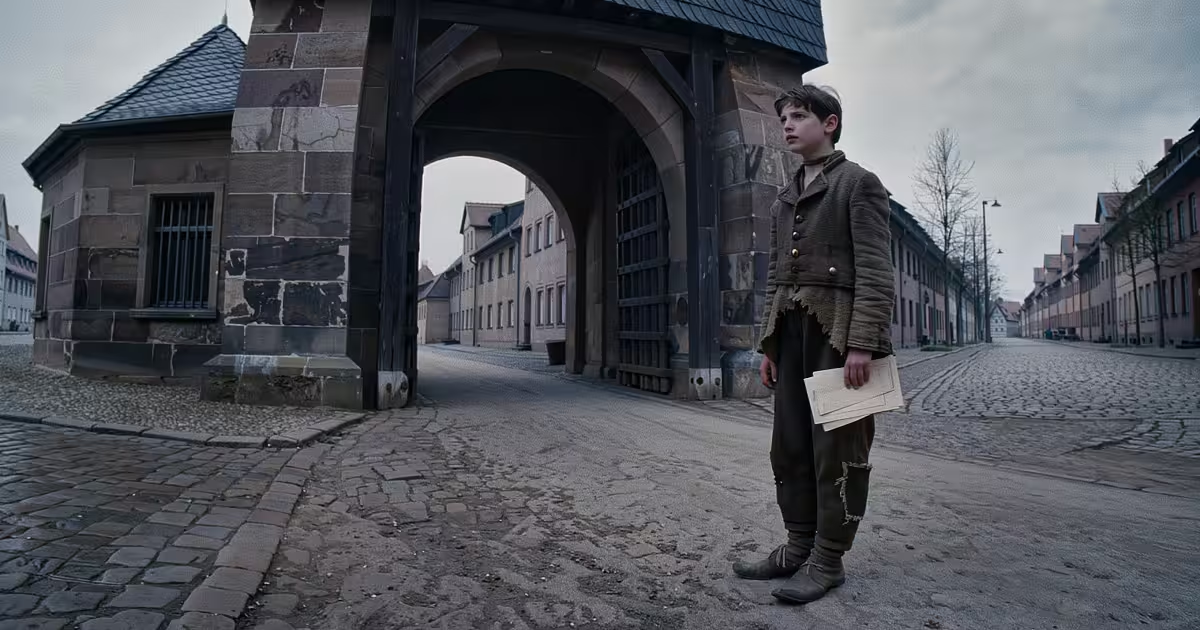
Nuremberg street. 1828, a boy with two letters.
Illustration, not a period photograph.
Opening
On 26 May 1828 a teenage boy was found in Nuremberg with two letters and almost no usable past. He said his name was Kaspar Hauser. He could write that name. He could not say where he had been kept, only that a man had brought him from a dark place toward the city and told him to be a soldier. One letter, in rough German from an unnamed Bavarian border, said a poor day-labourer had raised a child left with him in 1812. A second note said the boy was already baptised Kaspar and that a surname would have to be invented.
Nuremberg kept him, taught him, exhibited him, and argued whether he was a stolen prince or a fraud. In 1833 he was stabbed in Ansbach and died. The origin was not fixed. The grave does not settle it.
The spine of the file is a boy who arrived with letters and no childhood. Hauser is a square, two notes, and a wound. It is not a palace register with his birth in the right ink.
Timeline
26 May 1828, Unterm Torbogen. A youth in odd clothes, a letter for a cavalry captain, a wish written in that letter that the boy serve the king. Asked his name, he writes Kaspar Hauser. Speech is thin. Skin and gait look like a life spent indoors. He takes bread and water as if they were new.
Summer 1828 into 1831. Civic care in Nuremberg. Tutors. Crowds. Anselm von Feuerbach takes notes that treat him as a legal and human problem, not only a wonder. Stories of a low dark room, a man who brought bread, a floor he never left. Public kindness turns to suspicion as soon as he learns enough German to be tested.
1831-33. He is moved toward Ansbach under new keepers who want him quieter and more useful. 14 December 1833, a wound in the Hofgarten. He dies on the 17th. No one is held for the knife. Papers about Baden blood thicken after the funeral, which is the wrong direction for a birth record.
Later tests on clothing and later DNA arguments are later life. The 1828 letters and the 1833 wound stay the ends of the official string.
Key figures
Kaspar is the boy. Whatever else he was, he stood in a Nuremberg street with those notes and that written name.
The unnamed labourer of the first letter is a voice on paper, maybe a real keeper, maybe a script. He never comes to collect the child.
Feuerbach and the Nuremberg tutors own the first careful descriptions. They wanted a truth and also a case that would bear their names.
The Ansbach attacker is a missing person. The wound is not.
Physical and documentary trail
On the paper, 1828-1833 give you four hard objects and no fixed crib.
One: the appearance in Nuremberg on 26 May 1828 with limited speech and a body unused to weather.
Two: the two letters carried on him, labourer and mother-note.
Three: the years of tuition, testimony, and public display in Nuremberg and Ansbach.
Four: the December 1833 stabbing and death. Letters found on Kaspar Hauser, Nuremberg, 26 May 1828, are the arriving tray.
There is no 1812 baptism the file can hold without a fight. There is no living keeper at the gate. There is no convicted hand on the Ansbach knife.
I send you a boy who would serve his king faithfully.
Competing explanations
An abused or confined child dumped on a city with a cover story. This fits the gait, the letters, the hunger for bread and paper. It does not name the room.
A fraud who trained the part. Possible. Harder the longer he had to live it under eyes that wanted to catch him out.
A dynastic secret. Later romance. The 1828 paper does not print a palace.
Hybrid caution. A boy arrived with no usable childhood and died of a knife. Both ends are real. The middle is the fight.
Later life of the case
Prince theories, plays, DNA essays. I keep those on the later-life shelf. The square, the letters, and Ansbach stay first.
Finding
A boy calling himself Kaspar Hauser walked into Nuremberg on 26 May 1828 with two letters and almost no past, was taught and displayed, and died of a stab wound in Ansbach in 1833. Believe the arrival. A city does not invent a child at the gate.
What still will not resolve: a baptism or household book from 1812 that is his, or a name for the man who walked him to the city. Either one would end the prince-or-fraud loop. The proving object is still his first room, tied to those letters by a living keeper.