GREEN CHILDREN
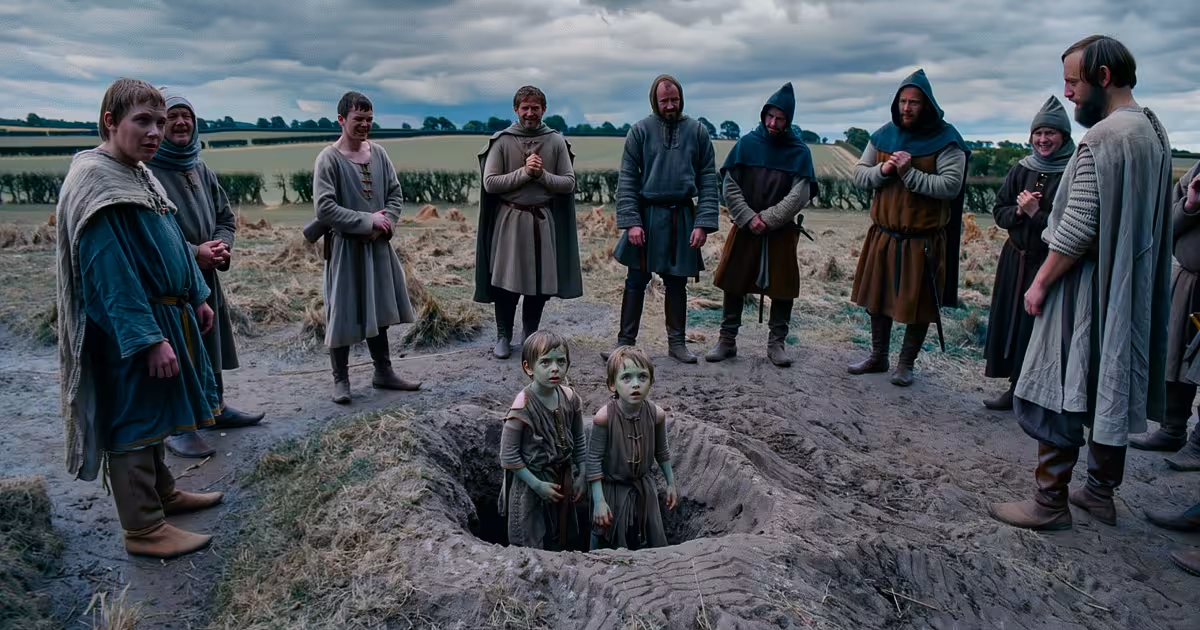
Medieval Suffolk village edge. Two children at a pit mouth.
Illustration, not a period photograph.
Opening
In the reign of King Stephen, harvesters at Woolpit in Suffolk found a boy and a girl coming from the wolf-pits the village is named for. Their skin was green. Their speech was not English. They would not eat ordinary food until someone gave them beans. The boy died. The girl lived, lost the colour as her diet changed, learned the language, and went into service in the house of Sir Richard de Calne at Wykes.
Ralph of Coggeshall wrote it down from that household. William of Newburgh, up in Yorkshire, wrote a second version and dated it to Stephen's years. She told them she had come from a land without sun, St Martin's Land in William's telling, through a cave toward bells, and had stepped out into a bright country that frightened her.
The spine of the file is two green children in a twelfth-century field. Woolpit is a chronicle wonder with a girl who grew up. It is not a kept sample of that skin.
Timeline
Sometime in Stephen's reign, 1135-54, as William places it. A harvest, a pit, two children.
They are taken to de Calne. Beans. The boy fades. The girl stays years in the house, is baptised, and is remembered as not especially holy in her later conduct.
Late twelfth century. Ralph writes the English Chronicle chapter from people who knew the girl. William writes his History of English Affairs from sources he calls trustworthy.
No medieval court file. No grave marker that later archaeology has tied to the boy. The village sign is modern.
Key figures
The boy and the girl are the find. Only she lives long enough to speak in English about a dark country and bells.
Richard de Calne is the knight whose kitchen and staff become the source. Ralph says he heard it there.
Ralph of Coggeshall is the local chronicler. William of Newburgh is the second pen, farther away, adding St Martin's Land.
The harvesters are unnamed. They are why the pit is in the story at all.
Physical and documentary trail
On the paper, the twelfth century gives you four hard objects and no green skin in a vial.
One: the find at Woolpit as a harvest event tied to the wolf-pits.
Two: the diet of beans, the boy's death, the girl's survival and service at Wykes.
Three: Ralph of Coggeshall, Chronicon Anglicanum, chapter on the boy and girl who emerged from the ground.
Four: William of Newburgh, Historia Rerum Anglicarum, chapter concerning green children, with the underground land and the Christian neighbours she described.
There is no contemporary charter that names the girl. There is no medical note. There is no second village that reports the same pair.
In the shape of their whole bodies they were like other people, but they differed in the colour of their skin from all the mortal inhabitants of our world; for the whole surface of their skin was a green colour.
Competing explanations
Lost or displaced children, sick with something that tinted the skin, speaking a language the field did not know. Flemish refugees are often offered. Beans as the first accepted food fits hunger better than a fairy door.
A wonder told truly as the household remembered it. Ralph and William were not writing romance for hire. They were filing a marvel among other marvels.
Folklore grown on a real pair of stray children. Possible. The green is the part that later readers want to sand off, and the part the chroniclers refused to drop.
Hybrid caution. Two children came out of a pit looking wrong. One lived long enough to tell a dark-country story in a Suffolk kitchen.
Later life of the case
Fairy handbooks, alien handbooks, the village sign. I keep those on the later-life shelf. Ralph and the girl at Wykes stay first.
Finding
Harvesters at Woolpit found a green boy and a green girl, Ralph of Coggeshall wrote it from the house that kept her, and William of Newburgh wrote it again. The boy died. The girl learned to eat and to speak and stayed. Believe the household. A twelfth-century kitchen does not invent a servant for a chronicle without something strange having walked in.
What still will not resolve: a name for the girl in a charter, or a grave for the boy that can be tied to that harvest. Either one would pin the wonder to two ordinary deaths and a life in service. The proving object is still her name, written while she was in de Calne's house.