TAMAM SHUD
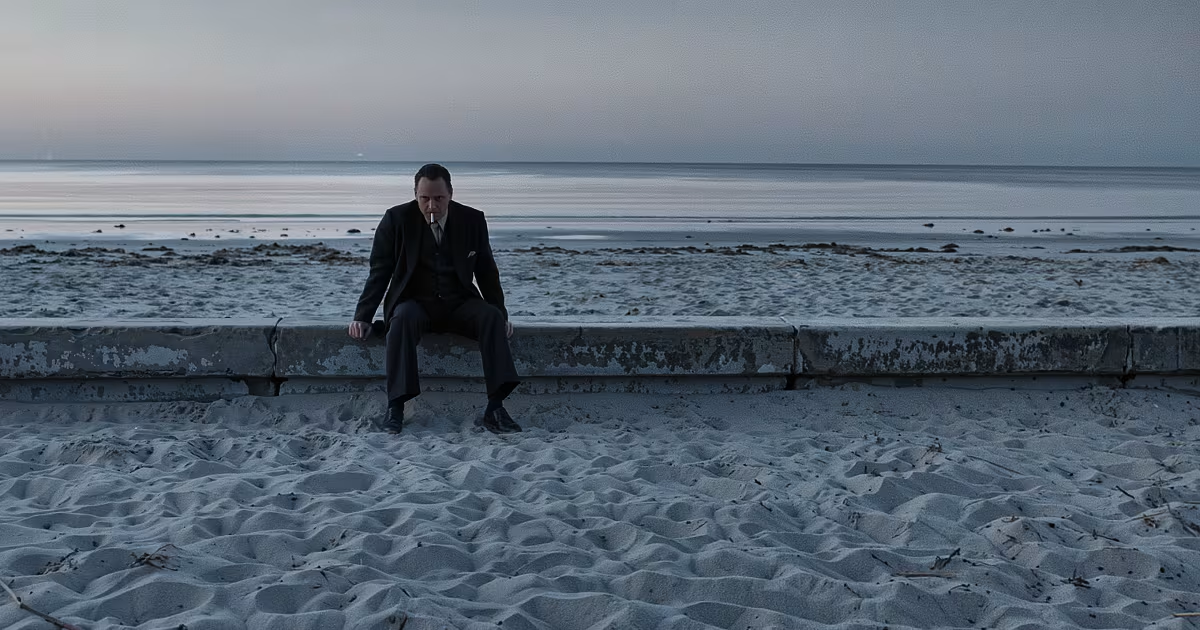
Somerton seawall at dawn. A suited man seated against it.
Illustration, not a period photograph.
Opening
On the morning of 1 December 1948, a man was found dead, slumped against a seawall on Somerton Beach near Adelaide, Australia, well-dressed in a pressed suit, an unlit cigarette resting on his collar, every clothing label removed. No wallet, no identification of any kind. Months later, a tiny scrap of paper, torn from the final page of a rare edition of the Rubáiyát of Omar Khayyám and printed with the Persian phrase "Tamám Shud," meaning "it is finished," turned up sewn into a hidden fob pocket in his trousers. The book itself was later found in an unlocked car nearby, containing a phone number, a name, and a short block of capital letters that has never been definitively decoded.
This case sat unresolved for seventy-three years, generating theories ranging from Cold War espionage to poisoning by a jilted lover, until DNA extracted from a single strand of hair changed the terms of the mystery in 2022. What makes this a genuinely rare entry in this archive is that ending: most of the cases here stay open forever. This one, at least on the question of who the man was, did not.
Timeline
30 November 1948, evening. Witnesses on Somerton Park beach separately notice a well-dressed man slumped in an unusual seated position against the seawall; one couple assumes he is drunk, another that he is simply asleep.
1 December 1948, morning. Witness John Lyons returns to the beach and finds the man in the identical position, now dead. No violence is evident on the body.
Following the discovery. An autopsy fails to determine a clear cause of death. City coroner Thomas Erskine Cleland later concludes at inquest that "there was no indication of violence, and I am compelled to the finding that death resulted from poison," while explicitly stating he cannot determine whether it was self-administered or given by another person, no toxin is ever positively identified in his system despite testing.
January 1949. A suitcase believed to belong to the man is located at Adelaide Railway Station; it contains clothing (some labels removed, others bearing variants of the name "T. Keane"), a stencilling brush suggesting possible maritime or dock work, a table knife ground down to a sharp point, and scissors similarly reground, along with a spool of thread whose orange color matches thread used to repair the man's trouser pocket, tying the case to the body without providing an identity.
14 June 1949. The unidentified man is buried at West Terrace Cemetery, his headstone and funeral paid for by the Bookmakers League; his grave is later marked simply "Here lies the Unknown Man who was found at Somerton Beach."
Several months after burial. A man contacts police to report he had found a torn page inside a copy of the Rubáiyát left in his unlocked car near the beach around the time of the death; the torn edge matches the "Tamám Shud" scrap found on the body precisely. Faint impressions on the book's back page, apparently made by someone pressing hard while writing on a page above it, reveal a short sequence of capital letters arranged in lines, along with an unlisted telephone number.
Following the phone number. Police trace the number to Jessica Thomson (then using the name Harkness), a nurse living not far from the beach. Thomson denies knowing the man, but is reported to have reacted with visible shock, described by some accounts as nearly fainting, when shown a cast of his face; she separately states she had once given a copy of the same edition of the Rubáiyát to a man named Alfred Boxall, a detail investigators pursue directly, only to locate Boxall himself alive and still in possession of his own copy, ruling him out as the dead man.
Ongoing, never resolved by contemporary investigators. The block of capital letters found in the book is examined by military and police cryptographers of the era, who are unable to determine whether it represents an actual cipher, a set of shorthand initials, or simply random impressions with no encoded meaning at all.
2009. Professor Derek Abbott of the University of Adelaide, having become interested in the case, begins a long-term effort to identify the man through DNA analysis of hair recovered from a plaster death mask made at the time of the original investigation.
2011-2018. DNA is successfully extracted from the death-mask hair by University of Adelaide researchers, though the material proves difficult to sequence with the technology available at each stage.
May 2021. At Abbott's urging, South Australian authorities exhume the man's remains from West Terrace Cemetery in a renewed attempt to obtain usable DNA directly, with Detective Superintendent Des Bray noting publicly that the identification mattered because "it's somebody's father, son, perhaps grandfather or uncle."
Through early 2022. Working with American forensic genealogist Colleen Fitzpatrick of Identifinders International and the DNA sequencing firm Astrea Forensics, Abbott's team successfully sequences and genotypes DNA from the death-mask hair, then uses genetic genealogy databases to build a family tree of more than 4,000 people, tracing a distant paternal cousin first, then a maternal-line living relative.
27 July 2022. Abbott announces the identification: Carl "Charles" Webb, an electrical engineer and instrument maker born 16 November 1905 in Footscray, Victoria, one of six siblings, separated from his wife Dorothy since April 1947, and the only member of his family with no recorded date of death. Abbott states he is "99.9 per cent confident" of the match; South Australia Police and Forensic Science SA decline to confirm the finding immediately, stating official confirmation would await the coroner's own review of the DNA evidence.
March 2024. Following further DNA comparison work, the identification of the Somerton Man as Carl Webb receives formal confirmation, closing the identity question that had defined the case for over seven decades.
Key figures
Webb himself remains, even after identification, a largely undocumented figure: no confirmed photograph of him as a living man has surfaced, and beyond his birth record, marriage, and 1947 separation, almost nothing is known about his life between vanishing from public record that year and his death eighteen months later, meaning identification has answered "who" without yet answering "why" or "how."
Thomson is the case's most persistently suspected figure without ever being formally implicated in any wrongdoing; her documented reaction to the death mask, her connection to the exact edition of the book in question, and her own daughter's later public statements suggesting her mother had described knowing something about the case all keep her at the center of speculation despite a complete absence of formal charges or confirmed motive.
Boxall is the case's most useful negative result: tracked down specifically because Thomson named him as the recipient of her copy of the Rubáiyát, his being found alive and still possessing his own copy directly ruled out one entire line of inquiry rather than deepening the mystery, a genuinely productive piece of period detective work.
Abbott is the modern case's central figure, whose personal, roughly fifteen-year sustained effort, spanning failed extraction attempts, an exhumation he specifically advocated for, and eventual successful genetic genealogy work, is directly responsible for the identification finally being made at all.
Fitzpatrick brought the specific genetic genealogy methodology, by this point already proven in numerous American cold cases, that made building out a usable family tree from a single degraded hair sample possible.
Physical and documentary trail
On the paper, this file has an original coronial inquest record with a formal, if incomplete, poison finding, a recovered suitcase with physical items directly linked to the body via matching thread, the original "Tamám Shud" scrap and its source book, the undeciphered code impressions, and, as of 2022-2024, a full modern DNA identification chain from extraction through genetic genealogy match to formal confirmation.
What remains completely unresolved even after identification is the cause and circumstances of death itself: no toxin was ever positively identified in 1948, and DNA identification of the body says nothing about who, if anyone, was responsible for whatever killed him, or why he arrived in Adelaide with every identifying label removed from his clothing.
There was no indication of violence, and I am compelled to the finding that death resulted from poison, but I cannot say whether it was administered by the deceased himself or by some other person.
Competing explanations
Suicide by an untraceable poison, chosen and administered by Webb himself, possibly connected to his 1947 marital separation and disappearance from public life. This reading fits the absence of violence, the meticulous personal grooming and dress noted at the scene, and the deliberate removal of identifying labels, consistent with someone wishing to die anonymously rather than be traced.
Murder by poisoning, potentially connected to Thomson, given her documented reaction to his face and her connection to the specific book edition, though no formal evidence beyond circumstance and her own visible distress has ever tied her to an actual act.
Cold War espionage, the case's most popular but least evidentially supported theory, resting almost entirely on the coded letters and the era's general atmosphere of postwar intelligence anxiety near a sensitive weapons-testing region in South Australia; this reading has been substantially undermined by identification of Webb as an ordinary Melbourne engineer with no confirmed intelligence connections.
An undiagnosed natural condition or accidental poisoning, unconnected to any deliberate act. Given no toxin was ever positively identified despite period testing, this reading cannot be ruled out, though the coroner's own explicit finding leaned toward poison as the most likely mechanism regardless of source.
Later life of the case
Tamám Shud remains one of the most internationally famous unsolved (now half-solved) mysteries in criminal history, and its resolution via forensic genetic genealogy, the same broad technique responsible for cracking numerous American cold cases including the Golden State Killer, represents a genuinely significant demonstration of how modern DNA methodology can answer identity questions that entirely defeated the investigative tools available in 1948, even while leaving the actual cause-of-death question exactly as open as it was seventy-five years ago.
Finding
Carl "Charles" Webb has been identified, through a rigorous and independently confirmed genetic genealogy process, as the man found dead on Somerton Beach in 1948, closing a seventy-three-year identity mystery that generations of investigators, cryptographers, and amateur sleuths failed to resolve. What identification has not touched at all is the original, and arguably more important, question: how he died, and whether anyone else was involved.
What still will not resolve: the specific poison, if any, involved in his death, since none was ever positively identified even with a body now available for renewed, modern toxicological reconsideration, and the meaning, if any, of the coded letters found in his copy of the Rubáiyát, which remain uncracked despite the identity of the book's owner now being known. This file's title mystery is solved. Its actual case is not.