ANTIKYTHERA MECHANISM
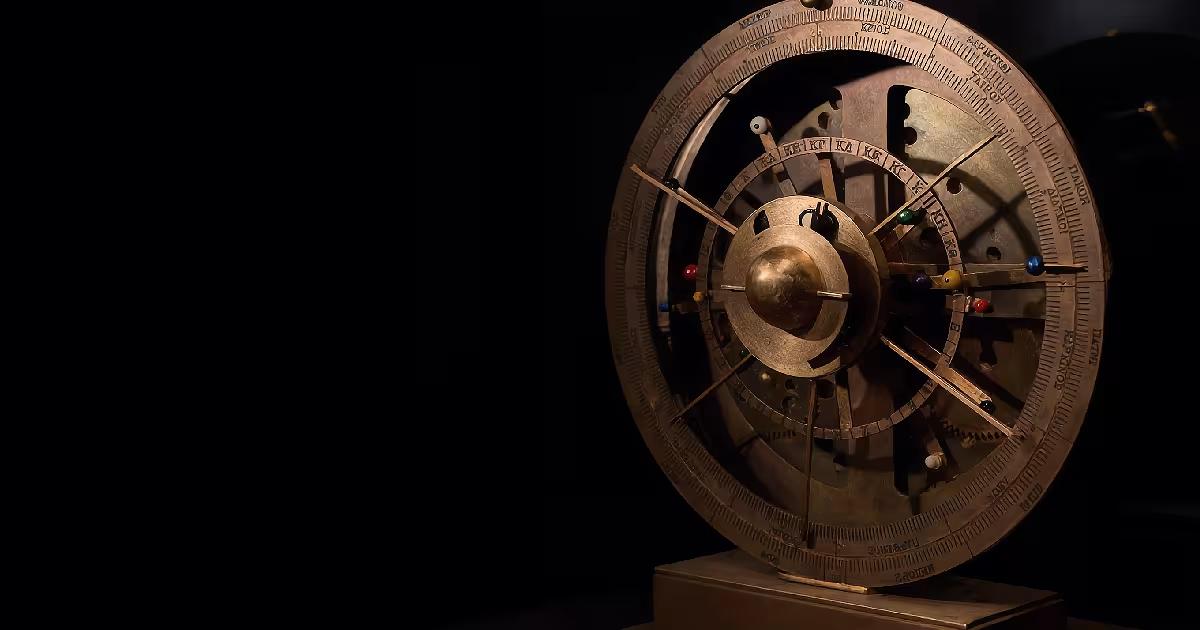
A bronze reconstruction of the mechanism's dials on a dark plinth.
Illustration, not a photograph.

Opening
In 1900 a crew of Greek sponge divers sheltering from a storm off the island of Antikythera, between Crete and the mainland, found a Roman-era shipwreck 45 metres down, full of bronze and marble statues. Over the next year, working with the Greek navy, they brought up what they could. Among the finds was a shoebox-sized lump of corroded bronze and wood that nobody paid much attention to. On 17 May 1902, at the National Archaeological Museum in Athens, the archaeologist Valerios Stais looked again at one of its pieces and saw a gear wheel.
It took most of the next century, and in the end X-ray tomography, to work out what it was: a hand-cranked astronomical calculator, built in Greece around the second century BC, with at least thirty interlocking bronze gears. It tracked the Sun and Moon, the phase of the Moon, the dates of eclipses and the cycle of the Olympic Games. Nothing with gearing this complex is known again for more than a thousand years. It is often cited as proof of lost or alien technology. The truth, worked out piece by piece from the fragments, is in some ways stranger: people built it.
Timeline
About 70 to 60 BCA large cargo ship, probably bound for Italy with luxury goods from the Greek world, sinks off Antikythera.
Early 1900Sponge divers from the island of Symi, under Captain Dimitrios Kontos, find the wreck.
1900 to 1901The divers and the Greek navy raise statues, pottery, coins and other objects. The mechanism is probably brought up in July 1901.
17 May 1902Valerios Stais and his cousin Spyridon notice a gear wheel set in one of the fragments.
Early 1900sThe German philologist Albert Rehm becomes the first to propose it was an astronomical calculator.
1951 to 1974The historian of science Derek de Solla Price studies it for two decades. In 1971, with the radiographer Charalampos Karakalos, he X-rays and gamma-rays the 82 fragments, and in 1974 publishes the first serious reconstruction of its gearing.
2002Michael Wright, a curator at London's Science Museum, builds a working model.
2005The Antikythera Mechanism Research Project, with a Cardiff University team led by Mike Edmunds, scans the fragments with high-powered X-ray tomography, reading hidden inscriptions and counting the gears.
2016New scans reveal the numbers 462 and 442, the cycles used for Venus and Saturn, evidence that the mechanism also showed the planets.
March 2021A University College London team led by Tony Freeth publishes a new reconstruction of the whole front display, planets included.
Key figures
The unknown maker or makers worked somewhere in the Greek world, drawing on Babylonian astronomical records and Greek geometry. Who they were is not known. Suggestions have included a workshop on Rhodes and the tradition of Archimedes, but no name is attached to it.
Derek de Solla Price was the first to treat it as the remarkable machine it is, and to say so publicly at a time when many scholars found the idea hard to believe.
Michael Wright, Mike Edmunds, Tony Freeth and Alexander Jones, among others, turned guesswork into measurement over the last twenty-five years.
Physical and documentary trail
What survives, and in a glass case: the 82 surviving fragments in the National Archaeological Museum in Athens, four of them containing gears; X-ray and CT scans that show gears and text hidden inside the corroded bronze; and the published reconstructions.
The original was probably a wooden case about 34 by 18 by 9 centimetres, with a crank on the side and dials on the front and back. The largest surviving gear is about 13 centimetres across with 223 teeth, a number that matters: 223 lunar months is the Saros cycle, after which eclipses repeat. On the back, a spiral dial counted the 235 months of the 19-year Metonic cycle, which brings the lunar months back into line with the solar year. Another dial tracked the 54-year Exeligmos cycle, and another the four-year cycle of the great Greek games, including the Olympics. A pin-and-slot arrangement of two gears, one slightly off-centre, made the Moon's pointer speed up and slow down, copying the Moon's uneven speed across the sky as Greek astronomers understood it.
What is missing is most of the machine. Only about a third of it is thought to survive, and the planetary gearing is reconstructed from inscriptions and a few surviving parts rather than found whole. The ancient texts that might describe such devices are brief, and nothing else like it has been found from the ancient world.
Things you might not know
- It came with instructions. Thousands of tiny Greek characters are engraved on its plates, explaining the dials. Some letters are only about a millimetre high and could not be read until the CT scans.
- Its teeth were cut by hand. The gear teeth are triangular, with an average spacing of about 1.6 millimetres, filed out of bronze sheet.
- Its Mars pointer could be badly out. The reconstruction suggests the Mars display could be wrong by up to 38 degrees, mainly because Greek planetary theory itself was imperfect.
- It may not have worked well. A 2025 study concluded that the manufacturing errors in its triangular teeth were probably too large for the gears to run smoothly.
- Its calendar was probably lunar. Counting the holes left in a broken calendar ring, researchers from 2020 onward have estimated about 354 positions, the number of days in a lunar year rather than a solar one.
- The divers came back. Jacques Cousteau's team worked the wreck in the 1970s, and new expeditions are still recovering finds from the site.
Competing explanations
A Greek astronomical calculator. This is the scientific consensus, built from the scans, the inscriptions and working models. It drew on Babylonian cycles and Greek geometric astronomy, both well documented, and turned them into gears.
Proof of lost or alien technology. The mechanism appears constantly in "ancient aliens" claims. Its weakness is that every part of it is explained by the astronomy of its own time, including its mistakes. An alien device would hardly copy the errors in Greek planetary theory.
A one-off or a tradition. The real open question. Its sophistication suggests it was not the first of its kind, and ancient writers such as Cicero described geared spheres attributed to Archimedes. But no second example has ever been found.
Later life of the case
The Antikythera mechanism has become one of the most famous objects in archaeology, the subject of documentaries, books, museum exhibitions and working replicas, and it is often called the world's first computer. It is also a fixture of fringe history, where it is used to argue that the ancient world was secretly far more advanced than historians admit. The fragments are still being studied, and each new scan has added to what is known rather than taken anything away.
Finding
The Antikythera mechanism is a real Greek machine, made around the second century BC, that modelled the movements of the Sun, Moon and probably the planets, predicted eclipses and kept track of calendars and games. It is extraordinary, and it is also thoroughly human: built on known astronomy, shaped by its makers' mistakes, and hand-cut from bronze. There is no need for a lost civilisation or a visitor to explain it.
What still will not resolve: who made it, where, and whether it was the only one, since one of the most advanced objects of the ancient world has no known siblings and no name attached to it.
Evidence signature
7/9 Strong
- Witnesses
- one person, or a tradition
- Instruments
- more than one sensor agrees
- Paper
- formal investigation, court or declassified file
How well documented the case is, not whether it's true. A strong record can still have an ordinary answer, and a thin one can still be real.
You decide · ANTIKYTHERA MECHANISM
What do you think happened?
One vote per case, anonymous. You'll see how other readers voted once you've voted.