BELL ISLAND BOOM
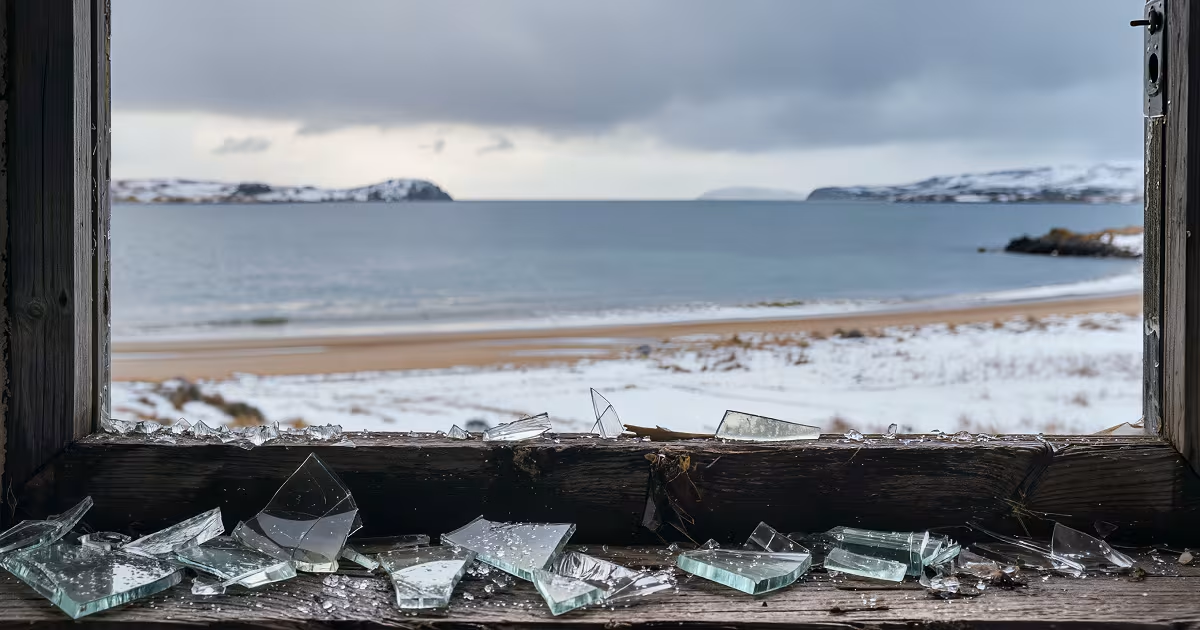
Broken glass on a window sill looking out over a snowy beach.
Illustration, not a period photograph.

Opening
On Sunday, 2 April 1978, at about 11:30 in the morning, a blast hit the house of James Bickford at Lance Cove, on Bell Island in Conception Bay, Newfoundland. The St. John's Daily News the next day called it a freak bolt of lightning: clapboard damaged, the electricity meter smashed, wires burned, outlets blasted out of the walls, a children's shed stripped of its roof, and a henhouse ripped off the barn. Five hens were dead. The Canadian Press count, in the Corner Brook Western Star on 4 April, is three chickens and a rat in a small outhouse on the same property.
Mrs. Edward Bennett, who lived nearby, told the Daily News on 4 April that her lights came on by themselves at about 11 a.m., and that the bang followed. Newfoundland Light and Power crews were at the house that afternoon.
Timeline
2 April, about 11:30 a.mJames Bickford's son-in-law, Stephen Parsley, had been in the henhouse minutes before, feeding the poultry. The Daily News on 3 April follows the bolt off the house, into the woods, and into a tree. A spokesman for the Bell Island RCMP detachment said the end of that trail was scorched bark and holes burned in the snow. Power dropped for a moment across the island. The only lasting outage the paper could confirm was a few houses near the strike. Light and Power workers were there that afternoon and would not comment. People had first taken the noise for an exploding power transformer.
4 AprilThe Daily News and the Western Star both have Memorial University scientists on the case, and no explanation from the university yet. One spokesman said a small meteor could account for the noise and the electrical discharge. Two holes in the ground were being investigated. The RCMP, in the Western Star, called it ball lightning. In the Daily News the same day they said it looked like some form of lightning, and they would not be more explicit. The weather office reported no unusual atmospheric activity at the time. Carol O'Brien's line in the Western Star is the visual report from that week: a rumble, then a big ball of fire. Houses shook in St. John's. Some people thought a plane had crashed at the airport. Bickford's phone was dead. Reporters could not reach him.
6 AprilA Western Star photo story still has Memorial scientists at work, and still no cause past "what could have been a lightning bolt." Bickford's property took the worst of it. Wiring in the house, a chicken coop, and a summer cabin near the house were virtually destroyed. Of two holes behind the barn, the biggest was a cup-shaped depression about two feet deep and three feet wide. The paper says the bolt apparently hit a pole in front of the house first and left a transformer installed the month before useless.
8 AprilA separate Western Star story, Canadian Press from Ottawa, is not about Lance Cove. Transport spokesman Neil Standen said the department was trying to tape mystery booms heard for months in Nova Scotia and down the U.S. eastern seaboard. Some experts blamed the Concorde. Standen said the booms were not typical of the pressure wave that aircraft makes. A recorder at Barrington, Nova Scotia, on 7-8 March had caught none of them.
11 AprilThe Daily News, inside a Brigus item, says the boom over Brigus that Sunday was a military practice explosion. The Bell Island sentence is the first time these clippings use the phrase that stuck. The paper says the noise and destruction on Bell Island were determined to be a case of "super lightning," according to the scientists who investigated the mishap. The clipping names neither the scientists nor a laboratory.
15 JuneWestern Star front page, Canadian Press. Andrew Michrowski, director of the Planetary Association for Clean Energy in Ottawa, says a report from that association attributes the 2 April boom to a Soviet extremely low frequency radio wave, probably interacting with the iron ore. The report places Bell Island between a transmitter at Gomel and a station in Havana. Michrowski said Soviet ELF experiments had been running since 1976, at up to 40 million watts, and that Havana had been known to cooperate. He treated a loud hum before the blast as a known sign of electrical breakdown over a smooth reflector such as ore. The same story's damage line is several hens and a shed knocked apart, plus three circular holes, each about 18 inches deep, in a triangle in the woods behind a house. The association calls that a "plasmic" explosion in an equilateral triangle. That hole count and those depths do not match 3, 4, or 6 April.
Key figures
James Bickford is the householder every April paper names. He is in the 6 April photograph, pointing at the damage. He is not quoted. His phone was out.
Stephen Parsley is in the 3 April Daily News only, as the son-in-law who had just left the henhouse. Mrs. Edward Bennett, nearby, is the witness for lights coming on by themselves and for the line "just like a bomb." Carol O'Brien is the witness for the ball of fire. None of the three is a named investigator.
The week-of investigators in print are an unnamed RCMP spokesman, unnamed scientists at Memorial University, and unnamed Newfoundland Light and Power workers. One university spokesman is the meteor suggestion. The RCMP is the lightning suggestion, already on 3 and 4 April, before any American names appear.
Andrew Michrowski is the named author of the Soviet-wave reading, by telephone, in the 15 June wire story. John Warren and Robert Freyman are not in any of these clippings. Brian Dunning, on Skeptoid for 26 January 2010, names them as the Los Alamos Scientific Laboratory pair who came because Vela satellite data lined up with a rare overland superbolt. He says CBC reporter Rick Cera spoke with Freyman off camera: they had been tracking east-coast superbolts since December 1977, they were asked to see the damage, and they were surprised it was not worse. Dunning calls Warren a plasma physicist and Freyman a radio-frequency specialist. The Newfoundland Herald of 19 November 2021 repeats that account and spells the second name Fryman.
Physical and documentary trail
The record: the Daily News, 3, 4, and 11 April 1978, and the Western Star, 4, 6, and 8 April and 15 June 1978. The 6 April issue has the photographs, including Bickford at the scorched fir. Historic Wabana posted these clippings; the St. John's Evening Telegram for those days was not available to its compiler.
The damage the April papers actually agree on is electrical and local: Bickford's house wiring, outlets or a fuse out of a wall, a wrecked outbuilding and henhouse, dead poultry, a short island-wide power dip, and holes. They do not agree on the poultry, the holes, or how many buildings. Five hens (Daily News, 3 April). Several hens (same paper, 4 April; Western Star, 15 June). Three chickens and a rat (Canadian Press, 4 April). Holes burned in the snow, no size given (RCMP, via the Daily News, 3 April). Two holes in the ground (4 April). The larger of two a cup about two feet deep and three feet wide, behind the barn (6 April). Three holes about 18 inches deep, in a triangle, in the woods (15 June, via Michrowski's report). A children's play shed, a small outhouse, a summer cabin, and a chicken coop may be two buildings or four. The papers do not sort that out. What they do not say, in the week of the blast, is that Bickford's television set exploded. They say some residents lost power to their sets.
B. N. Turman's "Detection of lightning superbolts," Journal of Geophysical Research, 1977, is the published Vela work that already existed: rare, extremely bright lightning flashes seen by the nuclear-watch satellites. It is not a Bell Island paper. The 11 April "super lightning" line is a newspaper sentence, and no 1978 clipping prints the names of any Los Alamos visitors.
Things you might not know
- Parsley had just walked out of the henhouse. The Daily News on 3 April says he had been in to feed the poultry only minutes before the bolt took the building off the barn.
- The Canadian Press casualty list includes a rat. Three chickens and a rat, in the outhouse on Bickford's property, is the Western Star version on 4 April. The Daily News the day before had said five hens and no rat.
- The lights came on, then died. Mrs. Edward Bennett told the 4 April Daily News that the lights in her house came on by themselves at about 11 a.m., the blast hit "just like a bomb," and the lights went out again.
- St. John's thought the airport had been hit. The same day's Western Star says the blast shook houses in the city, and that some people believed a plane had crashed at St. John's airport.
- The transformer was a month old. The Western Star on 6 April says the bolt apparently hit a pole in front of the house first and ruined a transformer installed the month before. A thin fir under the branches was scorched down to about a quarter of its 20-foot height.
- The whole island blinked. The Daily News on 3 April reported a momentary loss of power across Bell Island, and a lasting outage only in the houses next to the strike.
- Brigus, the next Sunday, was a drill. The Daily News on 11 April says the Armed Forces called that boom a practice explosion. Major Williams of the RCAF said the concern was probably the incident on Bell Island the week before.
- The wire could not settle the holes. Snow holes on 3 April, two ground holes on 4 April, a cup two feet by three feet on 6 April, and an 18-inch triangle on 15 June are all in print. They are not the same measurement.
Competing explanations
Lightning, called ball lightning on 4 April and super lightning on 11 April. This is what the RCMP said in the first papers, and what the Daily News says the investigators had settled on by the Brigus story. It fits a path through a pole, a meter, outlets, a tree, and snow. The weather office is the objection inside that reading, not a rival theory: no unusual atmospheric activity, and not the setup people expect for lightning. Turman's 1977 Vela paper is why "superbolt" was already a category for a flash much brighter than ordinary lightning, often discussed over oceans more than over a yard in Lance Cove. Dunning's 2010 account is that Warren and Freyman matched this blast to one rare overland case in that category.
A small meteor. One Memorial spokesman, 4 April, and nothing after him in these clippings. A meteor can be a boom and a hole. It is a poor fit for outlets leaving the walls and a month-old transformer dying on the pole in front of the house.
A Soviet ELF wave. Michrowski's association report, as the Canadian Press gave it on 15 June, is a real document in the record, not a later blog. Ore body between Gomel and Havana, a hum, a triangle of holes, a plasmic breakdown. What the wire story does not have is a recorded transmission at Lance Cove that morning. The electrical damage does not distinguish a radio wave from a lightning current. The triangle is the part that fails first: April's holes were not described that way.
Concorde, or the wider mystery-boom season. From December 1977, booms were reported along the U.S. east coast and in Nova Scotia. Sandra Claflin-Chalton and Gordon J. MacDonald wrote Sound and Light Phenomena: A Study of Historical and Modern Occurrences for the MITRE Corporation in 1978, 138 pages, aimed at that season of sound and light, much of it Nova Scotia. Eos on 30 January 1979 summarized a MITRE-sponsored count: 594 events from December 1977 through June 1978, 413 tied to supersonic aircraft, 181 not, with many of the remainder read as natural. Neither assigns the Lance Cove blast to the Concorde. Standen, on 8 April, was already saying the Nova Scotia booms did not look like a typical Concorde signature. A sonic boom also does not, by itself, blow the outlets out of one house.
A weapon test. This is the reading that uses Los Alamos as the evidence. Dunning says Warren and Freyman talked to reporters and to other scientists, and that the visit followed a Vela superbolt rather than a shot. The Herald in 2021 says they apparently came outside ordinary diplomatic channels, and it calls Freyman, under the Fryman spelling, a weapons design engineer. Those later accounts do not agree on how quiet the visit was. The April and June 1978 clippings do not mention the visit at all. No device was recovered. Michrowski's transmitter is the only weapons-adjacent claim that actually made a 1978 front page, and it is a radio-wave claim, not a bomb.
Later life of the case
Dunning's 26 January 2010 episode is the piece that fixed the modern shape: Bickford property, five dead chickens, an exploded television, exploded fuse boxes, two or three holes in the snow, and Warren and Freyman of Los Alamos. The five hens are already in the Daily News. The exploded television is not how the April papers put it. Holes in the snow are the RCMP line on 3 April. "Two or three" is Dunning's count, between the papers' two and the June triangle of three.
The Newfoundland Herald on 19 November 2021, Russell Bowers, adds the witness the 1978 clippings do not name: Darin Bickford, then 12, on a bicycle because a television show came on at 11. In that later interview he describes stillness, a boom, and a hovering ball, blue in the centre and orange and yellow at the edge, gone in a few seconds. Robert Hiscock's Product of Newfoundland account uses the same interview and puts the boom at around 11 a.m., which sits next to Bennett's lights and a little earlier than the Daily News clock of about 11:30. Hammerson Peters, in 2022, spells the boy Darrin and is the source for a claim that Memorial geologists John Malpas and Ken Collerson were on the island and were asked about security clearances. That scene is not in the clippings or in any second account.
Finding
The morning of 2 April at Lance Cove holds: James Bickford's electrical path, a henhouse off the barn, dead hens, and holes the papers do not measure the same way. A rare, powerful lightning discharge is the best explanation. It is what the RCMP said while the yard was still fresh, and what the Daily News says investigators were calling super lightning by 11 April. It fits the pole, the new transformer, the meter, the outlets, the scorched tree, and the snow better than a meteor, a wave from Gomel, or a Concorde boom.
What still will not resolve: the Los Alamos findings. Dunning says John Warren and Robert Freyman decided this was an overland superbolt and said so off camera. Neither that conversation nor any laboratory report has been published. Until one is, the superbolt reading rests on the damage and on the 11 April sentence, not on a laboratory paper.
Evidence signature
6/9 Solid
- Witnesses
- several people
- Instruments
- radar or measured data
- Paper
- official records at the time
How well documented the case is, not whether it's true. A strong record can still have an ordinary answer, and a thin one can still be real.
You decide · BELL ISLAND BOOM
What do you think happened?
One vote per case, anonymous. You'll see how other readers voted once you've voted.