OAK ISLAND
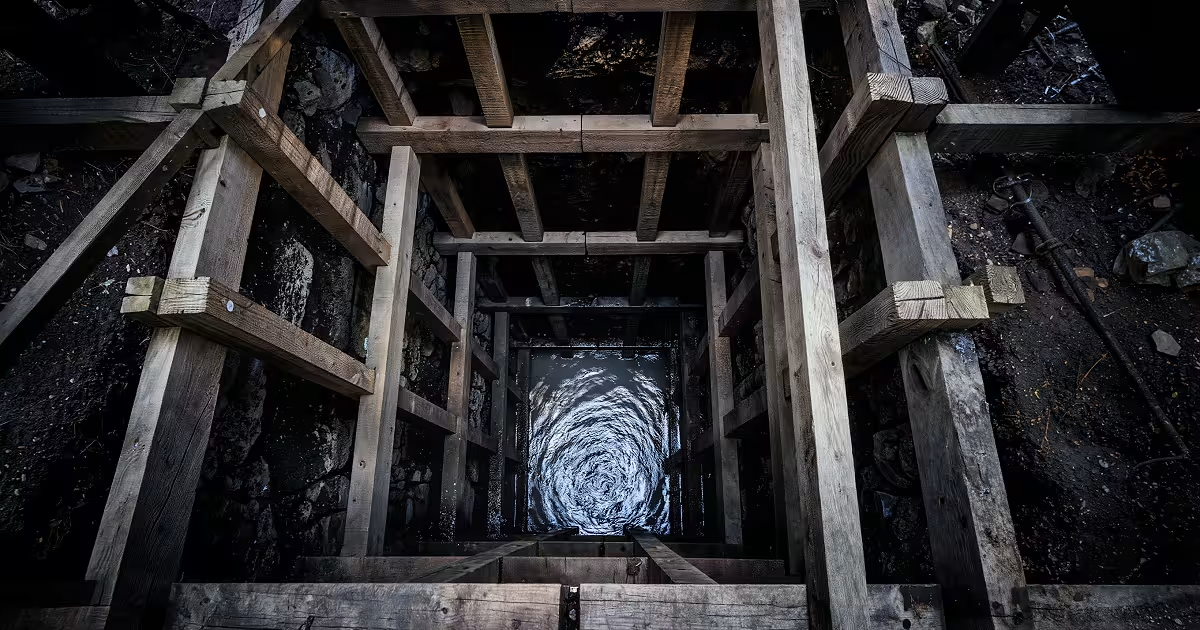
Looking down a timber-braced shaft into the Money Pit on Oak Island.
Illustration, not a period photograph.

Opening
In 1795 a teenager, Daniel McGinnis, exploring a small oak-covered island in Nova Scotia's Mahone Bay, found a circular depression in the ground near a tree bearing marks consistent with an old block and tackle. He and two friends began digging and, in the story as later told, hit layers of decayed oak log platforms roughly every ten feet.
More than two centuries of shafts and boreholes, six deaths and one future American president's fascination later, not a single coin of the fabled treasure has been recovered. What geologists who have studied the island's bedrock keep finding instead is a plainer, much less romantic explanation for why the pit exists at all.
Timeline
1795McGinnis, joined by friends John Smith and Anthony Vaughan, starts excavating the depression, meeting oak platforms at intervals as they go down. Wealthy local resident Simeon Lynds later joins the effort once word spreads.
Early 1800sDiggers from the Onslow Company reportedly recover a stone inscribed with symbols, said to have been found at around 80 to 90 feet. The decoded message, "Ten feet below are two million pounds buried", first appears in an 1893 share prospectus. The stone itself drops out of the record when the Halifax bookbindery holding it closed in 1919. No photograph or rubbing of its markings is known to survive, so every modern depiction rests on secondhand description.
1857The Liverpool Transcript prints the first known account of digging for Captain Kidd's treasure on the island, more than sixty years after McGinnis. A fuller version, based on Vaughan's recollections, follows in 1862.
1861During an attempt to clear the flooded shaft with a steam pump, a boiler bursts and scalds a worker to death, the first of six deaths linked to the treasure hunt.
1878Sophia Sellers is ploughing a field between Smith's Cove and the Money Pit when the ground gives way beneath her oxen. Treasure hunters have long cited this "Cave-in Pit" as a sign of a hidden tunnel or booby trap; skeptical geologists read it as a natural sinkhole, a normal feature of the island's geology.
26 March 1897Maynard Kaiser, working for a separate excavation group, falls to his death in a shaft, the second fatality.
1909Franklin D. Roosevelt, then a 27-year-old New York lawyer and not yet in politics, is a member of the Old Gold Salvage group that digs on the island that summer. He follows developments at Oak Island for the rest of his life.
1928A New York newspaper feature on the island reaches Gilbert Hedden, who runs a steel fabricating company and becomes fascinated by the engineering puzzle. He makes six trips to the island and travels to England to consult Harold T. Wilkins, an author who had written about pirate treasure maps.
17 August 1965Treasure hunter Robert Restall, his 18-year-old son Robert Jr., backer Karl Graeser and worker Cyril Hiltz are overcome by gas in a 27-foot shaft near Smith's Cove and die. The gas was never identified for certain; hydrogen sulphide, carbon monoxide from a pump engine and "swamp gas" have all been suggested, and the coroner ruled the deaths drownings. This one afternoon accounts for four of the six deaths in the island's history.
After 1965A local saying holds that seven people must die before the treasure is found. It gained far more currency once the toll reached six.
2000Skeptical Inquirer publishes Joe Nickell's analysis of the legend's origins. He argues the pit is a natural sinkhole, and that much of the legend's symbolic apparatus, the inscribed stone and the numerology, mirrors the "Secret Vault" allegory of Freemasonry rather than any genuine pirate scheme.
Throughout. Skeptics point out that the earliest accounts mention only "marks" at intervals. The now-famous engineered platforms at precisely every ten feet appear in later retellings.
Geotechnical work. Consulting reports by Warnock Hersey (1969) and Golder Associates (1971) log the ground beneath the Money Pit. In 1995, at the invitation of businessman David Mugar, the Woods Hole Oceanographic Institution runs a two-week survey with dye tests and concludes the flooding comes from a natural interaction between the island's freshwater lens and tidal pressure, not a man-made tunnel.
May 2020Retired geologist Steven Aitken, drawing on those three reports, tells CBC that the bedrock under the east side of the island is Windsor Group limestone and gypsum, minerals prone to dissolution under the right temperature, pressure and groundwater conditions. That process creates cavities whose roofs can collapse into sinkholes. His verdict was blunt (quoted below).
2010 and 2011Nova Scotia grants the site's operators a treasure-trove licence running to 31 December 2010, then replaces the licence system with the Oak Island Treasure Act, in force from 1 January 2011, under which digging continues by ministerial licence.
2014 to presentHistory's reality series The Curse of Oak Island, following brothers Rick and Marty Lagina, has run for more than a decade of seasons. It has recovered bone fragments, ship spikes and coconut fibre that the producers present as evidence of a hidden history, but nothing confirmed as treasure.
Key figures
McGinnis, Smith and Vaughan are the original discoverers. Because nothing about their find was written down until more than sixty years later, even the foundation of the story rests on retelling rather than contemporary record.
Restall paid the heaviest price. He spent six years living on the island with his family and, by 1964, about $70,000 in savings, friends' money and share sales, including drilling 65 test holes at Smith's Cove, before the 1965 gas killed him, his son and two companions.
Roosevelt is a documented participant whose lifelong interest gives the legend unusual real-world weight beyond ordinary treasure folklore.
Nickell is the leading skeptical voice. His Freemasonry reading explains the cipher and numerology without requiring any buried treasure.
Aitken is the key modern scientific voice. His review of the professional reports, not treasure-hunter speculation, led him to say flatly that there is no treasure at the pit. He does not dismiss the island: he has said the real treasure is the archaeological finds, which point to logging, farming, military activity and shipbuilding.
Physical and documentary trail
The record holds newspaper coverage from 1857 onward, dated deaths with named victims across more than a century, a verifiable link to a future president, and three professional studies of the site's geology: Warnock Hersey, Golder Associates and Woods Hole.
It lacks any confirmed physical trace of treasure after more than two centuries of digging, any written record of the first exploration before 1857, and the inscribed stone itself, which has been missing since 1919 with no photograph or rubbing to show what it said.
There is no treasure at the money pit.
Things you might not know
- Roosevelt was nearly a visitor in 1939. His grandfather Warren Delano Jr. had financed an Oak Island dig, and as president FDR secretly planned to call at the island while in Halifax in 1939. Fog and the international situation stopped him.
- The cipher stone ended up beating leather. It was used for years as a bookbinder's beating stone in Halifax. Captain Henry Bowdoin, who examined it around the time of the 1909 dig, found a hard basalt with no symbols on it.
- Restall was a motorcycle daredevil. Before Oak Island he and his wife Mildred rode the "Globe of Death", a steel cage in which they crisscrossed on motorcycles at about 65 mph, at circuses across Europe and North America.
- The "1704" stone may have been a joke. Restall dug up a small stone carved with the date 1704. Professor Edwin Hamilton, who dug there from 1938 to 1943, later told True magazine his men had cut it as a prank and buried it.
- The King was kept informed. Gilbert Hedden briefed King George VI on developments at the island in 1939.
- The widow never believed. The day after the 1965 deaths, Mildred Restall told a UPI reporter she had never believed in the treasure, not from the day she arrived in 1959; it had been her husband's dream.
Competing explanations
A natural sinkhole or collapsed cavern, formed by groundwater dissolving soluble bedrock, gypsum in particular, beneath the island. This reading rests on the professional geotechnical work described above and on comparable sinkholes on the nearby Nova Scotia mainland.
A hoax, or at least a story embellished by treasure-hunting syndicates to attract investors. The documented fact behind this reading is that the decoded cipher first appears in an 1893 company prospectus selling shares at five dollars each, decades after the stone was found, and that the twentieth-century firsthand descriptions, Bowdoin's and that of Harry Marshall, son of a bookbindery owner, report no inscription at all.
A symbolic or ritual construction tied to Masonic tradition rather than literal wealth, as Nickell suggests, which would account for the cipher and numerology with no treasure ever present.
A genuine treasure or artifact cache, the reading that has sustained two centuries of digging and that the Laginas' televised expedition still pursues. It rests on accumulated circumstantial finds, the bones, spikes and fibre, which sinkhole proponents acknowledge still need their own explanation.
Later life of the case
Oak Island is one of the longest-running treasure hunts on record, sustained commercially and culturally well past the point where professional geology concluded there is no treasure at its most famous spot. Its televised excavation shows how a strong founding legend can keep enormous momentum after the scientific question at its core has been professionally addressed.
Finding
The professional geotechnical record points to a natural sinkhole and collapsed cavern system as the most likely origin of the Money Pit, and a retired geologist reviewing that work put it in the plainest terms. Six deaths, a link to a future president and more than two centuries of digging have produced real artifacts that still need explaining, but no treasure. The earliest and most dramatic piece of claimed evidence, the inscribed stone, has been missing for more than a century, and the twentieth-century witnesses who saw it found no markings.
What still will not resolve: a confirmed explanation for the artifacts the digging has turned up, which the sinkhole theory alone does not account for, and any verification of what, if anything, the stone once said. Until either is settled, Oak Island has a strong scientific answer at its centre and loose ends around it.
Evidence signature
4/9 Solid
- Witnesses
- one person, or a tradition
- Instruments
- photo, film or physical traces
- Paper
- official records at the time
How well documented the case is, not whether it's true. A strong record can still have an ordinary answer, and a thin one can still be real.
You decide · OAK ISLAND
What do you think happened?
One vote per case, anonymous. You'll see how other readers voted once you've voted.