AOKIGAHARA
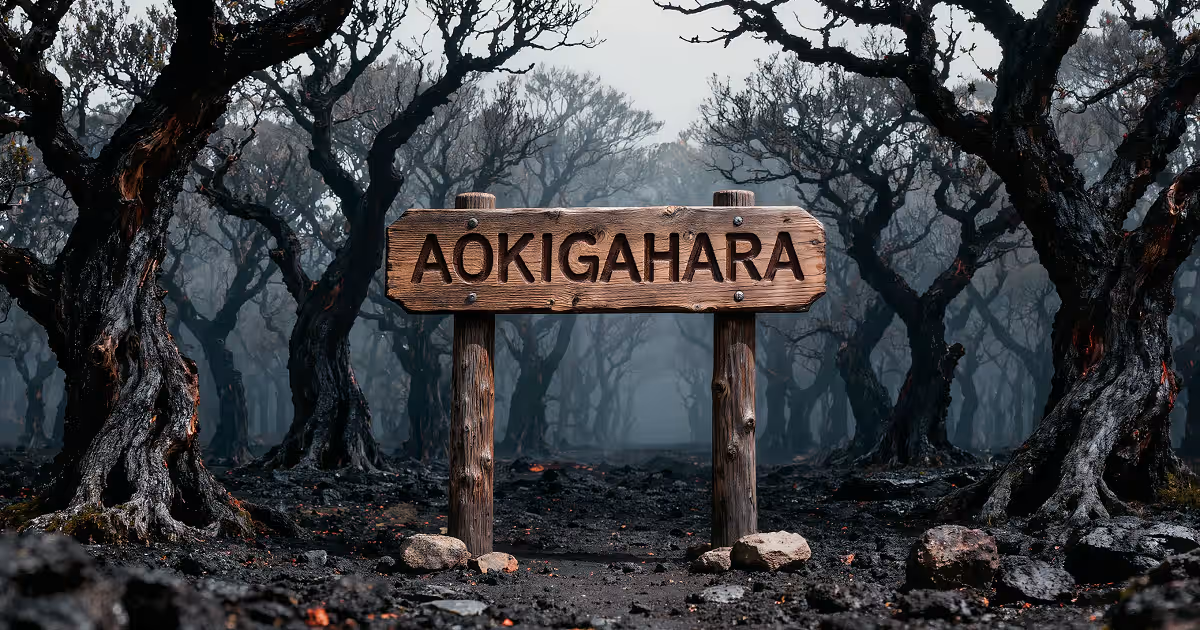
A wooden Aokigahara sign among twisted trees on the forest floor.
Illustration, not a period photograph.

Opening
Aokigahara, the dense forest spreading across the northwestern base of Mount Fuji, is a real place with a real, documented problem: for decades, popular books, films, and internet lists have framed it as a destination specifically associated with suicide, and that framing has itself measurably drawn people toward harm.
In direct response, Yamanashi Prefecture and volunteer groups have posted official signage at the forest's access points, explicit, plainly worded appeals asking anyone who has come there in crisis to turn back and seek help. This entry will not map the forest's interior, will not describe locations within it, and will not treat it as a destination. It will hold to the signs and to where help actually is.
Timeline
Long-standing natural history. Aokigahara grows on hardened lava rock from Mount Fuji's last major eruption roughly a thousand years ago, producing a forest floor with unusually dense root systems and, in places, natural magnetic anomalies in the rock itself, features sometimes cited in popular retellings as contributing to the forest's reputation for disorientation, though this report treats that detail as background rather than as any part of a route description.
20th century, gradual accumulationPopular Japanese fiction, most significantly a mid-century novel, begins associating the forest specifically with suicide, a literary framing that later nonfiction books, documentaries, and international media coverage substantially amplified over subsequent decades.
Following the framing's spreadJapanese authorities and volunteer organizations respond directly, installing signage at multiple points along the forest's access trails specifically addressing anyone who may have entered in crisis, urging them to reconsider and providing contact information for crisis support services.
OngoingLocal volunteer patrols, including groups organized specifically for this purpose, continue conducting periodic searches of the forest, a real, sustained community response to a real, documented problem rather than folklore.
Ongoing, media responseFollowing widespread international criticism of sensationalized coverage and content depicting the forest as a dark tourism destination, several major platforms and creators have removed or restricted such material, reflecting a broader, if incomplete, shift away from treating the location as entertainment.
Key figures
Yamanashi Prefecture and the volunteer groups working alongside it are the case's central, active figures, responsible for the posted signage and for ongoing efforts to help anyone who has entered the forest in crisis rather than to catalogue or narrate what happens there.
This entry itself takes a specific, deliberate position: it will not function as a guide, a map, or a source of location detail, because doing so would work directly against the purpose the posted signs themselves exist to serve.
Physical and documentary trail
The record has the real, posted, official warning signage as its central and only necessary documentary object, along with the broader, well-documented history of how popular media coverage measurably shaped the forest's reputation and, with it, real-world harm.
This report deliberately does not include, and will not be extended to include, any interior description, route information, or location-specific detail.
Things you might not know
- Its other name is Jukai. The forest is also called the "sea of trees" for the way it looks from above.
- It grows on a lava flow from 864. The ground is the hardened lava of the great Jōgan eruption of Mount Fuji.
- It is part of a national park. Aokigahara lies within Fuji-Hakone-Izu National Park, and is visited by ordinary hikers and nature lovers.
- Its lava caves are tourist sites. The Narusawa Ice Cave and the Fugaku Wind Cave, nearby, draw visitors all year.
- The compass story is a myth. Compasses work normally there; they only swing when held right against the magnetic rock.
- Help is close by. The signs at the trailheads urge anyone struggling to think of their family and to call for support, and volunteers patrol to offer it.
Competing explanations
A real forest whose reputation was substantially built and sustained by popular media rather than by any inherent property of the location itself, with the resulting real-world harm addressed directly through official signage and volunteer response rather than through any change to the forest's actual physical character.
A location whose specific geological and sensory qualities, dense, disorienting root systems and localized compass interference, may have contributed to an early, separate reputation for travelers becoming lost, later fused with the unrelated and more consequential suicide association through decades of popular retelling.
Later life of the case
Aokigahara remains a real, actively managed site where prefectural authorities and volunteers continue direct, practical crisis-response work, a genuinely different kind of "later life" than most entries in this archive, one measured in continued signage and patrols rather than in accumulating legend.
Finding
Aokigahara is a real forest that popular media turned into a symbol, and Japanese authorities have responded with direct, practical signage asking anyone in crisis to turn back and seek help. This report holds to that response rather than to the symbol.
Evidence signature
4/9 Solid
- Witnesses
- several people
- Instruments
- nothing on record
- Paper
- official records at the time
How well documented the case is, not whether it's true. A strong record can still have an ordinary answer, and a thin one can still be real.
You decide · AOKIGAHARA
What do you think happened?
One vote per case, anonymous. You'll see how other readers voted once you've voted.