WOW SIGNAL
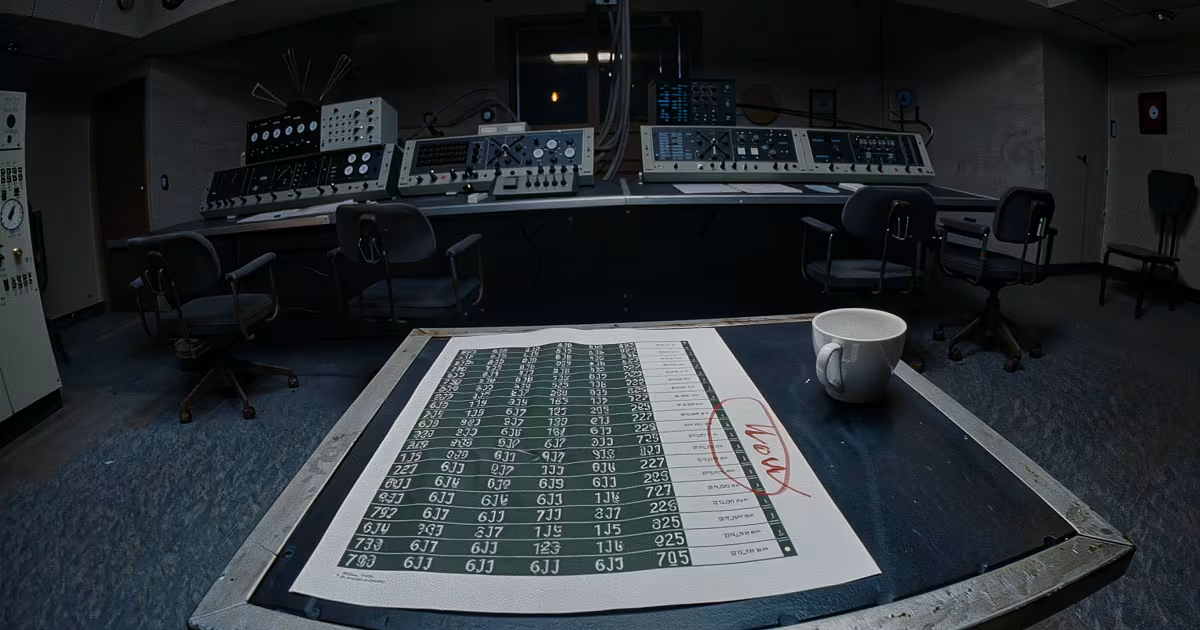
Tractor-feed printout with red circle and Wow.
Illustration, not a period photograph.
Opening
On 15 August 1977 Ohio State's Big Ear radio telescope, listening for narrowband signals near the hydrogen line, recorded a burst that rose and fell through seventy-two seconds as the beam swept the sky. A few days later Jerry Ehman was reading the printout by hand. In channel 2 he found the string 6EQUJ5, circled it in red, and wrote Wow! in the margin. That word became the name of the only SETI hit the public still bothers to learn.
The frequency sat close to 1420 megahertz. The intensity peaked far above the background. The shape was what a fixed point in the sky should do when a transit telescope drifts across it. Big Ear looked again. Other dishes looked. The burst has not come back.
The spine of the file is one line of printer paper and a sky that would not repeat itself. The Wow signal is a seventy-two-second guest. It is not a conversation.
Timeline
15 August 1977, 22:16 EST. Big Ear, Delaware, Ohio, on a SETI watch. The beam moves with the Earth. For one window the intensity in one channel climbs through the alphabet of the observatory's code and falls again. Nobody is watching the printer in real time.
A few days later. Ehman reviews the stack, circles 6EQUJ5, writes Wow!
Following months and years. Return looks at the same patch toward Sagittarius. Nothing repeats at that strength. John Kraus and Ehman later give frequencies a hair apart, both near the hydrogen line. Comets, debris, and Earth-side sources get tried and do not stick as a settled close.
The printout is kept. The dish is later lost to development. The signal stays a one-off.
Key figures
Jerry Ehman is the man who noticed. He was doing the unglamorous work of reading numbers. The red pen is why the case has a name.
John Kraus built Big Ear and ran the observatory. His later notes to Sagan sit in the technical file.
The SETI watch itself is the other actor: a method that expected a narrowband guest and, once, got a page that looked like one.
Later proposers of comets and satellites own hypotheses. They do not own a second burst.
Physical and documentary trail
On the paper, 15 August 1977 gives you four hard objects and no encore.
One: the Big Ear printout line 6EQUJ5, with intensity rising and falling across the seventy-two-second transit window.
Two: Ehman's circled Wow! on that same sheet, which is how the event entered public speech.
Three: the frequency near the hydrogen line, reported in slightly different figures by Kraus and by Ehman, both in the waterhole neighbourhood SETI had chosen on purpose.
Four: the failure of later pointings to catch a repeat. Ohio State Big Ear computer printout, 15 August 1977, Ehman annotation, is the entire physical take.
There is no second telescope that logged the same seventy-two seconds. There is no modulation everyone agrees is a message. There is no source that has been switched on again.
Wow!
Competing explanations
An interstellar beacon or leakage. This is why the page was exciting. Narrowband, hydrogen neighbourhood, transit shape. It has never said hello again, which is a problem for a beacon and less of one for a brief leak.
A cold hydrogen cloud or a comet, later offered. Useful as a try. Not signed off as the official close.
Earth-side interference that mimicked a point source. Always the first mundane guess. The transit envelope is the part this reading has to work for.
Hybrid caution. Big Ear recorded a clean burst. The sky has not repeated it. Both sentences are true.
Later life of the case
Every SETI documentary starts here. The dish is gone. I keep the comet papers and the anniversary audio on the later-life shelf. The printout and the empty follow-ups stay first.
Finding
Big Ear recorded a seventy-two-second narrowband burst on 15 August 1977, Jerry Ehman circled 6EQUJ5 and wrote Wow! on the page, and the sky has not said it again. Believe the printout. A radio telescope does not invent a column of numbers for a magazine. Something in that beam was loud, brief, and shaped like a point passing through.
What still will not resolve: a repeat from the same patch, or a second dish that logged the same seventy-two seconds. Either one would take Wow out of the one-off drawer and put a source on the map. The proving object is still another page like the first.