INTERSTELLAR VISITORS
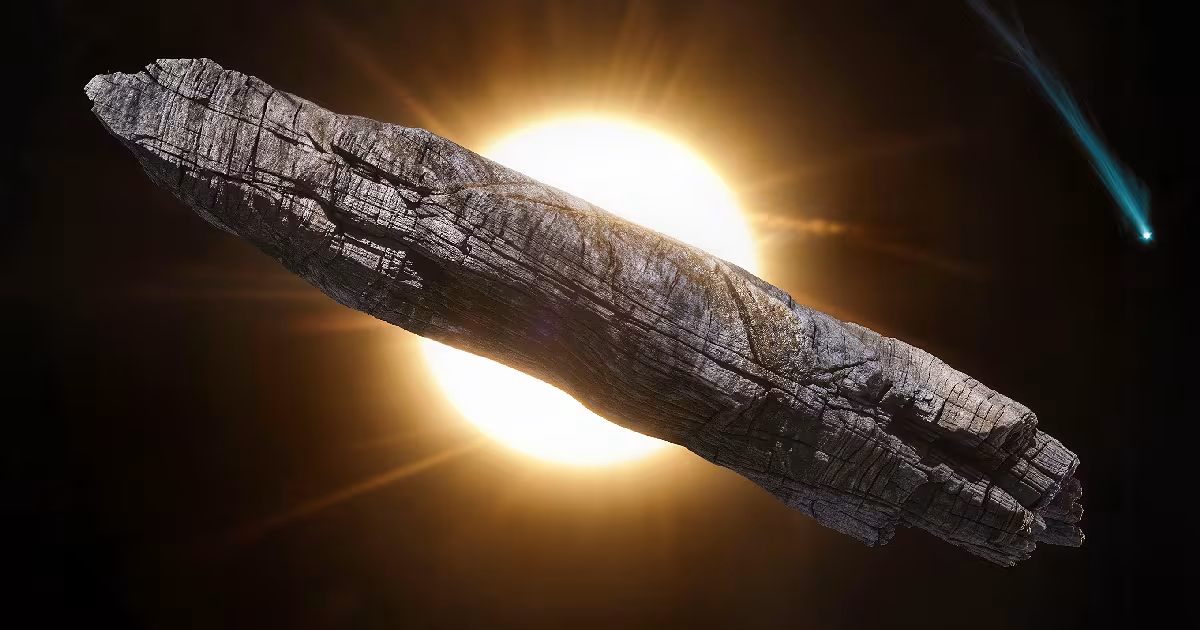
A long, tumbling rock crosses in front of the Sun.
Illustration, not a photograph.
Opening
In the whole history of astronomy, we have seen just three objects that came from another star and passed through our solar system. The first, 'Oumuamua in 2017, was shaped like nothing anyone had seen before, sped up as it left without any visible reason, and led a Harvard astronomer to suggest in a scientific journal that it might be an alien light sail. The second, Borisov, was an ordinary-looking comet found by an amateur with a homemade telescope. The third, 3I/ATLAS in 2025, may be older than the Sun itself, and it set off a second, louder round of the same argument. This is the story of all three, and of Avi Loeb, the scientist who refused to rule out the obvious question.
Timeline
19 October 2017. Robert Weryk, working with the Pan-STARRS survey telescope on Haleakalā in Hawaii, spots a faint, fast-moving object. It is already past the Sun and heading out. Its path is hyperbolic: it is not bound to the Sun and came from interstellar space.
November 2017. It is named 1I/2017 U1, or 'Oumuamua, the first object ever given the "I" for interstellar. Its brightness changes dramatically every few hours as it tumbles, suggesting a body far more elongated or flattened than any known asteroid or comet.
June 2018. A team led by Marco Micheli reports in Nature that 'Oumuamua was speeding up slightly as it moved away from the Sun, beyond what gravity alone can explain. Comets do this when gas jets off them, but no gas or dust had been seen.
12 November 2018. Avi Loeb, then chair of Harvard's astronomy department, and postdoctoral researcher Shmuel Bialy publish a paper in The Astrophysical Journal Letters asking whether sunlight pushing on a thin sheet, a light sail, could explain the acceleration. They suggest 'Oumuamua might be artificial.
29 August 2019. Gennadiy Borisov, an amateur astronomer and telescope maker, discovers the second interstellar object from his own observatory in Crimea, with a telescope he built himself. 2I/Borisov turns out to be a fairly normal comet, with a clear tail.
26 January 2021. Loeb's book Extraterrestrial: The First Sign of Intelligent Life Beyond Earth is published, and becomes a New York Times bestseller.
2021 to 2023. Rival natural explanations appear: a fragment of nitrogen ice chipped off a Pluto-like world, and, in 2023, a water-ice comet releasing trapped hydrogen too faint to see.
1 July 2025. The ATLAS survey telescope at Río Hurtado in Chile finds the third interstellar visitor, 3I/ATLAS. It is moving at about 58 kilometres a second relative to the Sun, far faster than the first two. Earlier images from NASA's TESS satellite, taken from 7 May, are later found to show it.
July to August 2025. Hubble images it on 21 July, and the James Webb Space Telescope on 6 August. It has a coma of gas and dust that is unusually rich in carbon dioxide. Loeb begins publishing a list of anomalies, and gives it a 4 on his new "Loeb scale" for interstellar objects, which runs from 0, an ordinary rock, to 10, alien technology that poses a threat.
3 October 2025. 3I/ATLAS passes Mars at about 29 million kilometres. Spacecraft orbiting Mars, including the European Space Agency's ExoMars Trace Gas Orbiter, photograph it.
1 October to 12 November 2025. A US government shutdown furloughs most NASA staff. Images taken during the Mars flyby go unreleased, and online speculation fills the silence.
29 October 2025. 3I/ATLAS makes its closest approach to the Sun, at about 1.36 times Earth's distance, while hidden behind the Sun as seen from Earth.
19 November 2025. NASA releases its images at a press briefing. Associate administrator Amit Kshatriya says plainly that the object is a comet.
19 December 2025. Closest approach to Earth, at about 270 million kilometres, never close enough to be a danger.
16 March 2026. It passes Jupiter at about 54 million kilometres on its way out of the solar system, never to return.
Key figures
Avi Loeb is the central figure of this report. An Israeli-American astrophysicist, he chaired Harvard's astronomy department from 2011 to 2020 and has written hundreds of papers on the early universe and black holes. He founded the Galileo Project in 2021 to search for evidence of alien technology with purpose-built instruments, and in 2026 he was asked to chair the government's new UAP Science Advisory Council. His position on all three visitors has been the same: scientists should not rule out a technological origin just because it is uncomfortable.
Robert Weryk discovered 'Oumuamua. Marco Micheli led the team that measured its acceleration. Shmuel Bialy co-wrote the light-sail paper. Gennadiy Borisov found the second visitor with his own equipment. Penn State astronomer Jason Wright, himself a SETI researcher, became the most detailed critic of Loeb's 3I/ATLAS anomalies.
Physical and documentary trail
'Oumuamua was seen for only about eleven weeks, and only as a point of light, so everything about its shape comes from how its brightness rose and fell. Estimates range from a cigar about 230 metres long to a flat pancake about 115 metres across. Its colour was reddish, like many icy bodies in the outer solar system. The Spitzer Space Telescope looked for it and saw nothing, which puts limits on how big it could be. The Breakthrough Listen project pointed the Green Bank radio telescope at it and heard no signals.
3I/ATLAS, by contrast, has been watched by almost every major telescope and several spacecraft. The measurements show a nucleus probably under a kilometre wide, a coma rich in carbon dioxide and poor in water, nickel vapour without the matching iron, an unusual sunward "anti-tail", and at times extreme polarisation of its light. Its age is estimated at 3 to 14 billion years, which means it may have formed before the Sun.
Things you might not know
- The name means "scout". 'Oumuamua is Hawaiian, roughly "a messenger from afar arriving first", chosen because it was found from a telescope on Maui.
- We only saw it leaving. 'Oumuamua was discovered more than a month after its closest pass of the Sun, already on its way out. Nobody saw it coming.
- The second one was found by an amateur. Gennadiy Borisov spotted 2I/Borisov with a 65-centimetre telescope he had built himself, at his own observatory in Crimea.
- 3I/ATLAS may be older than the Sun. Estimates of its age run from about 3 to 14 billion years. The solar system is about 4.6 billion years old.
- It came from near the Wow! signal. Loeb pointed out that 3I/ATLAS arrived from a direction about 9 degrees from the famous 1977 Wow! signal. Critics replied that 9 degrees is a big patch of sky.
- The shutdown made it stranger. NASA's best images from the Mars flyby were held back for weeks because of the 2025 government shutdown, which many people took as a sign something was being hidden.
- Loeb has his own scale. He devised a 0 to 10 scale for interstellar objects, in the spirit of the Torino scale for asteroid threats. He gave 3I/ATLAS a 4.
- Loeb wanted to send a spacecraft. In July 2025 he and colleagues worked out that NASA's Juno probe, already orbiting Jupiter, could be steered towards 3I/ATLAS for its March 2026 pass to get a much closer look than any telescope on Earth.
Competing explanations
Natural comets, unusual ones. This is the view of NASA and most astronomers. 'Oumuamua's acceleration may come from gas we could not see, such as hydrogen or nitrogen, which leave no visible tail. 3I/ATLAS has a coma, a tail and gas jets: it behaves like a comet, and its odd chemistry is what you might expect from a body born around another star billions of years ago. Jason Wright went through Loeb's list point by point, arguing that most of the anomalies are either known comet behaviour or probabilities worked out after the fact.
A light sail, or a probe. Loeb's argument is not that these objects are definitely alien. It is that the odds are not zero, that each object has features we cannot fully explain, and that dismissing the possibility without looking is bad science. For 'Oumuamua, a thin sail pushed by sunlight explains the acceleration without any gas. For 3I/ATLAS, he points to its alignment with the plane of the planets, its timing near Mars, Venus and Jupiter, and its nickel.
Something in between. Some scientists who reject the alien reading still say 'Oumuamua is unexplained: none of the natural theories fits everything we saw, and with only eleven weeks of data, we may never know.
Later life of the case
The Vera C. Rubin Observatory in Chile, which began its survey in 2025, is expected to find many more interstellar objects, perhaps several a year. The European Space Agency's Comet Interceptor mission, due to launch around 2029, will wait in space for a suitable target and could be sent to meet a future visitor. Engineers have also studied Project Lyra, a mission to chase 'Oumuamua itself, though it would take decades to catch up.
Loeb has gone on to lead an expedition to the Pacific Ocean floor in search of fragments of a meteor he believes came from another star, and in 2026 was asked to chair the UAP Science Advisory Council.
Finding
3I/ATLAS is a comet. It has a tail and gas jets and behaves as comets do, but it is an extraordinary one: a chunk of another solar system, possibly older than our own, that we were lucky to see. 'Oumuamua is the genuine mystery. It had no tail, an odd shape and a push nobody saw, and every natural explanation still has gaps. Loeb's light sail is a long shot, but no one has been able to rule it out.
What still will not resolve: what 'Oumuamua really was. It is now far beyond the planets, too faint for any telescope to see. The next visitor, and there will be more, is where the question gets answered.