JACQUES VALLÉE
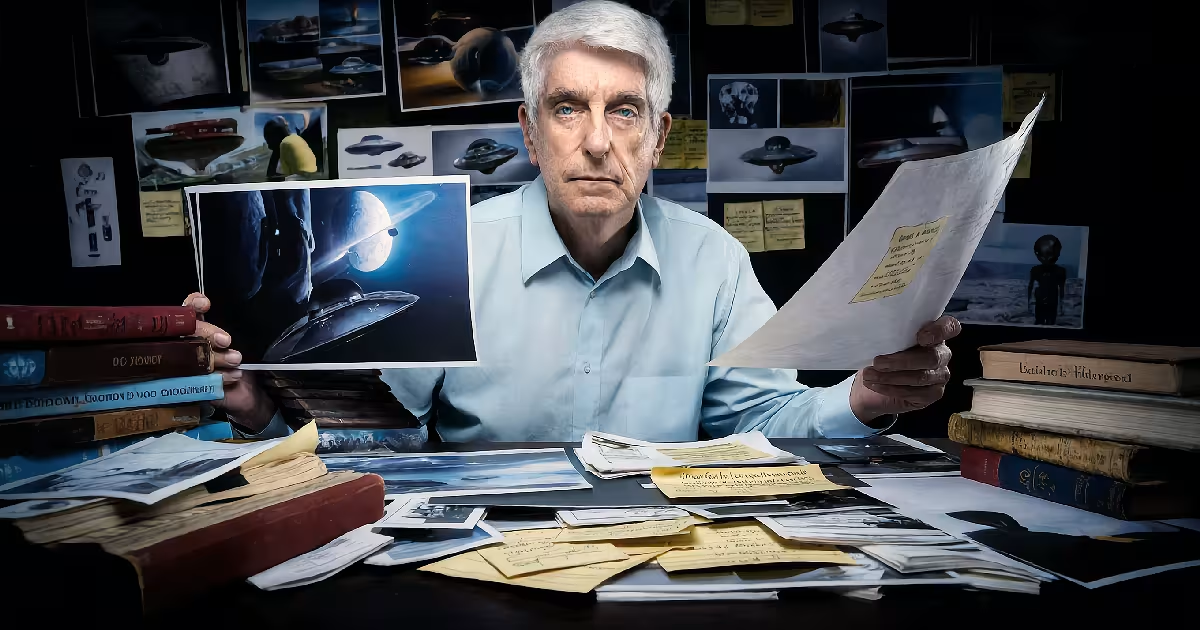
The legend himself, Jacques Vallée, among a lifetime of UFO files.
Illustration, not a photograph.
Opening
Jacques Vallée has had at least three careers that would each fill a normal life. He was an astronomer who helped map Mars for NASA. He was a computer scientist who helped build the first information centre on the ARPANET, the network that grew into the internet. And he was a Silicon Valley venture capitalist whose funds backed companies that went on to the stock market. Through all of it, for seventy years, he has studied UFOs. He worked beside J. Allen Hynek, inspired the French scientist in Close Encounters of the Third Kind, and argued, long before it was fashionable, that the phenomenon is stranger than visitors from another planet. Many researchers would call him the most important living figure in the field.
Timeline
24 September 1939. Jacques Fabrice Vallée is born in Pontoise, just outside Paris.
May 1955. Aged 15, he sees a UFO over his family's home in Pontoise, the sighting he credits with starting his interest.
1959 to 1961. He takes a degree in mathematics at the University of Paris, then a master's in astrophysics at Lille. In 1961 his first science fiction novel, Le Sub-espace, published under the pen name Jérôme Sériel, wins the Jules Verne Prize.
1961. Working on the Paris Observatory's satellite-tracking team, he watches the team record an unknown object in a retrograde orbit, travelling the opposite way to every known satellite. Before an orbit can be worked out, the project director destroys the tape.
1962 to 1963. He moves to the United States to work with astronomer Gérard de Vaucouleurs at the University of Texas, where they produce the first detailed computerised map of Mars for NASA.
1963. He joins Northwestern University near Chicago, where the astronomy department is chaired by J. Allen Hynek, the Air Force's UFO consultant. The two begin a partnership that lasts until Hynek's death.
1965 and 1966. He publishes Anatomy of a Phenomenon, then Challenge to Science with his wife, Janine. Both books argue that UFOs deserve scientific study, and both lean towards the idea of visitors from space.
1967. He earns his PhD in computer science at Northwestern.
1969. Passport to Magonia changes his direction. He sets modern UFO and abduction reports beside centuries of folklore about fairies, elves and sky-people, and argues they are the same phenomenon wearing the clothes of each age. The same year he moves to California to manage information systems at Stanford's computer centre.
1971 to 1976. At the Stanford Research Institute, in Douglas Engelbart's group, he helps set up the ARPANET's first Network Information Center. At the Institute for the Future he then leads early experiments in online conferencing, and in 1976 he founds InfoMedia, one of the first companies to sell it.
1975. The Invisible College introduces his "control system" idea, and The Edge of Reality, a book of conversations with Hynek, comes out the same year.
1977. Close Encounters of the Third Kind is released. Its French scientist, Claude Lacombe, played by François Truffaut, is widely seen as modelled on Vallée.
1979. Messengers of Deception looks at UFO contactee groups and warns that belief in saviours from space can be exploited.
1987 to 2010. As a general partner in the Euro-America Ventures funds, he backs technology and medical companies, including Accuray, maker of the CyberKnife radiosurgery system.
1988 to 1991. A trilogy, Dimensions, Confrontations and Revelations, covers his history of the subject, his field investigations, and the hoaxes and disinformation he found around it.
1990. He publishes "Five Arguments Against the Extraterrestrial Origin of Unidentified Flying Objects" in the Journal of Scientific Exploration.
2010. Wonders in the Sky, written with Chris Aubeck, collects reports of strange aerial events from ancient times to 1879. Janine Vallée, his wife of fifty years, dies the same year.
2021. Trinity: The Best-Kept Secret, with Paola Harris, presents the claim of a crash near the first atomic bomb test site in New Mexico in 1945.
2022. With Stanford immunologist Garry Nolan, he co-authors a peer-reviewed paper in Progress in Aerospace Sciences analysing material said to have fallen from a UFO at Council Bluffs, Iowa, in 1977.
January 2025. Forbidden Science 6: Scattered Castles publishes his private journals from 2010 to 2019, including his years around the AAWSAP study funded through Robert Bigelow.
Key figures
J. Allen Hynek was Vallée's mentor, colleague and friend. Vallée arrived at Northwestern as a young computer specialist, and helped push Hynek from Air Force consultant towards open scientific interest. Together they built the "Invisible College", Vallée's name for the scientists who discussed UFOs privately while keeping quiet in public.
Aimé Michel, the French writer who studied the 1954 French wave, corresponded with Vallée from 1958 and shaped his early thinking. Steven Spielberg consulted him for Close Encounters. Robert Bigelow brought him in as a consultant to the National Institute for Discovery Science and later to the scientific advisory board of Bigelow Aerospace. Garry Nolan is his most important recent collaborator, and Jeffrey Kripal of Rice University is the scholar who brought Vallée's lifetime archive to Houston.
Physical and documentary trail
Vallée's work is unusually well documented, because he wrote it down. There are more than a dozen UFO books, the long-running Forbidden Science series of private journals, books on computer networking such as The Network Revolution (1982), and the 1990 paper. Passport to Magonia's second half is a catalogue of 923 reported UFO landings from 1868 to 1968, one of the first serious databases in the field.
His case files, correspondence and notebooks, covering around 500 events he investigated, are now at Rice University's Archives of the Impossible. Some of the material is closed for several more years because of its sensitivity.
The five arguments in his 1990 paper, in short: there are far too many close encounters for any physical survey of Earth; the "aliens" are too human-shaped to have evolved on another world; the abduction reports do not fit genetic or scientific experiments by an advanced civilisation; the phenomenon goes back through all of history; and it seems able to bend time and space in ways that do not look like travel from one planet to another.
Things you might not know
- He won a science fiction prize before he was 22. His first novel, Le Sub-espace, about a twin universe reached by accident, won France's Jules Verne Prize in 1961 under the pen name Jérôme Sériel.
- He helped map Mars. In 1963, with Gérard de Vaucouleurs, he produced the first detailed computerised map of Mars for NASA.
- He was there at the birth of the internet. At the Stanford Research Institute he helped set up the first Network Information Center on the ARPANET with Elizabeth "Jake" Feinler, effectively the internet's first directory.
- A tape went missing in 1961. At the Paris Observatory, he says, the team tracked an object orbiting the wrong way round the Earth, and the director destroyed the tape the next morning before anyone could compute its orbit.
- Magonia comes from a ninth-century archbishop. Agobard of Lyon wrote around 815 AD about a crowd about to stone three men and a woman who were said to have climbed down from a ship in the clouds from a land called Magonia. Vallée borrowed the name for his book.
- He made his money in Silicon Valley. Fourteen of the companies his funds backed went public, among them Accuray, whose CyberKnife robot treats tumours with radiation.
- The X-Files named a pilot after him. In the 1996 episode "Jose Chung's From Outer Space", the two Air Force pilots are Jack Shaeffer and Robert Vallee, after sceptic Robert Sheaffer and Jacques Vallée. The same episode has a Sergeant Hynek and a Klass County.
- Truffaut's character is not quite him. Vallée urged Spielberg to show the phenomenon as something stranger than visitors from space. The film went the other way, and Lacombe greets the aliens as travellers from the stars.
Competing explanations
Vallée's view. He accepts that something real is happening, and that some of it is physical: it leaves marks, injures people and shows up on instruments. But he thinks it is not simply nuts-and-bolts visitors from another star. In The Invisible College he suggested it might work like a "control system", shaping human belief over centuries the way a thermostat controls the temperature of a room. He has since leaned towards ideas of other dimensions, or an intelligence that has always been here alongside us.
The extraterrestrial camp. Many researchers think Vallée overcomplicates things, and that craft from elsewhere remain the simplest reading of the best cases. Since 2017, the disclosure claims about crash retrievals and recovered craft have given that side new energy.
The sceptics. To sceptics, his folklore comparisons show something else: that the same human experiences, dreams, hoaxes and misperceptions are dressed in the language of each era. Some have also questioned his openness to witnesses in cases such as Trinity.
Later life of the case
Vallée has outlived almost all of his generation of researchers, and his standing has grown rather than faded. He appears in James Fox's The Phenomenon (2020), and his ideas are now discussed openly by scientists such as Garry Nolan and by the new generation of academic researchers, including those around the Rice archive. Several of the questions he raised in 1969, about why the phenomenon seems to speak in the language of each age, are now among the field's central questions.
Finding
Jacques Vallée is the field's great thinker. Hynek gave the subject scientific respectability, and Vallée gave it its biggest ideas. He brought real scientific training, an enormous case collection and an engineer's habit of looking at systems rather than single sightings. Even researchers who disagree with him work inside the questions he set.
What still will not resolve: what the phenomenon is, which is the question Vallée has spent seventy years asking. His files at Rice will open fully in the coming years, and they may yet answer some of it.