J. ALLEN HYNEK
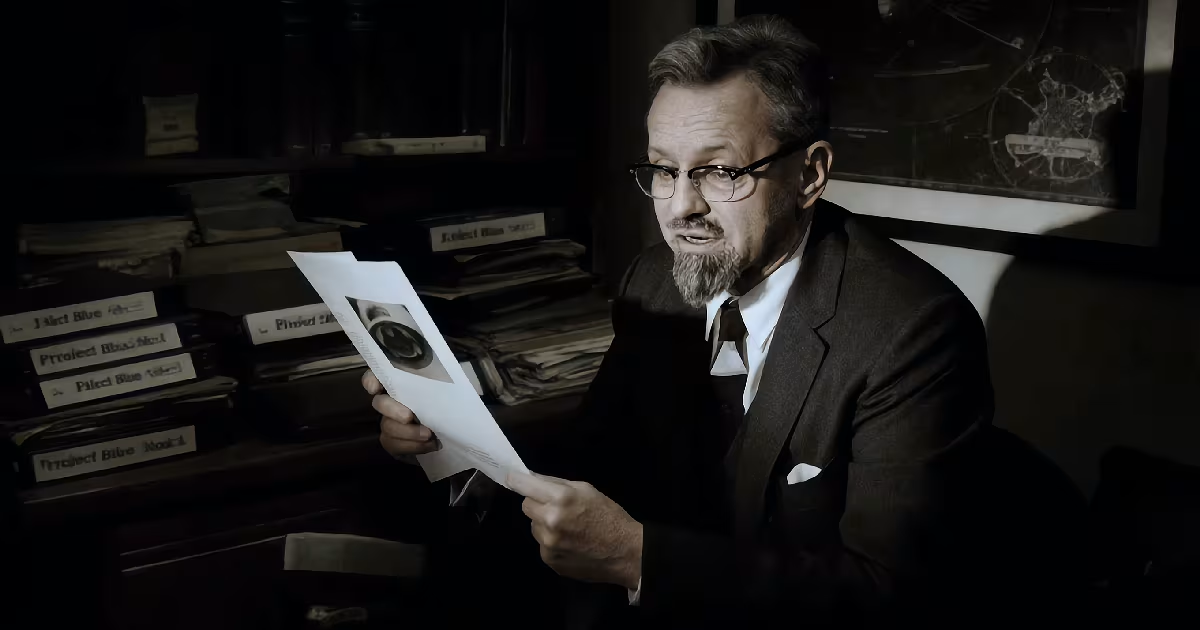
A bearded scientist reads a Project Blue Book file at his desk.
Illustration, not a photograph.
Opening
For twenty years, J. Allen Hynek was the US Air Force's scientific consultant on UFOs, the astronomer it called on to explain sightings away. He did that, often. But the more cases he studied, the more he found that some would not go away, and by the end he had become the most respected scientist ever to say publicly that the subject deserved serious study. He coined the phrase "close encounters", founded the first serious UFO research centre, and turned up in a cameo at the end of Steven Spielberg's film about it. His name appears in more bot313 reports than anyone else's.
Timeline
1 May 1910. Josef Allen Hynek is born in Chicago to Czech parents.
1935. He earns his PhD in astrophysics from the University of Chicago and soon joins the astronomy faculty at Ohio State University.
Second World War. He works at the Johns Hopkins Applied Physics Laboratory on the proximity fuze, a secret radar-triggered fuze for anti-aircraft shells.
1948. The Air Force hires him as astronomical consultant to Project Sign, its first official UFO study, to identify which sightings were stars, planets and meteors. He stays on through Project Grudge and Project Blue Book.
1957. As associate director of the Smithsonian Astrophysical Observatory, he helps run Operation Moonwatch, the network of volunteer observers who tracked the Soviet Sputnik satellite.
1960. He becomes chair of the astronomy department at Northwestern University near Chicago.
March 1966. Sent to investigate mass sightings in Dexter and Hillsdale, Michigan, he suggests some of the lights may have been swamp gas. The phrase is mocked nationally, and the backlash helps push Congress to hold hearings and the Air Force to fund the Condon study.
1969. Project Blue Book closes.
1972. He publishes The UFO Experience, which introduces his classification of close encounters of the first, second and third kind.
1973. He founds the Center for UFO Studies (CUFOS), in the Chicago area.
1977. He serves as technical adviser to Close Encounters of the Third Kind, and appears in it.
27 April 1986. He dies in Scottsdale, Arizona, of a brain tumour, aged 75.
Key figures
Jacques Vallée, a young French computer scientist, worked with Hynek at Northwestern in the 1960s. Together they built a private network of scientists interested in UFOs that Vallée called the "Invisible College". Edward Ruppelt, who headed Blue Book in the early 1950s, worked with Hynek and later wrote warmly of him. On the other side was the Air Force, which wanted explanations, and its later chosen investigator Edward Condon, who did not share Hynek's growing doubts.
On the paper
Hynek's career is documented in his books, The UFO Experience (1972), The Edge of Reality (1975, with Vallée) and The Hynek UFO Report (1977), and in the Blue Book files, where his signature appears on thousands of case evaluations. His papers and the CUFOS files survive, and Vallée's collection at Rice University includes material from their work together.
Ridicule is not part of the scientific method, and people should not be taught that it is.
Things you might not know
- He's in the film. In the final scene of Close Encounters of the Third Kind, as the aliens emerge from the mothership, a bearded man with a pipe steps forward from the crowd to watch. That is Hynek.
- The film's title is his. Spielberg took the phrase "close encounter of the third kind", meaning a sighting where beings are seen, straight from Hynek's 1972 book, and paid him $1,000 for it, another $1,000 to use stories from the book, and $1,500 for three days of technical advice.
- He was already saying it in 1953. His line about ridicule comes from a scientific paper he wrote while still working for the Air Force, long before he went public with his doubts.
- He started as the debunker. In 1948 he believed that UFO reports were all misidentifications, and his early Air Force work explained away case after case. His change of mind took about two decades.
- The swamp gas line followed him for life. He offered swamp gas as a possible explanation for only some of the Michigan lights, but the phrase became a national joke, and it came to stand for everything people disliked about the Air Force's easy answers.
- He tracked Sputnik. Before he was the UFO man, he helped the Smithsonian organise thousands of amateur observers to follow the world's first artificial satellite.
- He has a TV show. In the History channel drama Project Blue Book (2019 to 2020), Hynek was played by Aidan Gillen, best known as Littlefinger in Game of Thrones.
- He smoked a pipe through most of it. The pipe became so much a part of his image that it is in almost every photograph of him, and in his cameo.
Competing explanations
For Hynek himself, the debate was never about whether UFOs were spacecraft. It was about whether science should study the reports properly. His supporters see him as the scientist who was honest enough to follow the evidence where it led. Critics felt he was too willing in his later years to take witness reports at face value. Hynek's own view, set out in his later books, was that the phenomenon was real but its nature was unknown, and might be stranger than visitors from other planets.
Later life of the case
CUFOS still exists and still publishes. Hynek's classification system is used across the field. As the government has begun releasing its UAP records and Congress has held hearings, his central argument, that the reports deserve serious scientific attention rather than ridicule, has finally become the mainstream position.
Finding
J. Allen Hynek is the most important scientist in the history of the subject. He knew the Air Force's files better than anyone, he began as a sceptic, and the evidence changed his mind. That makes him the best witness the field has ever had.
What still will not resolve: what Hynek would make of the last ten years. He died in 1986, just as he predicted that science would one day have to face the question he spent his life asking.