YAKIMA
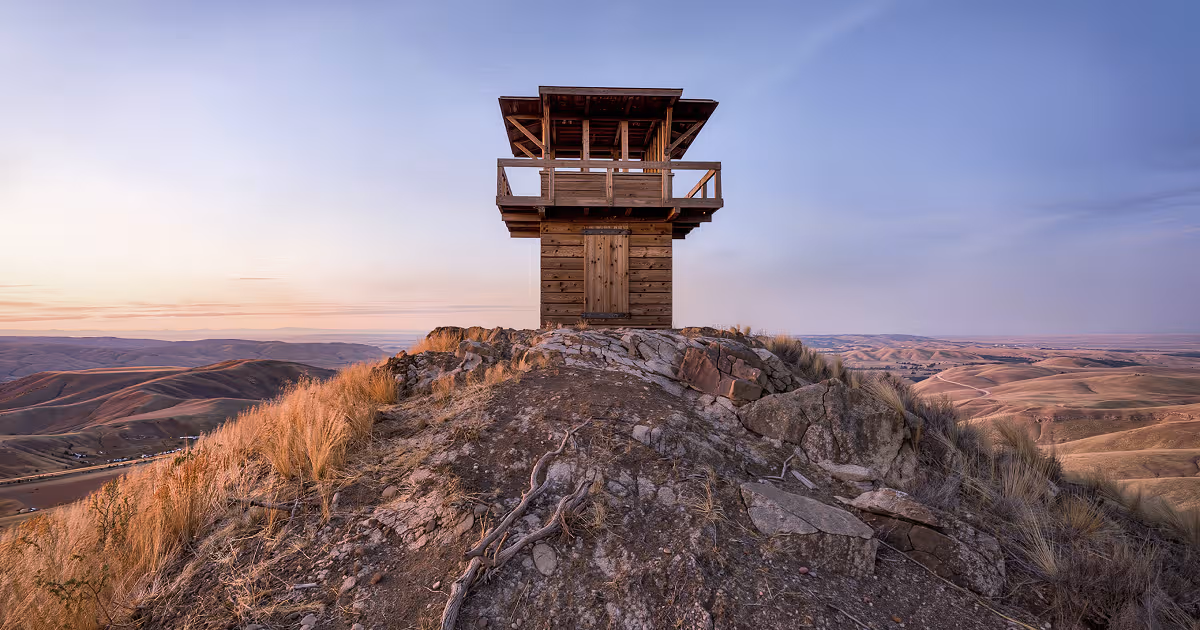
Fire lookout tower. Reservation ridge at dusk.
Illustration, not a period photograph.
Opening
Beginning in the early 1970s, forest fire lookouts stationed on Toppenish Ridge, within the roughly 2,800-square-mile Yakima Indian Reservation in south-central Washington, began logging a persistent pattern of unexplained nocturnal lights across the range they were already watching professionally for smoke. In August 1972, at the personal request of astronomer and Project Blue Book consultant J. Allen Hynek, independent researcher David W. Akers began a formal, sustained field study of the activity, working alongside Yakima Nation liaison Bill Vogel. The resulting multi-year "Toppenish Study" stands out from most UFO field investigations for one specific reason: its witnesses were, by profession, already trained to watch the sky for exactly the kind of anomaly they started reporting, and already knew the area's ordinary sources of light, aircraft, and other traffic well enough to say when something didn't fit.
Timeline
April 1972. Akers begins investigating unusual activity reported in the vicinity of the Yakima Indian Reservation, predating the formal study that would follow later that year.
August 1972. At Hynek's direct request, Akers undertakes a formal field study, later published as Report on the Investigation of Nocturnal Light Phenomena at Toppenish, Washington. Per Akers's own account, Hynek deliberately kept the original reports out of wide circulation at Akers's request, an unusual choice for a case receiving this level of scientific attention.
Same period. Akers adopts a specific methodological practice, omitting the names of individual reporters from the published record, a choice aimed at protecting witness privacy while still preserving the detailed content of each account for analysis.
Through 1972-1973. Reports accumulate steadily from fire lookout stations across the ridge, particularly the Satus Fire Lookout on the north side of Toppenish Ridge, which Akers's reports describe as a persistent focal point of activity. One lookout observer, specifically vetted by Akers and Vogel as personally known to them and familiar with both the area's genuine UFO-adjacent activity and its ordinary, mundane light sources, provides what Akers's report calls the most detailed daylight observation logged near that station to date.
19 February 1973, 7 p.m. A representative case from the study's compiled 1973 log: activity reported near Hembre Mountain, on Toppenish Ridge, observed from a position on Campbell Road, one of dozens of individually logged sightings Akers's report screens and classifies by evidentiary strength.
2 April 1973, 8:43 p.m. A separate case, this one from a ten-year-old boy in Toppenish itself, reporting a yellow, soccer-ball-sized light descending silently while he lay in bed, illustrating the range of witness ages and circumstances the study collected across its full run.
1974 and 1975. Akers publishes two follow-up reports summarizing continued developments and compiling statistics as the initial, most intensive phase of the field study concludes, though Akers's own account states the broader investigation effort continued in some form well beyond these formal published updates.
1995, retrospective publication. Akers releases the full set of Toppenish Study documents for public electronic distribution, noting in his foreword that both Vogel and Hynek had died in the intervening years, and dedicating the release to Vogel and others who had helped bring what he calls "the Yakima manifestation" to wider attention.
Geographic and institutional context, relevant to any assessment of the case. The Yakima Training Center, a large U.S. Army training installation, sits within the same general south-central Washington region, and military exercises involving illumination flares and other nighttime pyrotechnic activity are a documented, common source of misidentified nocturnal lights in comparable cases near other military ranges across the United States, though no specific, confirmed link between Yakima Training Center activity and any individual Toppenish Study sighting has been established in the available published record.
Key figures
Akers is the study's central investigator, a civilian researcher whose sustained, decades-spanning personal commitment to the project, still actively distributing and contextualizing the original documents more than two decades after the initial fieldwork, is itself a notable feature of the case's documentary history.
Hynek is the case's key scientific validator, whose direct personal request initiated the formal study and whose own later, cautious decision to limit the original reports' circulation suggests a scientist weighing the material's genuine interest against premature public sensationalism rather than either fully endorsing or dismissing it.
Vogel, as the Yakima Nation's own liaison to the study, is the figure most responsible for the project's on-the-ground community access and credibility, a detail worth noting given how much reservation land in the study area required special authorization to enter at all.
The fire lookout observers collectively represent the case's most distinctive evidentiary asset: professional, trained observers whose ordinary job already required distinguishing genuine anomalies from known local light sources, a witness pool with a built-in credibility advantage most UFO studies lack.
Physical and documentary trail
On the paper, this file has an unusually well-organized, multi-year, methodologically consistent documentary record: an original 1972 field report, a detailed 1973 compilation individually classifying dozens of specific sighting reports by evidentiary strength, two further follow-up summary reports, and a full later republication of the underlying materials for independent public review.
What it lacks is any photograph or physical trace evidence directly published and independently verified within the study's own materials as excerpted here, and no confirmed identification, positive or negative, tying the area's genuine, documented military training activity to any specific logged sighting.
The observer... qualifies as a "trained observer" for the purposes of this study project.
Competing explanations
Misidentified military training activity, given the documented proximity of the large Yakima Training Center and the well-established pattern, seen in numerous comparable cases nationally, of illumination flares and other nighttime exercises generating sustained local UFO reporting. This reading requires no anomalous phenomenon at all, though it has never been specifically confirmed or ruled out against the Toppenish Study's own logged cases in the available published record.
A genuine, still-unidentified recurring local nocturnal light phenomenon, akin in general character to other long-studied recurring-light sites such as Norway's Hessdalen valley, given the area's sustained, multi-year reporting pattern from a specifically trained and locally knowledgeable witness pool who continued distinguishing these sightings from ordinary local light sources over an extended period.
A combination of both: some proportion of the study's logged sightings reflecting genuine military or other conventional activity, and a smaller, harder-to-explain remainder resisting easy identification even by witnesses well-positioned to rule out the mundane candidates, consistent with Akers's own stated methodology of filtering out reports with "strong suggestions of a known cause" before classifying the rest as genuinely unexplained.
Later life of the case
The Toppenish Study remains a distinctive entry in UFO field research specifically because of its sustained, multi-year, methodologically consistent approach and its unusually credentialed witness pool, professional fire lookouts already trained to distinguish anomaly from routine. Akers's own decades-long personal stewardship of the material, culminating in his full 1995 public release specifically to preserve the record after his collaborators' deaths, gives this case a rare degree of documentary continuity for a UFO study of its era.
Finding
A sustained, multi-year pattern of nocturnal light reports from professionally trained fire lookout observers on the Yakima Indian Reservation drew direct, personal scientific interest from J. Allen Hynek and produced one of the more methodologically careful independent field studies in UFO research history. The area's genuine proximity to a large military training installation offers a plausible general category of mundane explanation, well-documented in comparable cases elsewhere, though no specific confirmed link to any individual logged Toppenish sighting has been established in the published record reviewed here.
What still will not resolve: a specific, case-by-case reconciliation between the Yakima Training Center's actual documented exercise schedule during the study period and the individual sightings Akers classified as genuinely unexplained, and any surviving physical or photographic evidence from the study beyond its extensive written witness record. Until that comparison is made, the Toppenish Study stands as a genuinely careful, sustained investigation that never fully closed its own case file either way.