RED BLUFF
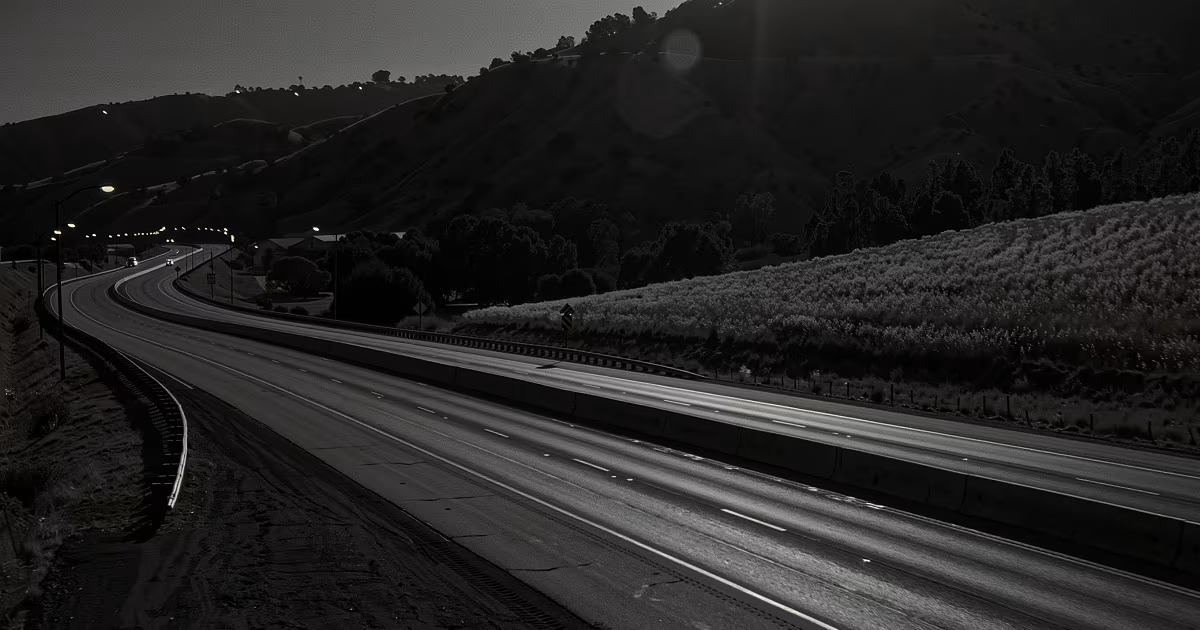
California highway 99 night. Empty field off the shoulder.
Illustration, not a period photograph.
Opening
Just before midnight on 13 August 1960, California Highway Patrol officers Charles A. Carson and Stanley E. Scott, searching for a speeding motorcyclist on Hoag Road east of Corning, California, saw what they first took to be a huge airliner falling from the sky directly ahead of them. They stopped, leapt out, and braced for a crash. Instead they found themselves watching, in complete silence, a large elliptical object ringed with lights reverse its descent, climb, and hover. Over the following two hours and fifteen minutes, the object and a second one that joined it maneuvered, swept the ground and sky with a projected red beam, and reportedly retreated the instant Scott aimed the patrol car's own red light at it. An Air Force radar operator confirmed tracking an unknown target that same night. By the next day, the Air Force was denying any such radar contact had occurred at all.
Timeline
13 August 1960, approximately 11:50 p.m. Carson and Scott, on routine patrol, spot the descending object and stop the patrol car, expecting an aircraft crash. Outside the vehicle, the first thing they notice, per Carson's own official teletype report, is "absolute silence."
Same night, moments later. Rather than crashing, the object reverses its descent at roughly 100 to 200 feet, climbs back to approximately 500 feet, and comes to a stop. Carson's report describes it as glowing, elliptical or oblong, with definite red lights at each end and as many as five white lights visible between them.
Same night, continuing. The object approaches to within roughly 450 feet, at one point close enough that Carson later describes it as "within easy pistol range," with both officers debating whether to draw their weapons before it stops. It begins sweeping the ground and sky with a red beam estimated at six feet in diameter, doing so six or seven times by Carson's count.
Same night. Scott switches on the patrol car's own red emergency light and points it at the object; the object immediately moves away. Static is separately noted appearing on the police radio during this general period.
Same night, continuing. The object begins moving slowly eastward; the officers follow in their patrol car, at times struggling to keep pace as its speed varies. They proceed to the Vina Plains fire station, from which they continue observing as a second, similar object approaches from the south and joins the first. Both hover together, periodically emitting the red beam, before finally disappearing below the eastern horizon.
Same night, total observed duration approximately two hours and fifteen minutes. The officers return to the Tehama County Sheriff's Office, where they learn that Deputies Fry and Montgomery, dispatched earlier after a radio alert, had independently traveled to Los Molinos and seen the same object clearly, describing its appearance and maneuvers in terms matching Carson and Scott's own account without having compared notes beforehand. The night jailer separately confirms observing the object as well.
Same night. A duty officer at the nearby Red Bluff Air Force Station radar facility confirms by phone that the unit is tracking an unidentified target moving in the manner the officers describe.
Following day. Carson and Scott drive to the Red Bluff Air Force Station to follow up in person and speak with the radar operator directly. They are told no such radar sighting was made, a direct reversal of what the duty officer had confirmed the night before, and their request to speak with the specific radarman on duty during the incident is denied. The station's commanding officer, Major Malden Leroy, personally denies the tracking the following day.
Following days. Reports of similar lights and objects continue from other witnesses in the area through 19 August.
Project Blue Book's initial explanation. The Air Force attributes the sighting to atmospheric refraction of the planet Mars and the stars Aldebaran and Betelgeuse. NICAP refers the claim to its own astronomical advisor, who determines that none of these three objects were actually positioned in the California night sky at the time in question, a specific, checkable factual error in the official explanation itself.
Following the astronomical challenge. Blue Book revises its explanation to instead cite Mars and the star Capella, a second attempt that itself does not appear to have been independently reconciled against the officers' detailed, close-range, two-hour observational account by any published follow-up analysis.
1968. Physicist James A. Harder presents the case, based on his own personal interview with one of the two principal witnesses and conversations with two other involved parties, to the U.S. House Committee on Science and Astronautics' symposium on UFOs, treating it as one of the more evidentially serious cases available for congressional review.
Same broader period. Atmospheric physicist James E. McDonald independently investigates and includes Red Bluff as a case study in his own analysis of what he considered ufology's most scientifically significant unresolved reports, specifically highlighting the Air Force's shifting and factually flawed celestial explanations as a point of concern.
Later documentary review. NICAP advisor Walter N. Webb obtains Carson's original report, his hand-drawn sketches of the object, and further correspondence directly from Carson, adding independently sourced primary material beyond the Blue Book file itself to the case's documentary record.
Key figures
Carson and Scott are the case's primary witnesses, two on-duty law enforcement officers whose detailed, technically specific teletype report, submitted the same night through their own chain of command, forms the case's core documentary record independent of any later UFO-research embellishment.
Fry, Montgomery, and the unnamed night jailer represent the case's crucial independent corroboration: law enforcement personnel who traveled to a separate vantage point after a radio alert and reported matching details without having compared accounts with Carson and Scott beforehand.
The unnamed Red Bluff radar duty officer and Major Leroy represent the case's central and most damaging institutional contradiction: one confirming the radar detection by phone the same night, the other flatly denying it the very next day, an internal Air Force inconsistency documented in the case's own contemporary record rather than alleged by outside critics.
Harder and McDonald are the case's most credentialed later scientific investigators, both treating it seriously enough for direct witness interviews and formal presentation to a congressional science committee, a level of institutional attention few UFO cases from this era received.
Physical and documentary trail
On the paper, this file has an unusually strong documentary foundation: Carson's own same-night official teletype report and hand-drawn sketches, at least four additional independent witness accounts from law enforcement personnel at a separate location, a documented and later contradicted radar confirmation, and two separate, both factually flawed, official Air Force explanations.
The specific, checkable failure of the first Blue Book explanation, citing celestial objects that were not actually visible in the sky that night, is a genuinely rare instance of an official UFO case explanation being directly falsifiable and shown to be wrong on its own specific terms, rather than merely disputed as unconvincing.
At this time it was clearly visible to both of us. It was surrounded by a glow making the round or oblong object visible.
Competing explanations
Atmospheric refraction of Mars and either Aldebaran/Betelgeuse or, in the revised version, Capella, per Project Blue Book's two successive official explanations. The first version is specifically and factually disproven by independent astronomical calculation showing none of the three cited objects were in the sky at the relevant time; the second version has not been independently reconciled in the available published record against the officers' detailed account of sustained, close-range, apparently controlled maneuvering, red-beam projection, and a second joining object.
A secret or experimental aircraft, conventional or otherwise, that the Air Force had genuine reason to deny and misdirect inquiry away from, which would account for the specific, documented radar confirmation-then-denial contradiction more directly than an honest misidentification would. This reading requires positing a deliberate cover story rather than simple institutional error, a stronger claim than the documented facts alone confirm, though the specific reversal is a real, dated event rather than speculation.
A genuine unconventional object, exactly as the two officers, their independent corroborating witnesses, and later credentialed scientific investigators like Harder and McDonald treated it. This reading is supported by the sheer number and independence of the corroborating witnesses and by the specific, demonstrated failure of the leading conventional explanation on its own factual terms.
Later life of the case
Red Bluff remains one of the most frequently cited "hard" cases in serious UFO literature specifically because its central weakness in the official record, the astronomically impossible first explanation, is not a matter of interpretation but a directly checkable factual error, giving critics of the Air Force's UFO investigation program a concrete, citable example rather than only general dissatisfaction. Its presentation to a congressional science committee in 1968 gave it an institutional profile few comparable cases achieved.
Finding
Two on-duty police officers, independently corroborated by at least three additional law enforcement witnesses at a separate location, documented a sustained, close-range encounter with a maneuvering, light-emitting object, initially confirmed by military radar the same night. The Air Force's first official explanation was directly and specifically disproven by independent astronomical calculation, and its revised second explanation has never been fully reconciled against the officers' detailed account in any published analysis.
What still will not resolve: any confirmed explanation, mundane or otherwise, accounting for the full documented sequence, sustained multi-witness observation, radar confirmation followed by official denial, and a demonstrated factual error in the case's own primary explanation. Until one emerges, Red Bluff stays one of the strongest multi-witness, radar-adjacent UFO cases on record, precisely because its official explanation is not merely unconvincing but independently shown to be wrong.