COLUMBUS AFB
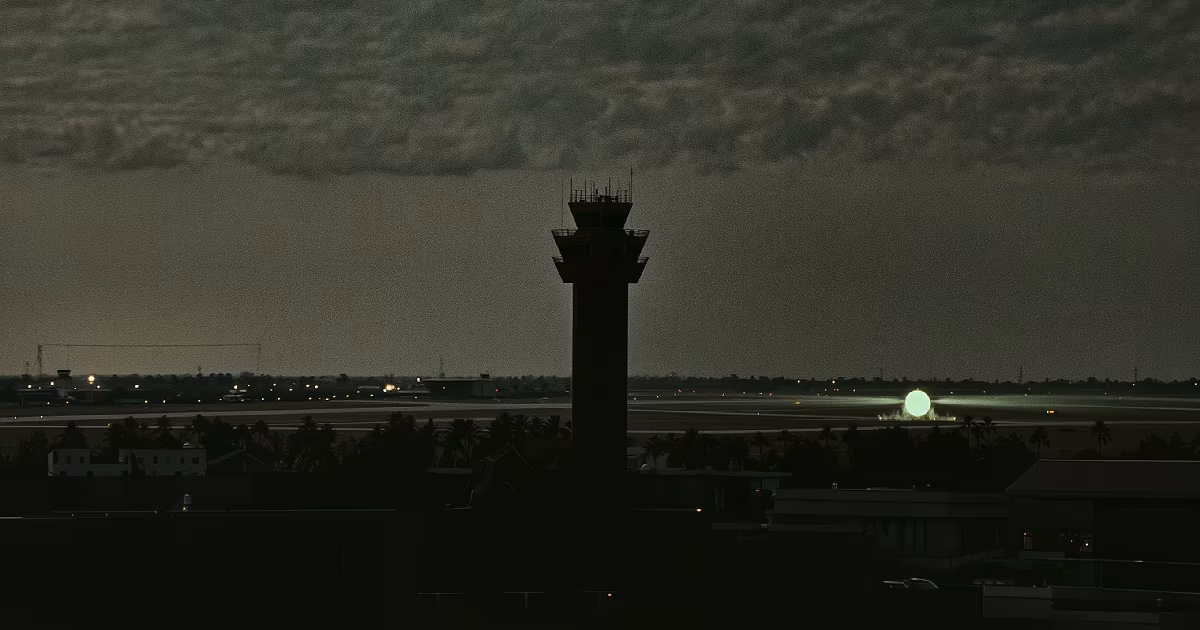
Mississippi training runway. T-38-scale, empty sky.
Illustration, not a period photograph.
Opening
At around 7 p.m. on 29 August 1942, two soldiers on duty in the air traffic control tower at the Army Air Corps flying school in Columbus, Mississippi, reportedly watched two red, glowing, round objects descend rapidly and maneuver with a speed and control neither man could account for, before the objects came to hover over woods at the end of the runway. What happened next is the detail that sets this case apart from an ordinary wartime light-in-the-sky report: both men later described a gap in their memory, finding themselves standing out in a field with no recollection of how they got there.
This is one of the earliest reported instances of what UFO literature would later formalize as "missing time," predating the term's popular currency by decades and predating the Betty and Barney Hill case, usually cited as the first widely known American abduction-adjacent account, by nineteen years. That alone makes it worth a serious look. It should also come with a clear note on how thin its documentary trail actually is.
Timeline
1941. The base itself is real and well documented outside any UFO context: the War Department approved an Army airfield for Columbus, Mississippi on 26 June 1941, construction began that September, and the first enlisted personnel arrived in January 1942.
February-March 1942. The installation is briefly named Kaye Field, then renamed Columbus Army Flying School in March 1942 to avoid confusion with the similarly named Key Field in Meridian, Mississippi. It trains twin-engine pilots for the rest of the war, graduating over seven thousand of them. It would not carry the name Columbus Air Force Base until a 1950 redesignation.
29 August 1942, approximately 7 p.m. The reported sighting occurs: two soldiers in the control tower observe the descent and hovering of two red round objects, followed by their own unexplained relocation to a nearby field.
No known date. No same-year newspaper account, official base incident report, or wartime intelligence file describing this event has been located in this search. The case exists in the historical record only through later secondary compilations.
Later 20th century. The incident is picked up and repeated in UFO history references, most notably Richard Hall's The UFO Evidence and his later catalog From Airships to Arnold, and Richard Dolan's UFO's and the National Security State, with Jerome Clark's journal The Anomalist also citing it back to NICAP's own files as the underlying source.
Key figures
The two soldiers are never named in any source located in this search, unusual for a case with this much circulation, and a meaningful gap given how central their personal testimony is to the "missing time" detail specifically.
Richard Hall, a longtime NICAP director and one of the more methodical compilers in mid-20th-century American ufology, is the earliest identifiable link in this case's documented chain, though NICAP's own file appears to be a compilation entry rather than a contemporaneous 1942 investigation, since NICAP itself was not founded until 1956.
Richard Dolan, a UFO historian who has written extensively on Cold War-era secrecy claims, includes the case in his chronology, treating it as one data point among many rather than a centerpiece case, consistent with how it is generally handled in the wider literature: mentioned, dated, sourced to the same handful of compilers, and rarely examined in isolation.
Physical and documentary trail
On the paper, this file is unusually light for how often it gets repeated. There is no contemporary 1942 newspaper clipping located in this search, a real gap given that other wartime and postwar UFO sightings from the same general region and era, including several 1950s Ohio and Kentucky cases, do survive in local press archives. There is no cited wartime base log, incident report, or military correspondence describing the event. There is no surviving named witness statement; the entire account rests on secondhand description passed through Hall's and Dolan's own compilations, which do not themselves cite an original document, only "NICAP" as a source, itself a later organization compiling earlier claims.
This does not mean the case is fabricated. Wartime sightings of unusual aerial phenomena, later folded into the broader "foo fighter" category reported by aircrews in multiple theaters during the war, were genuinely common and generally undocumented at the time, since neither side had a formal reporting channel for them in 1942, five years before Kenneth Arnold's sighting made "flying saucer" a household term and gave future witnesses a framework and a reason to file reports. The absence of a paper trail here is consistent with how the entire category of wartime sightings was handled, or rather not handled, at the time.
Competing explanations
A genuinely unexplained aerial phenomenon with an early instance of reported amnesia. This is the case as retold in UFO compilations, and its interest lies specifically in how early the "missing time" element appears relative to when that concept became a standard feature of later abduction narratives.
Ordinary wartime confusion, misidentified flares, aircraft lights, or ordnance testing, retold and embellished over decades of compilation. A flying school in wartime Mississippi would have had night flight operations, flare use, and training aircraft with red position lights on a routine basis, any of which could seed a mundane account that gained detail with each retelling.
Later editorial invention or compounding error in the compilation chain itself. Given that no source in this search traces back further than later 20th-century UFO-history compilers citing each other and an organization not founded until 1956, it remains possible some or all of the story's most striking detail, the missing time specifically, was added or sharpened at some point in that chain rather than present in whatever original account, if any, existed in 1942.
Later life of the case
This case has not, as far as this search located, been the subject of dedicated investigation, a book chapter, or a documentary in its own right. It survives almost entirely as a single dated entry repeated across UFO chronologies and "on this day" compilations, cited to the same small set of secondary sources each time.
Finding
The base is real, its 1942 history is solidly documented, and wartime aerial sightings without formal reporting channels genuinely went unrecorded at the time as a matter of course. What is not solid is any primary document for this specific event: no named witness, no contemporary press account, and no source older than later UFO-history compilations citing one another back to an organization founded fourteen years after the fact.
What still will not resolve: a contemporary 1942 record, or the two soldiers' names. Until one of those surfaces, this stays a case worth flagging for its unusually early "missing time" detail and worth treating with real caution about how much of that detail can be traced to 1942 rather than to however many retellings came after it.