ROBERT HASTINGS
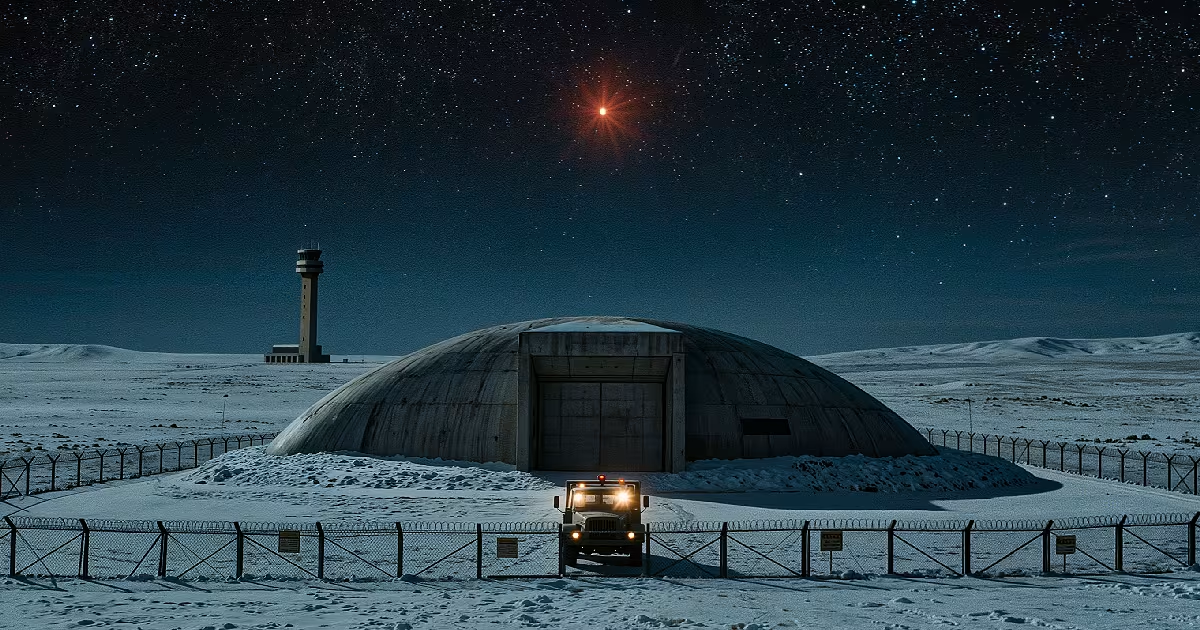
A red light hovers over a fenced missile site in the snow at night.
Illustration, not a photograph.
Opening
In March 1967, a 16-year-old Air Force kid working as a janitor in the control tower at Malmstrom Air Force Base, Montana, says he watched the radar operators track five unknown objects moving over the base's nuclear missile field. That teenager was Robert Hastings, and he spent the next fifty years finding the men who had been out there with the missiles. He interviewed more than 150 of them, and later more than 170: launch officers, security guards, radar operators and pilots who said that something had been showing a very specific interest in America's nuclear weapons. Long before the subject reached Congress, Hastings was making the case that UFOs and nukes go together.
Timeline
6 May 1950. Robert Lambert Hastings is born at Sandia Base in Albuquerque, New Mexico, where America's atomic weapons were engineered. His father is a career Air Force sergeant.
1966 to 1967. The family is stationed at Malmstrom Air Force Base in Great Falls, Montana, home to Minuteman nuclear missiles, during a period of intense UFO reports around the missile sites.
March 1967. Working as a janitor in the base's air traffic control tower, Hastings says he saw controllers tracking five unknown objects on radar near the missile silos. The same month, two flights of Minuteman missiles at Malmstrom, Echo Flight and Oscar Flight, went offline, in what became the Malmstrom incidents.
1972. He graduates in photography from Ohio University, then works as a photographic technician and later as a laboratory analyst in the semiconductor industry.
1981 onwards. He begins lecturing on the subject and over the following decades speaks at more than 500 colleges and universities across the US, as well as at Oxford University.
2008. He publishes UFOs and Nukes: Extraordinary Encounters at Nuclear Weapons Sites, built on his interviews with former military personnel.
27 September 2010. He organises a press conference at the National Press Club in Washington, where seven former Air Force officers and enlisted men, including Robert Salas and Charles Halt, describe UFO activity at nuclear sites on the record. CNN streams it live.
2016. His documentary UFOs and Nukes: The Secret Link Revealed is released.
2017. A revised and expanded second edition of the book is published.
2019. He co-authors Confession: Our Hidden Alien Encounters Revealed with Bob Jacobs, the former Air Force officer at the centre of the Big Sur missile-film case.
Key figures
Hastings himself is a researcher, not a former officer, and that has shaped his method: he goes looking for the people who were there and records their names and accounts. Many of his sources were speaking for the first time, decades later, after their security obligations had eased.
Among the best known of those witnesses:
- Robert Salas. A former Air Force missile launch officer who says the missiles in his capsule shut down at Malmstrom's Oscar Flight in March 1967 while guards reported a glowing red object over the site.
- Charles Halt. The deputy base commander at RAF Bentwaters during the 1980 Rendlesham Forest incident, whose memo about it is one of the most famous UFO documents in the world.
- Bob Jacobs. The Air Force officer who says a 1964 missile test film at Big Sur caught an object circling and hitting a dummy warhead.
On the paper
Hastings' main contribution is testimony: named, on the record, collected over decades from people who held real military jobs at real nuclear sites. He has also gathered released Air Force and government documents describing unidentified objects near weapons sites, such as reports from Loring and Wurtsmith Air Force Bases in October 1975 of unknown craft hovering over nuclear weapons storage areas, which the Air Force's own message traffic took seriously.
What his work does not have is physical evidence or a document that explains what the objects were. Much of it rests on memories recorded long after the events.
Competing explanations
A real pattern. Hastings argues that the sheer number of independent military witnesses, across different bases and decades, shows a genuine and continuing interest in nuclear weapons by something unknown. That idea has since gained ground: it appears in the 1952 Ruppelt briefing in the PURSUE files, in the VASCO team's nuclear-test findings, and in the testimony given to Congress since 2023.
Memory and retelling. Critics argue that decades-old recollections are unreliable and can merge separate events. Researcher James Carlson, whose father was an Echo Flight commander at Malmstrom, has argued that the Echo Flight shutdown had an ordinary technical cause and that later accounts mixed it up with UFO stories. Sceptical writer Benjamin Radford has called Hastings' material "a rehashing of old, discredited reports."
Somewhere between. Some cases have documents behind them and some rest on a single memory. Weighing them one at a time, rather than all or nothing, is the fair way to read the body of work.
Later life of the case
For most of his career, the nuclear connection was a fringe idea. It is now one of the central threads of the modern UAP story, discussed in congressional hearings and official releases. Hastings' interviews, gathered when few others were asking, form one of the largest bodies of military testimony on the subject.
Finding
bot313's view is that Robert Hastings did something the field badly needed: he found the witnesses, put their names on the record, and kept at it for half a century. Not every account will stand up equally, and he has fair critics on specific cases, but the pattern he documented, unknown objects turning up again and again near nuclear weapons, is now taken seriously by people who once dismissed it.
What still will not resolve: why nuclear sites. If the government ever releases the full records behind the incidents his witnesses describe, Hastings' fifty years of interviews will be the first thing people check them against.