SAO VICENTE
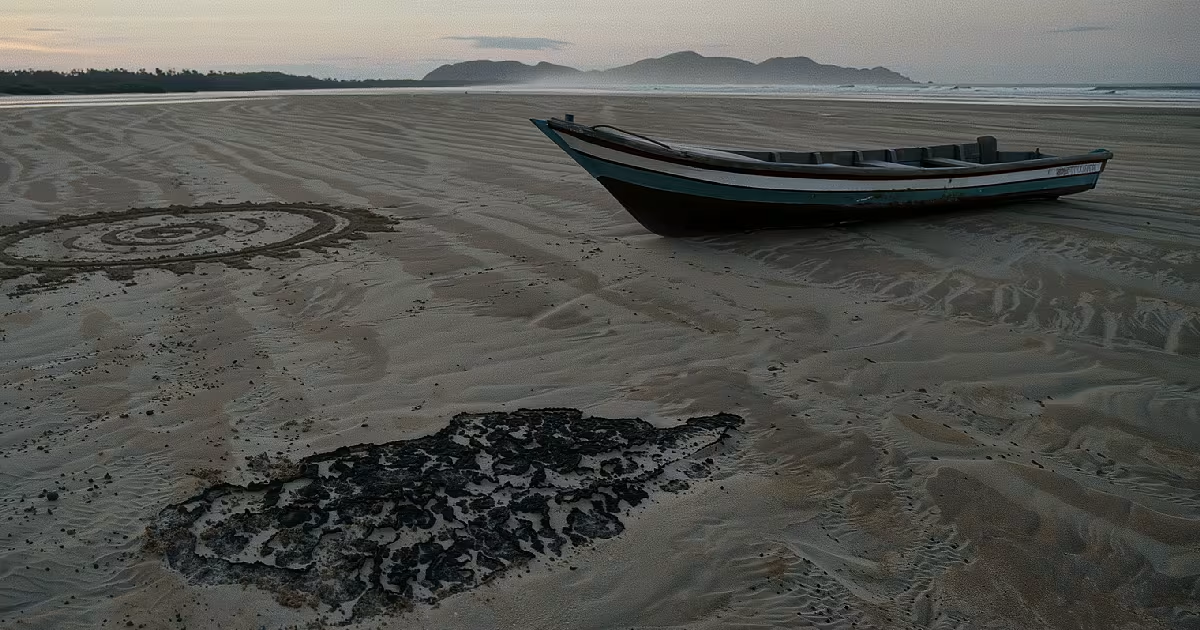
Shoreline off Sao Vicente. Low swell on an empty horizon.
Illustration, not a period photograph.
Opening
On 1 October 1995, two fishermen, named in later accounts as Fernando Beserra and Wilson da Silva Oliveira, were gathering nets on a small island called Ilha do Major off the São Paulo coast, in the general area near São Vicente in Brazil's Baixada Santista region, when they reported a bright yellow, disc-shaped object approaching overhead. Believing at first it was a balloon, they fled by boat as the object descended and appeared to land a short distance away. What survives of this case afterward is not the sighting itself but a set of physical traces: flattened grass in a circular pattern, a notch or depression in the soil, and a claimed follow-up test in which seeds planted in soil from inside the circle germinated normally while seeds from soil taken outside it failed and were attacked by fungus.
This file needs an unusual amount of front-loaded caution. Every account of it located in this search traces to the same recirculated English-language tabloid write-up, which does not name an investigating organization, a lab, or a researcher behind the seed test it describes in some detail. No Portuguese-language source, Brazilian ufology society file, or contemporary 1995 press account has been located independently.
Timeline
1 October 1995. The reported sighting and landing occur at Ilha do Major.
Date unknown. Photographs described as showing the aftermath, flattened circular vegetation and a soil notch, and a seed-germination comparison test are referenced in later reporting, with no date given for when either the photographs or the test were produced relative to the sighting itself.
Date unknown, before recent republication. The case circulates in UFO-interest media; the version located in this search is a 2025 English-language tabloid piece describing the photographs as newly surfaced, itself citing unspecified "UK media outlets" as its own source rather than a primary Brazilian one.
Key figures
Beserra and Oliveira are named as the witnesses in every version of this story located, but no independent confirmation of their identities, a follow-up interview, or a formal statement taken by any investigating body has been found.
No named investigator, laboratory, or Brazilian ufology organization is credited anywhere in this search with conducting the soil analysis, the landing-gear weight estimate, or the seed-germination comparison, all of which are stated as findings without attribution. This is a meaningful gap: comparable Brazilian cases from the same general era and region, including the well-documented Ubatuba magnesium-fragment case and the Trindade Island photographs, carry named investigators, named laboratories, or an identifiable ufology society attached to the physical evidence. This case does not.
Physical and documentary trail
On the paper, this file has photographs described as showing flattened vegetation in a circular pattern and a notch in the soil, and a claimed comparative planting test. Photographs of ground traces are not, on their own, uncommon or difficult to produce by mundane means, vehicle parking, equipment staging, or natural vegetation die-off patterns have all produced similar circular marks in other cases eventually explained without any anomalous cause.
The germination claim is the file's most specific piece of evidence and also its least sourced: no methodology, sample size, control conditions, or named party conducting the comparison is given in any account located here. A claim this specific normally comes with a named agronomist, lab, or at minimum a ufology bulletin publishing the numbers; none of that has surfaced in this search.
There is no radar data, no second witness beyond the two fishermen, and no contemporary 1995 newspaper account in Portuguese or English located in this pass.
Competing explanations
A genuine landing trace case with unusual soil chemistry effects. This is the reading implied by the germination claim, and it would be a meaningful data point if the underlying test could be traced to a named, credentialed source. As presented, it cannot be evaluated on its merits because its methodology is not available.
A mundane light or object misidentified, with unrelated or coincidental ground marks later connected to the sighting. Circular flattened vegetation has many ordinary causes, and nothing in the located sourcing rules out the marks and the sighting being separate events retroactively linked in the retelling.
An embellished or partly invented story circulating through tabloid republication rather than Brazilian ufology channels. The absence of any Portuguese-language primary source for a Brazilian case, unusual on its own, combined with the specific but unattributed seed-test detail, is consistent with a story that gained precision through retelling rather than through documented investigation.
Later life of the case
This case does not appear in the major English-language UFO sighting lists for Brazil alongside better-known cases from the same decades, and this search located no Brazilian ufology bulletin, book, or society file discussing it. Its visible life is limited to periodic tabloid republication of the same photographs and claims.
Finding
Two named fishermen, a described sighting, and photographs of ground traces exist in circulation. The case's most specific and most interesting claim, the differential seed germination, has no traceable source, methodology, or named investigator behind it in anything located here, which is unusual for a Brazilian landing-trace case and should weigh heavily against treating this as comparable to the country's better-documented incidents.
What still will not resolve: a primary Portuguese-language source, a named investigator or laboratory for the soil and seed claims, and independent confirmation of the witnesses' account. Until one of those surfaces, this file stays closer to a recirculated tabloid item than a documented case.