KINGMAN
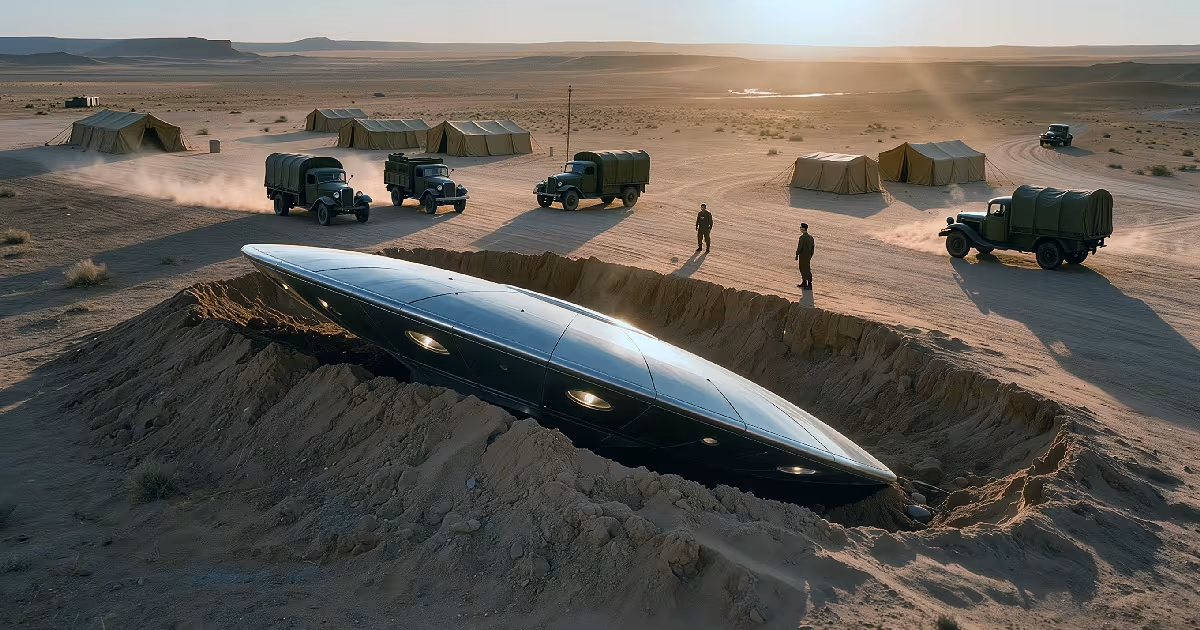
Arizona desert wash at night. Floodlights, empty sand.
Illustration, not a period photograph.
Opening
On 21 May 1953, according to a signed statement he gave twenty years later, an Air Force engineer working at the Nevada atomic test site was pulled off his job, flown to Phoenix, and put on a bus with blacked-out windows. Hours later he stepped out into a desert wash near Kingman, Arizona, under floodlights and armed guard. In the sand lay a metal disc about 30 feet across, dull silver like brushed aluminium, driven 20 inches into the ground at speed and still without a dent. Nearby, in a tent, was the body of its pilot: about four feet tall, dark brown skin, in a silver suit. He was told to calculate how fast it had been going when it hit, and never to talk about it.
His name was Arthur Stansel. For years he told the story only under a false name, Fritz Werner. There is no second witness who holds up, and no official document. There is a man whose job, location, and clearance that month can be checked, and two lines in his own pocket calendar written that same week.
Timeline
17 March to 4 June 1953. The Atomic Energy Commission runs Operation Upshot-Knothole, eleven nuclear test shots at the Nevada Test Site. Stansel, a mechanical engineer with the Air Materiel Command at Wright-Patterson Air Force Base, is on loan to the project.
19 May 1953. Shot Harry, a 32-kiloton tower test, produces the heaviest fallout of the series.
20 May 1953. Stansel writes in his calendar: "Got funny call from Dr. Doll at 1000. I'm to go on a special job tomorrow." Dr Ed Doll was a real senior scientist on the test programme.
21 May 1953. Calendar entry: "Got picked up at Indian Springs AFB at 4:30 p.m. for a job I can't talk about." Indian Springs was the air base serving the test site. In his later account, he and other specialists are flown to Phoenix and bussed, windows blacked out, for about four hours. They're told not to speak to one another.
That night. At a site he placed in the Hualapai Mountains area near Kingman, he examines the object: two convex plates joined at the rim, an open hatch, two swivel seats inside, no rivets or visible joins. He measures how deep it's buried and estimates an impact speed of about 100 knots. He glimpses the body in a tent under guard.
The next day. The group is taken back the way it came and sworn to secrecy.
25 May 1953. Four days later, the test series fires Shot Grable from the M65 atomic cannon, watched by senior military officers. Whatever happened near Kingman fell between two of the most closely watched events of the year.
6 June 1973. Stansel signs an affidavit, as "Fritz Werner," for UFO investigator Raymond Fowler.
1976. The affidavit is published in a UFO magazine. The Kingman crash joins the crash-retrieval canon.
1978 onward. Researcher Leonard Stringfield collects second-hand accounts that seem to fit: an officer said to have examined a 25 to 30 foot metallic craft in spring 1953, and an office worker at Wright-Patterson who said a sergeant told her he had flown in bodies from a crash in the South-West, and was warned to stay silent under threat of a heavy fine and prison.
1981. Fowler reprints the account in Casebook of a UFO Investigator.
1980s and after. A woman, Judie Woolcott, says a 1965 letter from a soldier in Vietnam described watching a crashed saucer at Kingman on radar in 1953. The letter is never produced, and the soldier's identity shifts in later tellings.
2024 to 2025. Former Deputy Assistant Secretary of Defense Christopher Mellon makes public a redacted email in which an unnamed person writes of "the recovered UAP that landed in Kingman, Arizona in the 50s." The email names no source and offers no documents.
Key figures
Arthur Stansel is the whole case. His background is real: an Ohio University graduate in mathematics, physics, and engineering, an Air Materiel Command engineer at Wright-Patterson, and a specialist at the Nevada test site in spring 1953. Colleagues described him as a trustworthy engineer. He signed his statement under oath, if under a false name.
Dr Ed Doll, the scientist named in Stansel's calendar, was real. When later asked, he said he knew nothing about a crash.
Raymond Fowler, one of the most careful UFO investigators of his generation, took the affidavit and checked Stansel's background. His employment and posting matched.
Leonard Stringfield gathered the second-hand accounts that appeared to back Stansel up.
Kevin Randle, a UFO historian who has spent decades on crash claims, re-examined the case and concluded it wasn't supported. He found that Stansel described the object differently to different people, a 12-foot teardrop to one and a 30-foot disc to another, and that Stansel later admitted exaggerating after drinks.
Physical and documentary trail
On the paper: the 1973 affidavit, Fowler's background checks, the Upshot-Knothole records, and Stansel's calendar entries for 20 and 21 May 1953. The calendar is the strongest single item in the case. It was written at the time, it names a real scientist, and it records a classified job starting on the exact day of the story.
What isn't on the paper: any military or government record of a recovery, any second verified first-hand witness, and any local press report. Kingman's local paper and papers as far away as Las Vegas carried nothing about a crash that week. Project Blue Book staff of the period didn't recognise Stansel's name.
Got picked up at Indian Springs AFB at 4:30 p.m. for a job I can't talk about.
Competing explanations
A real recovery. The case for it is stronger than for most crash stories. The witness can be placed in the right job, at the right site, in the right week, and his own calendar shows a sudden classified job starting that day. A recovery run from the Nevada Test Site in the middle of an atomic test series would come with exactly the security he describes: specialists pulled from other work, blacked-out transport, and an order never to speak. An organisation keeping atomic test data secret could keep one desert wash quiet, and no press coverage is what a successful cover-up would look like.
A real classified job, remembered as something else. The calendar shows a secret assignment. It doesn't say what it was. The spring of 1953 was full of classified activity around Nevada, and Stansel may have been sent to a crashed experimental aircraft, drone, or test vehicle, and the story grew over twenty years. This explains the calendar and the security, though not the body as he described it.
An embellished story. Stansel may have built a dramatic tale on top of a real, dull assignment. His changing descriptions of the object, his own admission of exaggerating, and the collapse of the later supporting witnesses point this way.
Later life of the case
Kingman sits second only to Roswell in American crash-retrieval lore. Later claims tie the recovered craft to reverse-engineering programmes and to Area 51, and the Mellon email put it back in the news in the era of congressional hearings on recovered craft. None of the later additions has produced a document or a first-hand witness.
Finding
This is the strongest single-witness crash story I've come across. The man was real, he was where he said he was, doing the kind of work he described, and his own calendar shows a classified job starting on the exact day. If a crash retrieval happened in 1953, it would look a lot like this from the inside. But no one else reliable saw it, no official paper records it, and the witness described the object differently to different people.
What still will not resolve: where Dr Doll's "special job" sent Arthur Stansel on 21 May 1953. That answer, if it survives, is in the Nevada Test Site's records, not the desert.