LEONARD STRINGFIELD
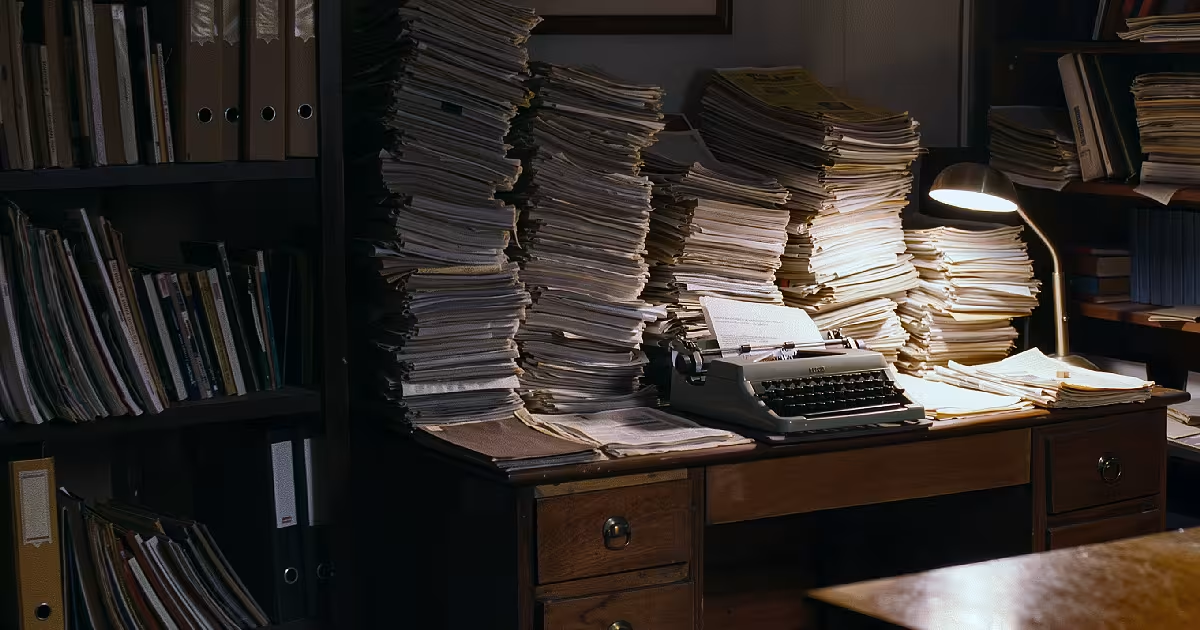
A typewriter on a desk buried in stacked newsletters and papers.
Illustration, not a photograph.

Opening
Leonard H. Stringfield was a Cincinnati public relations executive who spent four decades on UFOs in his spare time. In the 1950s he ran a civilian research group, CRIFO, and its newsletter ORBIT. In the 1970s he wrote Situation Red: The UFO Siege. From 1978 until his death in December 1994 he collected and published accounts of alleged crashed-saucer retrievals, in a series he called Status Reports.
Those reports are his main legacy. They gathered dozens of second- and third-hand accounts from military and civilian sources, mostly anonymous, at a time when almost nobody else would take the subject on. They are also the hardest part of his work to check, because the anonymity that brought the witnesses forward is what keeps the accounts from being tested.
Timeline
1920Stringfield is born. He lives most of his life in the Cincinnati area.
28 August 1945Serving with a Fifth Air Force intelligence team sent to occupy Atsugi airfield near Tokyo, he is a passenger in a C-46 transport between Ie Shima and Iwo Jima when an engine falters. He says he saw three bright white lights pacing the aircraft through cloud, and that the engine recovered when they left. He later counted this as the start of his interest. He is the only known witness to the lights.
1950He joins DuBois Chemicals in Cincinnati, later a division of Chemed Corporation, where he spends his career in public relations.
1953 to 1957He runs CRIFO, Civilian Research, Interplanetary Flying Objects, and publishes ORBIT. During this period he says he worked with the Air Defense Command's Ground Observer Corps, passing on sightings by telephone under a code name. The arrangement is described in his own writing and has not been confirmed from a military record.
1957He self-publishes Inside Saucer Post... 3-0 Blue, winds down CRIFO, and becomes public relations adviser to NICAP under Donald Keyhoe, a friend since 1953.
1967 to 1969He serves as an "early warning coordinator" for the University of Colorado UFO study under Edward Condon, passing on fresh reports from his area.
1977Situation Red: The UFO Siege is published by Fawcett Crest. It touches on the crash-retrieval rumours that would take over his later work.
July 1978He presents "Retrievals of the Third Kind" at the ninth annual MUFON symposium in Dayton, Ohio. It is later counted as Status Report I. The same year he acts as UFO research adviser to Sir Eric Gairy, prime minister of Grenada, who was pressing the United Nations to set up a UFO agency.
1980 to 1994Six more Status Reports follow: The UFO Crash/Retrieval Syndrome (1980), Amassing the Evidence (1982), The Fatal Encounter at Ft. Dix-McGuire (1985), Is the Cover-Up Lid Lifting? (1989), The Inner Sanctum (1991) and Search for Proof in a Hall of Mirrors (1994).
1981He retires from DuBois after 31 years, as director of public relations and marketing services.
18 December 1994He dies of lung cancer after a long illness.
Key figures
Donald Keyhoe was his friend and ally, and NICAP gave him a national role. J. Allen Hynek's Center for UFO Studies and the Mutual UFO Network both used him as an investigator and adviser, and MUFON gave him the platform for the 1978 paper. Sir Eric Gairy gave him a brief diplomatic sideline. The most important figures in his work are people he did not name: the soldiers, nurses, pilots and officers who told him about bodies and wreckage on condition of anonymity.
Physical and documentary trail
ORBIT, his books and the seven Status Reports are the record, and they are dated. They are honest about their own limits: Stringfield usually said when a source was second-hand, when he could not verify a detail, and when a witness refused to be named. What they do not contain is a government document, a photograph or a recovered object that supports any specific retrieval. His correspondence would be the place to look for the identities behind the accounts, and I have not found a public archive of it.
Things you might not know
- His interest started in a failing aircraft. The August 1945 C-46 incident near Iwo Jima is the story he told most often about how he began.
- He was a PR man by trade. He spent 31 years at DuBois Chemicals and retired in 1981.
- He advised a head of government. In 1978 he advised Grenada's prime minister, Sir Eric Gairy, who raised UFOs at the United Nations.
- He worked for the Condon study. The project that ended Blue Book used him as an early warning coordinator.
- He gave the crash-retrieval subject its name and shape. "Retrievals of the Third Kind" set out the template that later writers on Roswell and other alleged crashes followed.
Competing explanations
A careful collector of real testimony. Stringfield gathered accounts he could not test and said so plainly. On this reading the Status Reports are a valuable record of what servicemen and others reported, collected at a time when many of them were still alive, and their anonymity is a cost of getting them at all.
A collector whose sources fed on each other. Once Stringfield became known as the man to tell, he received stories from people who had read his earlier reports. A catalogue built that way can grow by repetition, and accounts can borrow detail from one another without anyone intending it.
A mix of both. Some accounts may describe real events misunderstood, such as the recovery of classified aircraft or balloon equipment, while others are rumour. Without names, the reports cannot sort one from the other.
Later life of the case
The crash-retrieval stories Stringfield collected now sit behind a large part of the UFO literature, and the subject reached Congress in 2023 when a former intelligence officer testified about alleged retrieval programmes. Stringfield's reports are where many of those stories first appear in print. Few of them have been traced to a named witness since.
Finding
Stringfield's real contribution is the record he kept. He collected crash-retrieval accounts that no one else was gathering, he was open about how thin some of them were, and his reports remain the best map of that material. None of the specific retrievals he described has been confirmed by a document, a photograph or an object. The best reading is a careful collector whose reports are more useful as a catalogue of claims than as proof of events.
What still will not resolve: who his anonymous sources were, and whether any of their accounts can be matched to a service record, a hospital log or a unit history.
You decide · LEONARD STRINGFIELD
What do you think happened?
One vote per case, anonymous. You'll see how other readers voted once you've voted.