STANTON FRIEDMAN
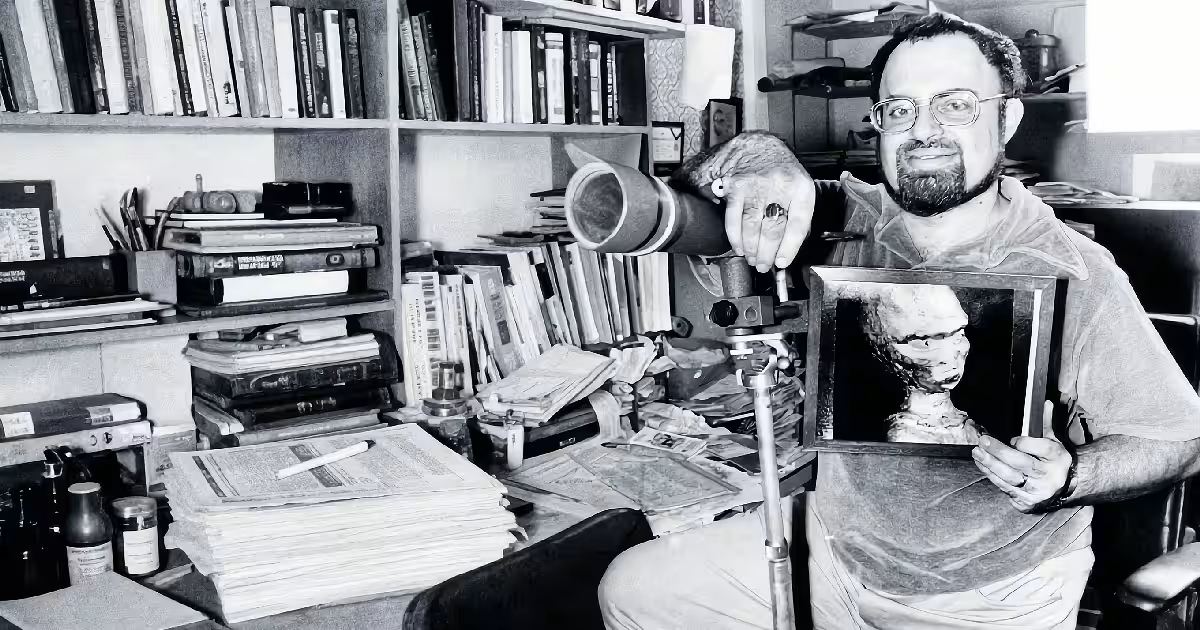
Stanton Friedman at his desk, holding up a photo of an alien head.
An old photograph, photographer unknown, expanded at the edges.

Opening
Stanton T. Friedman spent fourteen years as a nuclear physicist in American industry, working on nuclear aircraft engines, fission and fusion rockets and compact reactors for space. Then he spent five decades as the most persistent public voice for one idea: that some UFOs are extraterrestrial spacecraft and that the US government has known it since the 1940s.
He is the man who found Jesse Marcel in 1978 and brought Roswell back from thirty years of silence. He also helped launch the Majestic 12 documents, defended the Betty Hill star map, and lectured at more than 600 colleges. He died in 2019, in an airport, on his way home from a talk.
Timeline
29 July 1934Stanton Terry Friedman is born in Elizabeth, New Jersey. He grows up in nearby Linden.
1955 and 1956After starting at Rutgers, he earns a BS and then an MS in physics at the University of Chicago, where Carl Sagan is a fellow student.
1956 to 1970He works as a nuclear physicist for General Electric, General Motors, Westinghouse, TRW, Aerojet General Nucleonics and McDonnell Douglas.
1958By his own account, he becomes interested in UFOs.
1967He begins lecturing on the subject.
29 July 1968He submits a statement to the House Committee on Science and Astronautics for its symposium on UFOs.
1970He leaves full-time physics to lecture.
December 1974In Astronomy magazine he defends Marjorie Fish's reading of the star map Betty Hill drew after the Hill abduction as pointing to Zeta Reticuli.
20 February 1978In Baton Rouge for a lecture, he is told by a television station director that Jesse Marcel, a retired officer living in Houma, Louisiana, says he once handled pieces of a flying saucer. Friedman calls him from the airport. By Friedman's account, Marcel describes the debris but cannot remember the year.
1980The Roswell Incident, by Charles Berlitz and William Moore, is published, drawing on research by Moore and Friedman.
Early 1980sHe moves to Fredericton, New Brunswick, his wife Marilyn's hometown.
December 1984TV producer Jaime Shandera receives a roll of film with the MJ-12 briefing papers. Friedman works on them with Moore and Shandera.
1992Crash at Corona, written with Don Berliner, argues for a second crash site on the Plains of San Agustin.
1996Top Secret/MAJIC sets out his defence of the MJ-12 papers.
2007Captured! The Betty and Barney Hill UFO Experience, written with Betty Hill's niece Kathleen Marden, is published. Fredericton declares a Stanton Friedman Day.
13 May 2019He dies at Toronto Pearson International Airport, returning from a speaking engagement in Columbus, Ohio. He was 84.
Key figures
Jesse Marcel was Friedman's most important witness. William Moore was his research partner on Roswell and MJ-12, and Jaime Shandera received the MJ-12 film. Don Berliner co-wrote Crash at Corona, and Kathleen Marden co-wrote three books with him, including the Hill book. His most famous opponent was the aviation journalist Philip Klass. The Harvard psychiatrist John Mack came at the same subject from the opposite direction, through experiencers rather than documents.
Physical and documentary trail
Friedman's work is unusually well documented by himself: his books, his 1968 congressional statement, decades of recorded lectures, and his records, now at the Provincial Archives of New Brunswick. The key Roswell moment is less solid. The first Marcel call was made from an airport telephone, was not recorded, and is known only from Friedman's account.
I have never seen a flying saucer, and I have never seen an alien. But remember, I chased neutrons and gamma rays for a lot of years as a physicist, and never saw one of them either.
Things you might not know
- He won money from Philip Klass. Klass bet that a detail of one MJ-12 paper's typing would not turn up in genuine government documents of the period. Friedman sent him examples, and Klass paid him $1,000.
- He studied alongside Carl Sagan. Two University of Chicago physics students of the 1950s ended up on opposite sides of the UFO argument.
- He never saw a UFO. He said so often, and compared it to never having seen Tokyo.
- A city gave him a day. Fredericton declared Stanton Friedman Day in 2007.
- He separated UFOs from flying saucers. He liked to say that very few unidentified flying objects are flying saucers, and that the flying saucers were the part that interested him.
Competing explanations
To his admirers, Friedman was a working scientist who did his homework, read the documents, found the witnesses and refused to be laughed off. His co-author Kathleen Marden said he "was the original civilian investigator of the Roswell crash." To his critics, he was a skilled advocate who started from the conclusion. They point to MJ-12, which the FBI called completely bogus and which many researchers, including some who believe Roswell was a crash, consider forged, and to the way Marcel's story expanded after 1978. Friedman's reply was that his opponents had not done the research, and he never stopped asking them to.
Later life of the case
Roswell, which was barely remembered in 1977, is now the best-known UFO case in the world, and Friedman's 1978 call is where that begins. The MJ-12 papers and the Fish reading of the Hill star map are both still argued over.
Finding
Stanton Friedman changed the history of the subject more than almost anyone. Without him there might be no Roswell story as the world knows it. His central achievement, finding and publicising Marcel, is solid. His strongest commitment, the authenticity of MJ-12, is the part of his work that has held up least well.
What still will not resolve: what Marcel actually told him on that first unrecorded call in February 1978, before anyone else had shaped the story.
You decide · STANTON FRIEDMAN
What do you think happened?
One vote per case, anonymous. You'll see how other readers voted once you've voted.