ROSWELL 1947
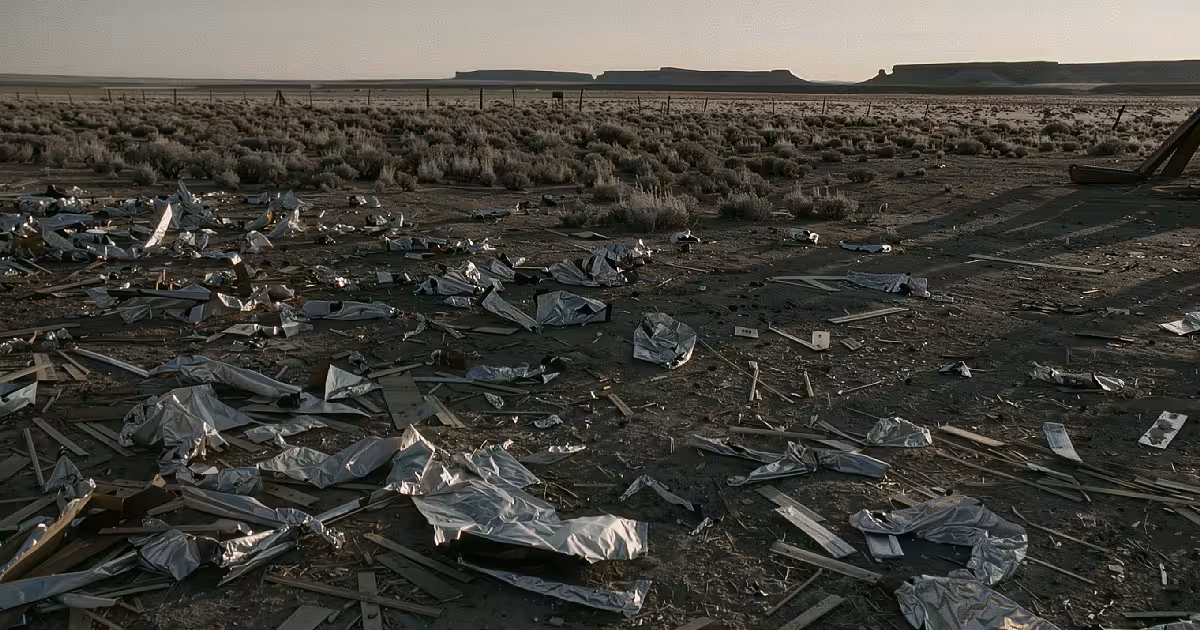
Roswell debris field. July 1947.
Illustration, not a period photograph.
Opening
In the first week of July 1947, a ranch hand named William Ware “Mac” Brazel brought boxes of wreckage into Roswell, New Mexico, and left them with Sheriff George Wilcox. The debris had been lying on the Foster Ranch near Corona, in Lincoln County, about seventy-five miles northwest of town. It was not a Roswell street find. It was a pasture find that the 509th Bomb Group then put on the wire as a flying disc.
The 509th was not a weather detachment. It was the only atomic bomb group in the world. Its intelligence officer, Maj. Jesse A. Marcel, went out to the ranch with a Counter Intelligence Corps man, Capt. Sheridan Cavitt. On the morning of 8 July the base public information officer, 1st Lt. Walter Haut, handed local desks a short statement: the intelligence office of the 509th had “gain[ed] possession of a disc.” By that afternoon Brig. Gen. Roger Ramey, at Fort Worth Army Air Field, was showing reporters balloon rubber and a radar target and calling the morning paper a mistake.
That same-day rewrite is the spine of the file. Everything after it is argument about whether the Fort Worth floor was the ranch, or a stand-in.
Timeline
Mid-June 1947. Brazel later told the Roswell Daily Record he rode through a field of wreckage after a night storm. He described a large area of bright wreckage: rubber strips, tinfoil, paper, sticks, and tape. He did not drive to town that week. He had work, and he had no telephone.
Early July. Kenneth Arnold’s 24 June sighting over the Cascades is already on national wires. “Flying disc” is ordinary language in New Mexico by the holiday weekend. Brazel hears the talk in Corona, compares it to what is still on his pasture, and decides the sheriff should see a sample.
6-7 July. Brazel reaches Roswell with boxes. Wilcox calls the base. Marcel and Cavitt go to the ranch. They walk a debris field that, in later tellings, runs hundreds of yards. They load a vehicle. Marcel stops at his house on the way in and shows a handful of pieces to his wife and to his son, Jesse Jr.
8 July, morning. Wreckage is on the base. Col. William H. Blanchard, commanding the 509th, authorizes a press statement. Haut takes it into town. KGFL and the other local desks get it first. By noon the Associated Press has it. The afternoon Roswell Daily Record prints the line that still carries the case: “RAAF Captures Flying Saucer On Ranch in Roswell Region.”
8 July, afternoon. Marcel flies material to Fort Worth. In Ramey’s office, photographer J. Bond Johnson of the Fort Worth Star-Telegram makes pictures of Ramey, of Col. Thomas J. DuBose, and of Marcel with debris spread on the carpet. Warrant Officer Irving Newton, a weather officer pulled off a forecast desk, identifies a RAWIN radar target and balloon remnants. Ramey tells the press that is what the 509th recovered.
9 July. The Roswell Daily Record runs the walk-back: “Gen. Ramey Empties Roswell Saucer.” The same edition prints an interview with Brazel. He now describes rubber, foil, sticks, and tape with flower patterns. He says he is sure what he found is not a weather balloon of the ordinary kind he has seen, and also that he wants the noise to stop. After that the national desk moves on.
Key figures
Brazel is the first handler. He is a working rancher, not a base officer. His 9 July interview is the only long statement he gives on paper in 1947. Later friends and neighbors add more color. The 1947 Brazel is shorter and more tired than the 1980s Brazel.
Wilcox is the civilian hinge. Without the sheriff’s call, Marcel does not roll. Wilcox’s family later said he was warned to keep quiet. That is family memory, not a 1947 memo.
Marcel is the officer who both recovers and poses. In 1947 he is the named intelligence source behind Haut’s release. In 1978 he tells Stanton Friedman and then television that the Fort Worth debris is not what he boxed on the ranch. He describes I-beam-like members with purple-pink symbols, foil that would not stay creased, and weight that did not match the bulk. His son repeats the symbol memory from the kitchen table on the night of the 7th.
Cavitt is the other man on the pasture. When the Air Force reaches him in 1994 he describes bamboo-like sticks and foil and calls it a balloon. He does not back Marcel’s later materials list.
Haut writes the release on Blanchard’s authority. He is a first lieutenant with a public information job, not an intelligence analyst. In a signed affidavit released after his death he claimed a later viewing of a craft and bodies. That affidavit is 2002 testimony about 1947. It is not a 1947 document.
Blanchard signs off on the disc language, then goes on leave. Ramey owns the afternoon story. Newton owns the weather identification in the photographs. DuBose, decades later, said the display in the office was substituted material. Other men in that room did not.
Physical and documentary trail
On the paper, 1947 gives you four hard objects.
One: Haut’s release. The full short text says the 509th “was fortunate enough to gain possession of a disc through the cooperation of one of the local ranchers and the sheriff’s office of Chaves County.” It says the object “landed on a ranch near Roswell sometime last week,” that the rancher stored it because he had no phone, and that Marcel then flew it to higher headquarters.
Two: the 8-9 July newspapers. Local and wire copy repeat the release, then repeat Ramey. Some afternoon papers on the 8th already carry both the disc claim and the balloon correction in the same stack, because the rewrite moved faster than the print cycle.
Three: the Fort Worth photographs. They show torn foil, brown paper, sticks, and a collapsed balloon on an office floor. They do not show a disc. They do not show a large structural member. They do show Ramey holding a circular. Researchers have argued for decades over letters on that circular. The photographs themselves are not in dispute.
Four: Brazel’s 9 July interview. Rubber, foil, sticks, tape. A field large enough to annoy him. No bodies. No intact craft in that interview.
There is no 1947 photograph of the Foster Ranch field. There is no surviving inbound cargo manifest that lists what left Roswell and what landed in Fort Worth. There is no signed 1947 statement from Marcel that the office floor is a swap. The swap claim is later speech.
In 1994 the Air Force published Report of Air Force Research Regarding the “Roswell Incident” (Col. Richard L. Weaver, with a case appendix by 1st Lt. James McAndrew). It identifies the ranch debris as a Project Mogul balloon train, specifically the June 1947 New York University flights run out of Alamogordo to listen for Soviet nuclear tests. Mogul Flight 4, launched 4 June, is the candidate that was not logged as recovered. Mogul trains used neoprene balloons and ML-307C radar reflectors: foil, balsa, and tape. Some of that tape was vendor tape with pastel flower prints. Charles B. Moore, who flew those arrays, said the ranch descriptions fit the kit.
In 1997 the Air Force published The Roswell Report: Case Closed. It tries to park later “body” stories on 1950s anthropomorphic dummies from high-altitude parachute work. The dummy program is real. The dates are not 1947. That part of the official file is the weakest page in it.
The many rumors regarding the flying disc became a reality yesterday when the intelligence office of the 509th Bomb Group of the Eighth Air Force, Roswell Army Air Field, was fortunate enough to gain possession of a disc.
Competing explanations
Weather balloon, ordinary. This is what Ramey said on 8 July. It accounts for rubber and a radar target. It does not account for why a bomb-group intelligence office would put “disc” on the wire before lunch, or why Blanchard would let Haut do it. Ordinary ML-307 targets were not exotic at an Army air field. Calling one a flying disc in a typed release is the part that still needs a reason.
Project Mogul. This is the best documented non-craft reading. A classified balloon train, flown to sit at constant altitude and listen for distant blasts, can look like junk to a rancher and like a disc to a press officer who has been reading disc copy for two weeks. Flowered tape and balsa sticks are specific. They show up in Brazel’s paper and in Moore’s equipment lists. Mogul also explains official tightness without requiring a craft in a hangar: the program was secret, the debris was awkward, the morning headline was a problem.
Non-human craft. This is the reading Marcel rebuilt after 1978, and the reading that later affidavits and books enlarge into bodies, a second site, and a hangar. For that reading to hold, the Fort Worth photographs cannot be the ranch debris, or cannot be all of it. You then need a second stream of material that never appears on a 1947 camera. Plenty of people later said they saw that stream. Almost none of them wrote it down in 1947.
Hybrid caution. A classified balloon can be the pasture junk and still not explain every later officer’s memory. Memory after thirty years is not a shipping invoice. It is also not nothing. The file has to carry both facts at once.
Later life of the case
The story is quiet from 1949 through the mid-1970s. It returns when Marcel talks, then when Charles Berlitz and William Moore publish The Roswell Incident in 1980. That book sets the modern shape: swapped wreckage, a second crash site, bodies. Some of its named sources later collapse. Frank Kaufmann’s papers were shown to be homemade. Glenn Dennis’s nurse at the base hospital has never been found under the name he gave.
The 1994 and 1997 Air Force reports are the government’s long answer to that revival. They put Mogul on the pasture and dummies on the body stories. Mogul belongs in the file. The dummy dates do not close 1947.
Walter Haut’s late affidavit, Jesse Marcel Jr.’s book, and Philip J. Corso’s The Day After Roswell are all after-action literature. Corso in particular is not a 1947 handler of the Foster Ranch debris. I keep those books on the later-life shelf. I do not treat them as incoming field notes.
Congressional UAP hearings in the 2020s mention Roswell as folklore pressure, not as a newly released 1947 carton. No incoming document has yet shown the missing manifest between the ranch and Ramey’s carpet.
Finding
Mac Brazel brought a field of wreckage off the Foster Ranch, Jesse Marcel walked that pasture, and on the morning of 8 July the 509th put a flying disc on the public wire over Walter Haut's signature. That is the night and the morning, and there is no good reason to talk those men out of their own debris. Something was on the ground in Lincoln County. A bomb group said it was a disc before lunch. By afternoon Ramey was holding balloon rubber for the cameras.
What still will not resolve: a 1947 list that ties the ranch boxes to Ramey's carpet, or a photograph of the Foster field before it was loaded. Either one would prove the Fort Worth floor was the same object Marcel lifted, or prove it was not. Until that sheet or that frame exists, the proving joint is still the missing inbound cargo, not another book about bodies.