PROJECT MOGUL
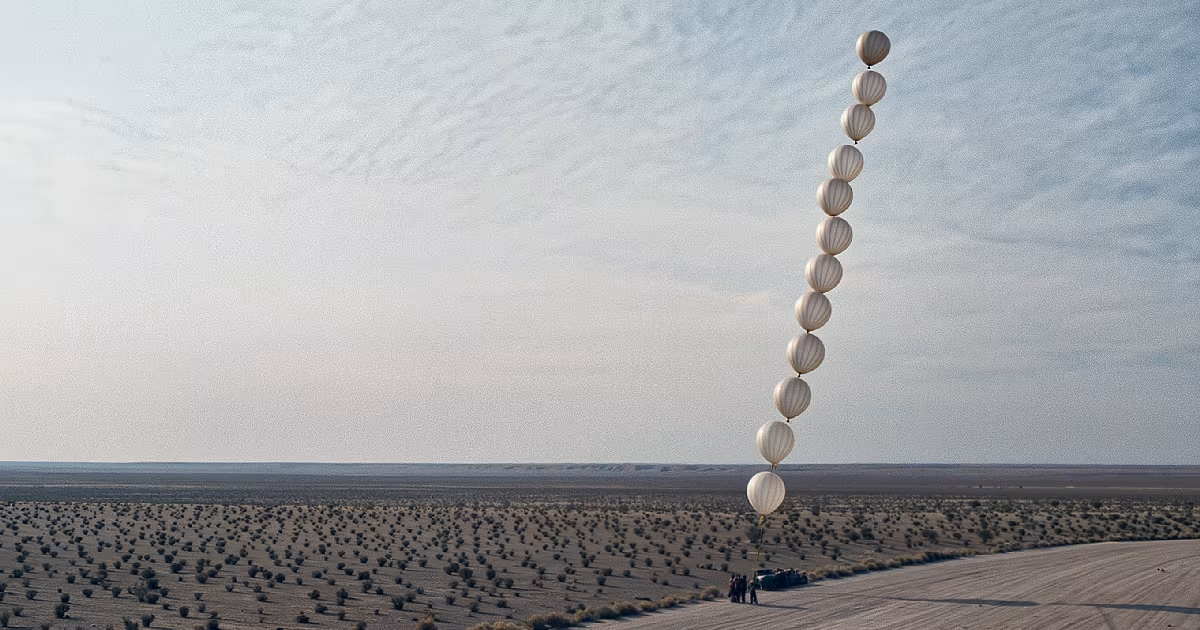
A long chain of pale balloons climbs over a New Mexico desert.
Illustration, not a photograph.

Opening
Project Mogul was a classified programme, run for the Army Air Forces by New York University from 1947 until early 1949, to detect Soviet nuclear tests by listening for their sound waves high in the atmosphere. Publicly the NYU team was doing balloon research. The real equipment was microphones and radio gear carried high under long trains of balloons, with foil-and-stick radar reflectors added so the trains could be tracked. In June and July 1947 the team launched flights from Alamogordo Army Air Field in New Mexico.
In 1994 the Air Force concluded that the debris rancher Mac Brazel found on the Foster ranch near Corona, the debris at the root of the Roswell story, was most likely from a Mogul train that had never been recovered. Charles B. Moore, an NYU engineer who launched the flights, identified the likely culprit as Flight 4 of 4 June 1947. The match is strong on the equipment and the timing. It is weaker on the paperwork and on the witnesses' later descriptions.
Timeline
Spring 1947The first trial flights are made in the eastern United States, and the project moves its field operations to New Mexico. The field director is the geophysicist Albert Crary.
Early June 1947NYU launches begin at Alamogordo. The early trains are clusters of neoprene weather balloons strung on a line that could run to hundreds of feet, carrying radar reflectors, sonobuoy microphones and ballast.
4 June 1947NYU Flight 4 goes up from Alamogordo. Tracking is lost as it drifts north-east. The project's records for this flight are incomplete: no flight data for it appears in NYU's published reports, and Crary's field diary for the day has been read both as recording a cancellation for cloud and as recording a cluster launched anyway. Moore says it flew.
Mid-June 1947Brazel, by his own account to the Roswell Daily Record in July, comes across a scatter of rubber, foil, paper, tape and sticks on the ranch on 14 June and leaves it for several weeks.
6 July 1947After hearing about flying saucers in Corona, Brazel reports the debris to Chaves County Sheriff George Wilcox, who calls Roswell Army Air Field.
8 July 1947The base's public information officer, Walter Haut, issues the press release saying the 509th Bomb Group has recovered a "flying disc". The same day, at Eighth Air Force headquarters in Fort Worth, Brigadier General Roger Ramey and weather officer Irving Newton identify the material as a weather balloon and radar target.
1949Mogul ends. Its work passes to other detection methods.
1993Representative Steven Schiff of New Mexico asks the General Accounting Office to search for Roswell records. The GAO asks the Air Force to report on what it holds.
July to September 1994The Air Force's report by Colonel Richard L. Weaver concludes that the debris was consistent with a balloon device, most likely a Mogul flight. It is published in 1995 as The Roswell Report: Fact vs. Fiction in the New Mexico Desert.
July 1995The GAO reports that Roswell Army Air Field's outgoing messages from late 1946 to late 1949 had been destroyed, without a record of who authorised it.
1997Moore sets out his case, including a reconstruction of Flight 4's likely path from wind data, in UFO Crash at Roswell: The Genesis of a Modern Myth, written with the anthropologists Benson Saler and Charles Ziegler and published by the Smithsonian Institution Press. In June the Air Force releases The Roswell Report: Case Closed, on the later alien body stories.
2010Moore dies, aged 89.
Key figures
Charles B. Moore launched the balloons and later became a professor of atmospheric physics at the New Mexico Institute of Mining and Technology. He was among the surviving Mogul scientists interviewed for the 1994 report, and he said that he and his colleagues did not learn the programme's code name until decades later. Albert Crary led the field work and kept the diary. Mac Brazel found the debris. Sheriff Wilcox, Major Jesse Marcel and Walter Haut handled the first days at Roswell. Steven Schiff started the inquiry that produced the 1994 report.
Physical and documentary trail
The surviving NYU reports and Crary's diary, the 1994 Weaver report and its 1995 publication, the 1995 GAO report and Moore's 1997 chapter are the core documents. The radar targets were made of foil-backed paper on balsa-like sticks, and some were reinforced with tape printed with a floral or geometric pattern, because they had been made by a toy and novelty manufacturer. Bessie Brazel, Mac's daughter, later described tape with flowers on it, and Jesse Marcel Jr. described markings like purple hieroglyphics, which supporters of the Mogul explanation link to the same tape.
What is missing is a document tying a specific flight to the Foster ranch. The 1947 flight records do not track Flight 4 to its landing, and the base's outgoing messages for the period no longer exist.
Things you might not know
- The engineers did not know their project's name. Moore said he only learned it was called Mogul in the 1990s.
- The tape came from a toy company. The radar targets were assembled by a novelty manufacturer, which is why the reinforcing tape had decorative patterns.
- Roswell's records were destroyed. The GAO found that the base's outgoing messages for 1946 to 1949 had been destroyed without authorisation on record.
- Moore wrote his case down. His reconstruction of Flight 4 was published by the Smithsonian Institution Press in 1997.
- The base did not know about Mogul. Nobody at Roswell Army Air Field had been told, which helps explain both the disc release and the hurried weather-balloon correction.
Competing explanations
Mogul debris. The equipment matches the materials Brazel described in July 1947: rubber, foil, paper, tape and sticks, spread over an area. The timing fits a June launch, and Moore's wind reconstruction puts Flight 4 within reach of the ranch. The Air Force reached the same conclusion.
Something other than Mogul. Critics argue that later witnesses described material that does not match balloon parts: foil that sprang back flat, beams that would not cut or burn. They also dispute Moore's wind data and his reading of the Flight 4 records. If those later accounts are taken at face value, the match is incomplete.
A match that rests on reconstruction. No document links Mogul to the ranch. The case depends on Moore's memory of a 1947 flight, recalled in the 1990s, on his trajectory reconstruction, and on the agreement between the July 1947 descriptions and the equipment. The 1947 descriptions are the strongest part. The later ones, given decades on, are the part that disagrees.
Later life of the case
The 1994 report is the official position on the debris, and the 1997 report is the official position on the bodies. Most historians accept Mogul as the best explanation for the ranch debris. Many Roswell researchers do not, and they point to the destroyed messages and to the later witnesses as reasons the case should stay open.
Finding
Mogul is the best-supported explanation for the debris Brazel found. The equipment, the timing and the 1947 descriptions fit, and the Air Force and most historians reached the same conclusion. It rests on reconstruction and testimony, not on a record tying the ranch to one flight, and the doubts over Flight 4's records and the later witness descriptions remain open.
What still will not resolve: where NYU Flight 4 actually came down, which the 1947 tracking never recorded and the destroyed Roswell messages can no longer show.
Evidence signature
7/9 Strong
- Witnesses
- trained, independent witnesses
- Instruments
- photo, film or physical traces
- Paper
- formal investigation, court or declassified file
How well documented the case is, not whether it's true. A strong record can still have an ordinary answer, and a thin one can still be real.
You decide · PROJECT MOGUL
What do you think happened?
One vote per case, anonymous. You'll see how other readers voted once you've voted.