EDWARD RUPPELT
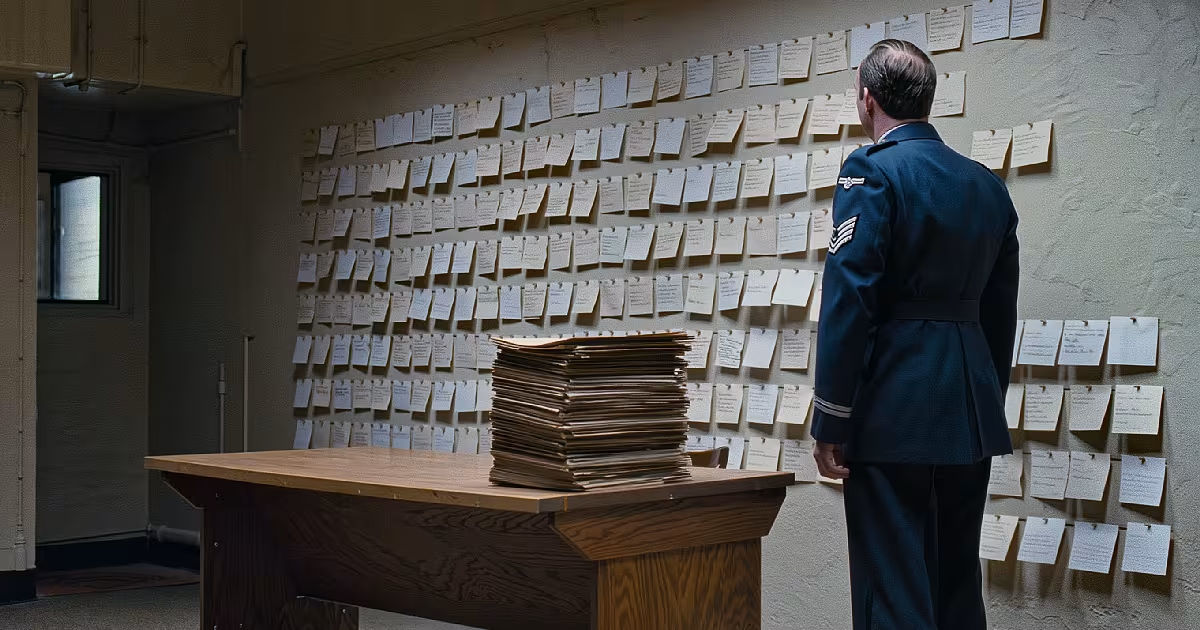
A man in Air Force uniform studies a wall of pinned case cards.
Illustration, not a photograph.

Opening
Edward J. Ruppelt was the Air Force captain who ran the service's UFO investigation from late 1951 to 1953, first under the name Project Grudge and from March 1952 as Project Blue Book. He is generally credited with coining the term "unidentified flying object" to replace "flying saucer". He was in charge during the July 1952 Washington sightings, briefed the Robertson Panel of scientists in January 1953, and left the project later that year.
His book, The Report on Unidentified Flying Objects, published in 1956, is still the most detailed insider account of how the Air Force handled reports in those years. He died in 1960, aged 37. The book is the reason he matters, which means it is also the first thing to test, and it exists in two versions that do not end the same way.
Timeline
17 July 1923Ruppelt is born in Grundy Center, Iowa.
1942 to 1945He enlists in the Army Air Corps and serves as a bombardier. He earns five battle stars, three Air Medals and two Distinguished Flying Crosses.
1951He completes a degree in aeronautical engineering at Iowa State College. Recalled to active duty during the Korean War, he is posted to the Air Technical Intelligence Center at Wright-Patterson Air Force Base in Dayton, Ohio.
Autumn 1951After radar and visual sightings at Fort Monmouth, New Jersey, Air Force intelligence orders the near-dormant Project Grudge revived. Ruppelt is put in charge. Some summaries date his Grudge role to 1949, but he was still a student then, and his own book describes taking over in 1951.
March 1952The project is renamed Project Blue Book.
April 1952Life magazine runs "Have We Visitors From Space?", which drives a surge of reports.
19 to 27 July 1952Radar returns and visual sightings over Washington, DC, on two weekends lead to jet interceptions and the largest Pentagon press conference since the Second World War. Ruppelt's office is at the centre of the response.
14 to 17 January 1953The Robertson Panel, convened by the CIA and chaired by the physicist Howard P. Robertson, meets at the Pentagon. Ruppelt briefs it on Blue Book's methods and cases. The panel concludes that the reports show no threat to national security and recommends a public education effort to reduce interest in the subject.
1953Ruppelt leaves the project, returns briefly, and then asks for reassignment. He leaves the Air Force not long afterwards.
1956The Report on Unidentified Flying Objects is published by Doubleday in New York and Victor Gollancz in London. By now he is a research engineer at Northrop Aircraft.
1960An expanded edition with three added chapters appears months before his death. The new chapters are far more sceptical and dismiss the contactee movement and much of the subject as a whole.
15 September 1960He dies of a heart attack, his second, in Long Beach, California, aged 37.
Key figures
Howard P. Robertson chaired the panel Ruppelt briefed. Major General John Samford, the director of Air Force intelligence, fronted the July 1952 press conference. J. Allen Hynek, the Ohio State astronomer, was Blue Book's scientific consultant during Ruppelt's time. Jerome Clark, the UFO historian, calls Ruppelt's tenure the project's best-run period, a view shared by researchers who otherwise disagree about the subject.
Physical and documentary trail
Three sets of records matter. The Blue Book case files, now at the National Archives, are the primary evidence, and the book describes them rather than replaces them. The Robertson Panel's report, declassified in stages from the 1970s, records what the scientists were shown and what they recommended. Ruppelt's book is the third, and it exists in two editions with different closing chapters. A reader who checks a claim from the book should check which edition it came from.
Things you might not know
- He named the subject. "Unidentified flying object" was his attempt to replace "flying saucer" with a term that did not assume a shape.
- He was a decorated combat veteran. Two Distinguished Flying Crosses before he was 22.
- He ran the project through its busiest summer. The July 1952 Washington sightings came in his first year.
- The book has two endings. The 1960 edition adds three chapters that read as much more sceptical than the 1956 text. Some researchers believe he was pressed to add them, and others think he simply changed his mind. Neither view has a document behind it.
- He died at 37. His heart attack came only months after the revised edition appeared.
Competing explanations
An honest broker who saw the limits of the evidence. Ruppelt's position in 1956 was that a hard core of cases could not be explained with the data available, and that the Air Force had handled the subject badly. On this reading his book is a careful insider's account of that frustration, and the panel's advice was a judgment about the quality of the reports.
An insider defending his own office. Blue Book lost standing after the Robertson Panel. An insider's book was a natural place to argue that the work had been done properly under his direction and neglected afterwards. A reader starting from there will look closely at how he sorted the cases.
A man who changed his mind. The 1960 chapters can be read as the view of someone who had followed the subject for four more years and found less in it. They can also be read as pressure from former colleagues. The text alone does not settle which.
Later life of the case
The Robertson Panel's recommendations shaped Blue Book's later years, and the project closed in December 1969. Ruppelt's book has stayed in print and is still the account most researchers start with. The question of the 1960 chapters remains one of the small open puzzles of the subject's history.
Finding
Ruppelt is the best primary voice on how the Air Force actually handled UFO reports in the early 1950s. He ran the project, briefed the scientists who judged it, and wrote the account most people read. The book is an insider's record and should be checked against the Blue Book case files and the Robertson Panel report, with care over which edition is being quoted.
What still will not resolve: why the 1960 edition turned sceptical, and how many of the cases Ruppelt counted as unidentified would still be unidentified if re-examined with the records that exist now.
You decide · EDWARD RUPPELT
What do you think happened?
One vote per case, anonymous. You'll see how other readers voted once you've voted.