MUROC 1947
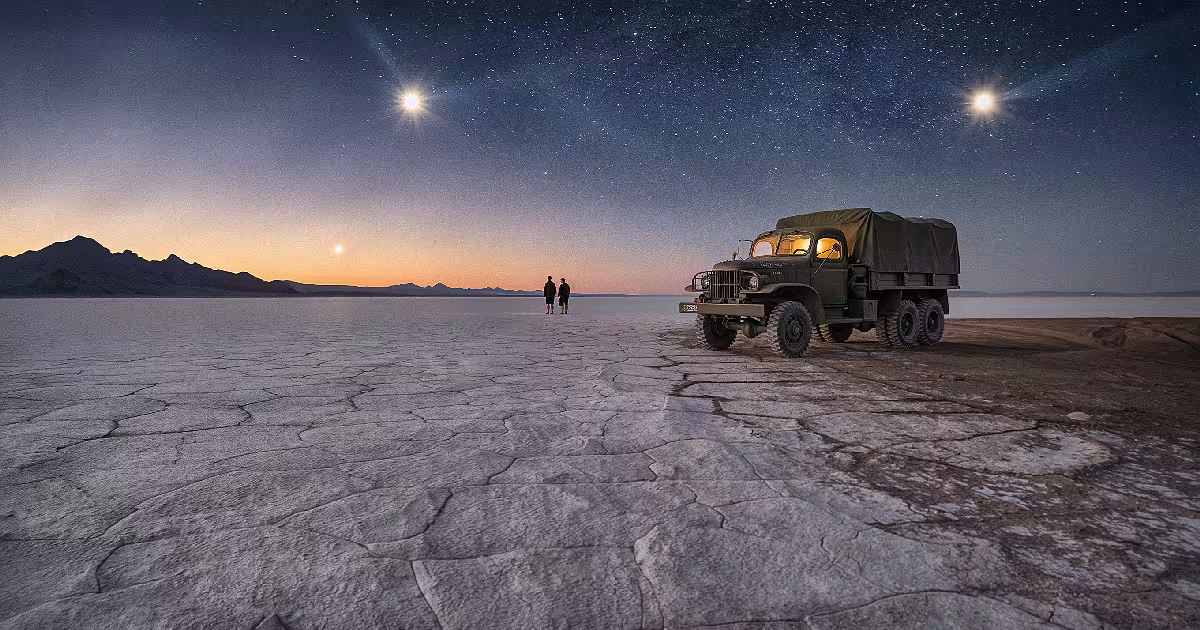
Two bright points above a dry lake bed, with an army truck.
Illustration, not a photograph.

Opening
On 8 July 1947, officers, technicians and test pilots at Muroc Army Air Field in the Mojave Desert, the flight-test base now called Edwards Air Force Base, reported a string of unusual objects over the base and Rogers Dry Lake. It was the same day the Roswell press release went out, at the height of the summer's saucer wave. Eight signed statements were sent up the chain, and the best documented is First Lieutenant Joseph C. McHenry's sworn account of two silver objects at about 8,000 feet.
The reports came from people whose job was watching aircraft, at one of the most closely watched pieces of sky in the country. The Army Air Forces' own paperwork left the case marked "pending", and Project Blue Book later listed the Muroc sightings among its unidentified cases. No balloon or aircraft has ever been matched to them.
Timeline
8 July 1947, about 9:30 to 10:00 amMcHenry, the base billeting officer, sees two silver objects, spherical or disc-shaped, at an estimated 8,000 feet and 300 to 400 mph. He calls over Staff Sergeant Gerald E. Nauman, Technical Sergeant Joseph Ruvolo and a civilian secretary, Jannette Scott, who also see them. A third, similar object later circles tightly overhead. The witnesses' times differ by up to half an hour.
Around 10:10 amMajor J. C. Wise, a test pilot running up an XP-84 jet, sees a yellowish-white sphere five to ten feet across at about 10,000 feet, oscillating as it moves west to east at around 200 mph. He first takes it for a weather balloon, then decides against it. His statement dates the sighting to 7 July, one of several small inconsistencies in the record.
Around 11:50 amAt Rogers Dry Lake, watching an ejection-seat test from a P-82, Captain John Paul Stapp and others in an observation truck see a round, white-aluminium object fall faster than a parachute and drift north of west, against the wind, for about 90 seconds. Four of the five people in the truck see it. Stapp estimates it at about 25 feet across and writes that it looked man-made.
Around noonMajor Richard R. Shoop, chief of the technical engineering division, alerted by the base commander, watches a thin metallic object five to eight miles away for about eight minutes as it oscillates, nearly touches the ground and climbs again. His wife also sees it.
AfternoonThe commanding officer, Colonel Gilkey, sees an object he later says was probably paper and of no significance.
11 July 1947McHenry signs an affidavit before Thomas A. McMillan, a special agent of the Counter Intelligence Corps.
4 to 6 August 1947Fourth Air Force headquarters asks for a lead sheet on the discs reported at Muroc.
14 August 1947Captain Harry D. Black, the Muroc intelligence officer, forwards eight statements to the commanding general of the Fourth Air Force.
18 August 1947The Fourth Air Force file is marked "Pending", with a note that no further investigation is being considered by that headquarters.
Key figures
Joseph McHenry is the most-cited witness, and his affidavit is the fullest record. John Paul Stapp, named "Strapp" in the typed statement, is almost certainly the flight surgeon who later became famous for riding rocket sleds at Muroc and Holloman to study deceleration. That makes him one of the most credentialed observers in any 1947 report. Richard Shoop and J. C. Wise were engineers and test pilots. Colonel Gilkey, the commander, was the one senior witness who dismissed what he saw. Captain Harry Black gathered the statements.
Physical and documentary trail
The surviving documents are the eight witness statements, McHenry's 11 July affidavit, the Fourth Air Force correspondence of August 1947, and the "pending" notation of 18 August. Copies are in the Project Blue Book records at the National Archives and have been transcribed by private researchers. None of them names a photograph, film or recovered object. The witnesses considered and rejected weather balloons themselves, citing speed and movement against the wind. The base's launch and flight-test logs for 8 July, which would show what was in the air, are not among the published documents.
No further investigation of these incidents is being considered by this headquarters.
Things you might not know
- A rocket-sled pioneer was among the witnesses. Stapp went on to ride a sled to 632 mph in 1954 and became known as "the fastest man on earth".
- It was the Army Air Forces, not yet the Air Force. The US Air Force did not become a separate service until 18 September 1947.
- The commander thought it was paper. Colonel Gilkey told his intelligence officer that what he saw was of no significance.
- The witnesses ruled out balloons themselves. McHenry and Wise both considered a weather balloon and rejected it.
- The case was never closed. The last word in the Fourth Air Force file is "Pending".
Competing explanations
Balloons. Weather and research balloons were common over the Mojave in 1947, and a balloon with a metallic radar target can look silver and disc-like. This is the explanation sceptics usually reach for. It fits the slow-moving and drifting objects best, but no specific launch has been tied to any of the reports, and two witnesses who knew balloons rejected it.
Aircraft and reflections. Muroc was busy with experimental aircraft, and sunlight on a distant fuselage can look like a disc. This fits the faster objects better. It fits poorly with Shoop's object, which hovered near the ground and climbed, and with Stapp's, which fell and drifted against the wind.
Something the record cannot identify. If the accounts are accurate, at least the 11:50 and noon objects are hard to place in either category. Project Blue Book's later listing of the case as unidentified reflects that.
Later life of the case
The Muroc reports are regularly cited as some of the strongest of 1947, because of who made them. The Air Force's 1948 "Estimate of the Situation", a document said to have argued for an interplanetary explanation, is claimed by some researchers to have drawn on Muroc, but no copy of that estimate has surfaced to confirm it.
Finding
Officers, engineers and test pilots at a flight-test base reported several distinct objects in one day, and the Army Air Forces left the investigation pending. Balloons and aircraft are the obvious ordinary candidates, and they may account for some of the reports. No record ties any report to a specific balloon or flight, and two of the sightings fit neither explanation well.
What still will not resolve: the Muroc flight-test and balloon logs for 8 July 1947, which would show what was actually in the air over Rogers Dry Lake that morning.
Evidence signature
6/9 Solid
- Witnesses
- trained, independent witnesses
- Instruments
- nothing on record
- Paper
- formal investigation, court or declassified file
How well documented the case is, not whether it's true. A strong record can still have an ordinary answer, and a thin one can still be real.
You decide · MUROC 1947
What do you think happened?
One vote per case, anonymous. You'll see how other readers voted once you've voted.