PHILIP CORSO
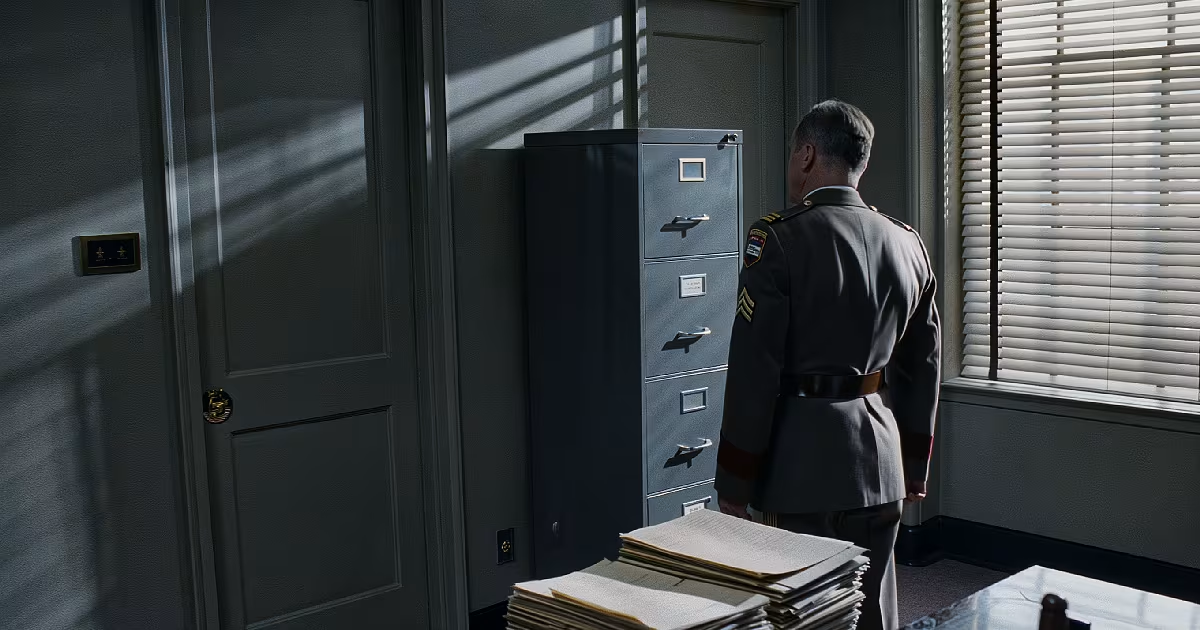
A man in Army uniform stands beside a filing cabinet in an office.
Illustration, not a photograph.

Opening
Philip J. Corso was a retired Army lieutenant colonel who said that, while running the Foreign Technology desk in the Army's research and development office in the early 1960s, he was handed a filing cabinet of material from the 1947 Roswell crash and quietly fed it to American defence contractors. He told the story in The Day After Roswell, written with William J. Birnes and published by Pocket Books in 1997. He died the following year, aged 83.
His military career is documented in outline. The Roswell claims are not. They rest on the book, on his interviews and on a 1998 affidavit, and no inventory, receipt or independent record has surfaced that backs them up. The record confirms the desk he sat at, not the story he told about it.
Timeline
22 May 1915Corso is born in California, Pennsylvania, a small town on the Monongahela River.
23 February 1942He joins the Army. In Europe he serves in Army Intelligence and rises to head the Counter Intelligence Corps in Rome. Biographical summaries credit him with helping Jewish refugees leave Italy for Palestine in 1945 and with acting as a contact to Giovanni Battista Montini at the Vatican, the future Pope Paul VI.
July 1947By his own account he is serving at Fort Riley, Kansas, when, on night duty, he opens a crate that has come from Roswell and sees a small body inside. This is the earliest event in the book and the only one in 1947.
1950 to 1953In the Korean War he works in the Intelligence Division of the Far East Command under Douglas MacArthur, as chief of a special projects branch. Part of his job is tracking prisoner-of-war camps in North Korea.
1953 to 1957Corso says he served on the staff of President Eisenhower's National Security Council. This is one of the claims his critics challenge (see below).
1961He takes over the Foreign Technology desk in Army Research and Development, under Lieutenant General Arthur Trudeau. Sources disagree on the month. Philip Klass argued that Corso's service record shows him in the office from about mid-1961 to mid-1962 and heading the desk for only part of that time.
1 March 1963He leaves the Army as a lieutenant colonel.
1990sHe gives testimony to congressional inquiries on American prisoners of war from Korea, saying he believed hundreds were never returned.
24 June 1997Corso appears on Dateline NBC to promote the book. The same day, the Air Force releases The Roswell Report: Case Closed.
Summer 1997The book spends three weeks on the New York Times bestseller list, peaking at number twelve. On 23 July he appears on Art Bell's Coast to Coast AM.
1998A few weeks before his death he signs an affidavit for Citizens Against UFO Secrecy, which uses the book in a lawsuit seeking government records on crash retrievals. A federal court dismisses the suit in April 1999.
16 July 1998Corso dies of a heart attack in Jupiter, Florida. He is buried at Florida National Cemetery.
Key figures
Lieutenant General Arthur Trudeau, head of Army Research and Development, is the superior Corso says knew about and approved the programme. Trudeau died in 1991, six years before the book appeared, so he never commented on it. William J. Birnes, the co-author, has said the two spent around two years on the book and first planned a straight military memoir, until Corso's UFO stories took over.
Senator Strom Thurmond, for whom Corso had worked as a Senate staffer in the 1960s, wrote the foreword. It praised the book's stories of military history and espionage and did not mention UFOs. Once the book came out, Thurmond said he had believed he was endorsing a conventional memoir, and added: "I know of no such 'cover-up,' and do not believe one existed."
The book's main critics were Philip Klass, Kevin Randle, Karl Pflock and Brad Sparks. Randle in particular is a Roswell researcher who takes the crash seriously, which makes his objections harder to set aside as scepticism by default.
Physical and documentary trail
Corso's Army service is real, and the Foreign Technology desk existed. The Roswell material is another matter. The book says crash artifacts were passed to industry and seeded developments such as integrated circuits, fibre optics, lasers and night vision. Each of those has its own documented development history in civilian and military labs, and the book names no receiving engineer, no inventory and no 1960s document recording a transfer. The 1998 affidavit is a statement by Corso, not an Army record.
The critiques are part of the trail too. Klass listed factual errors, among them placing Eighth Air Force headquarters at Fort Bliss rather than Fort Worth, misdating Walter Haut's Roswell press release, and calling the Hawk missile heat-seeking when it is radar-guided. Randle, citing an archivist at the Eisenhower Library, found no record of Corso serving on the National Security Council, and argued that a confrontation the book places at CIA headquarters in 1961 could not have happened as told. Pflock noted the book credits Corso with contributing to the CORONA satellite programme before its first launch. Sparks, writing in the Skeptical Inquirer, pointed out that the book puts Corso near the centre of events such as the Cuban Missile Crisis without any record of his involvement. A 1997 British Ministry of Defence memo, declassified in 2011, dismissed the book on the grounds of Corso's "previous track record of unreliable testimony".
I know of no such 'cover-up,' and do not believe one existed.
Things you might not know
- The senator did not know it was a UFO book. Thurmond's foreword praised military history and espionage. He distanced himself once he saw the finished book.
- It launched on the same day as the Air Force's last Roswell report. Corso's Dateline interview aired on 24 June 1997, the day Case Closed was released.
- The Fort Riley body is the heart of it. Corso said he saw a small, child-sized body in a glass container in a crate at Fort Riley in July 1947. No other witness to that crate has been identified.
- His Korean War work is the most solid part of his record. His testimony on POWs was taken seriously by congressional committees in the 1990s, which is one reason some readers gave the book the benefit of the doubt.
- The book became a lawsuit. Citizens Against UFO Secrecy cited it in a 1998 suit for crash-retrieval records. The court dismissed it in 1999.
Competing explanations
A genuine insider with real access. Corso's intelligence jobs were real, and a Foreign Technology desk did handle foreign equipment. On this reading he saw things he could not explain, and the book records what he came to believe about them in old age. Supporters note that a man with his intelligence background had little to gain from inventing a story at 82.
A memoir that ran ahead of the records. The book mixes real postings with claims the record does not support, and the errors cluster in exactly the places where his role is biggest. A writer working from memory with a co-author keen on the UFO angle could produce that pattern without setting out to deceive anyone.
A story shaped by its time. Roswell was a crowded subject by the 1990s. The book's account of the crash follows the versions popularised in the books of the 1980s and early 1990s, and a retired officer could have absorbed a great deal from them before he sat down to write.
Later life of the case
The Day After Roswell remains the main source for the idea that crash material was reverse engineered and handed to industry, and that idea runs through later books, documentaries and congressional testimony on UAP. In 2001 The Guardian put it on a list of the top ten literary hoaxes. Corso's account has had no independent corroboration, and the book now matters more as an influence on later claims than as evidence for them.
Finding
Corso had a real intelligence career, and the post at the centre of his story existed. The claim that he handled Roswell material rests on his book, his interviews and an affidavit, with no inventory, receipt or second witness. His critics' strongest evidence is his own service record and a long list of checkable errors, and the senator whose name opened the book walked away from it. The strongest reading is an officer with real access who wrote a memoir that went beyond what his records show.
What still will not resolve: what the Army's Foreign Technology files for 1961 and 1962 actually contain, and whether any of the items Corso describes ever passed through that office.
You decide · PHILIP CORSO
What do you think happened?
One vote per case, anonymous. You'll see how other readers voted once you've voted.