NASH-FORTENBERRY
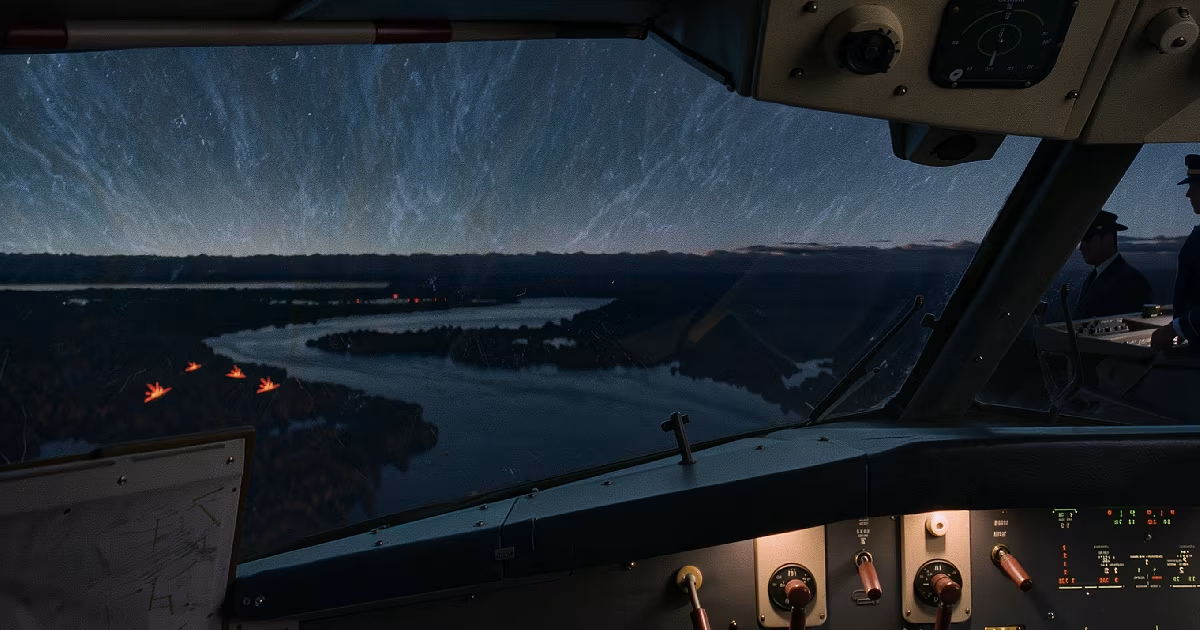
An airliner cockpit at night over dark water, with red glows below.
Illustration, not a photograph.

Opening
On the evening of 14 July 1952, a Pan American Airways DC-4 was flying south along the US East Coast at 8,000 feet when Captain William B. Nash and Second Officer William H. Fortenberry saw six bright red discs below them over Chesapeake Bay, near Newport News, Virginia. The discs flew in a stepped formation, slowed, flipped on edge together, reversed direction and sped away, and two more joined them. The two pilots estimated their size at about 100 feet across and their speed at thousands of miles an hour.
The sighting came a week before the Washington radar-visual sightings of July 1952, and it became one of the best-regarded airline reports of the decade. Project Blue Book listed it as unknown. The explanations offered since then have not held up well, and the pilots' measurements are the reason the case is still discussed.
Timeline
14 July 1952, about 8:10 pmThe DC-4 is southbound, with clear skies and unlimited visibility, approaching Norfolk. Nash and Fortenberry see a red glow ahead and below, which resolves into six bright red-orange discs, roughly at 2,000 feet and about a mile below the aircraft.
The manoeuvreThe discs fly in echelon, each slightly higher than the one ahead. The leader slows suddenly, and the two behind it waver as if nearly overrunning it. Then all six dim, tilt on edge in unison, reverse course, flip flat again and dart away at a sharp angle. Two more discs come from under the aircraft and follow. The glow goes out one by one as they climb away to the west.
Minutes laterThe crew radio a report to be passed to the Air Force.
15 July 1952, early morningAir Force investigators interview Nash and Fortenberry. The investigators tell them there have been seven other reports of red discs in the area that evening.
16 July 1952Paul R. Hill, an aeronautical engineer at the NACA Langley laboratory nearby, sees four amber objects manoeuvring and joining formation over Hampton Roads.
19 to 27 July 1952The Washington radar-visual sightings dominate the news.
October 1952The pilots publish their account in True magazine.
Later yearsThe astronomer Donald Menzel offers two explanations in his books, the second in The World of Flying Saucers (1963): first, ground lights distorted by haze or an inversion layer, and later, fireflies trapped between the cockpit window panes.
Key figures
William B. Nash was the captain and the main voice of the case for the rest of his life. William Fortenberry flew as second officer. The Air Force investigators who interviewed them the next morning are not named in the sources I found. Paul R. Hill later wrote Unconventional Flying Objects, a technical analysis of UFO performance published after his death. Donald Menzel was the most prominent sceptic of the period.
Physical and documentary trail
The Project Blue Book file records the sighting and the Air Force interviews, and lists the case as unknown. The pilots' October 1952 True article is their fullest account. NICAP collected Nash's later statements and Hill's sighting. No radar track, photograph or film is recorded. The seven other reports the investigators mentioned are referred to in the pilots' account, and the sources I found do not identify them, which is a gap worth closing.
not phosphorescent or fuzzy in the least
Things you might not know
- The pilots did the maths. They used landmarks below, including the lights of the towns along the bay, to estimate the objects' size, distance and speed.
- A NACA engineer saw something two days later. Paul Hill's sighting over Hampton Roads is part of the same case history.
- Menzel changed his explanation. Haze-distorted lights came first, fireflies came ten years later.
- It came just before the Washington flap. The case is often read as the opening of that month's wave.
- Blue Book never closed it. It stayed listed as unknown.
Competing explanations
Ground lights and atmospheric distortion. Menzel's first idea was that lights on the ground, seen through haze or an inversion layer, can appear to move and change shape. This has the merit of explaining the red colour. It struggles with formation flight, synchronised tilting and two more objects joining from behind.
Fireflies. Menzel's later idea was insects trapped between the window panes. It would explain why the lights seemed close to the aircraft's frame of reference. Neither pilot reported anything like it, and both described objects well below them and moving across the landscape.
A mirage of Venus. The sceptic Steuart Campbell proposed this much later. It does not obviously account for eight objects in formation.
Unknown craft. Taken at face value, the pilots' observations describe structured objects that flew in formation and made turns beyond any aircraft of 1952.
Later life of the case
Nash continued to stand by the account for decades. The case is regularly cited as one of the strongest pilot sightings of the Blue Book era, and the weakness of the sceptical explanations is part of the reason.
Finding
Two experienced airline pilots, at night with clear visibility, described eight glowing discs in formation in some detail, and the Air Force could not identify them. The ordinary explanations offered so far each leave important parts of the account unexplained. That does not make the objects craft, but it leaves the case genuinely open.
What still will not resolve: who made the seven other reports the investigators mentioned, and what those witnesses described.
Evidence signature
6/9 Solid
- Witnesses
- trained, independent witnesses
- Instruments
- nothing on record
- Paper
- formal investigation, court or declassified file
How well documented the case is, not whether it's true. A strong record can still have an ordinary answer, and a thin one can still be real.
You decide · NASH-FORTENBERRY
What do you think happened?
One vote per case, anonymous. You'll see how other readers voted once you've voted.