CHILES-WHITTED
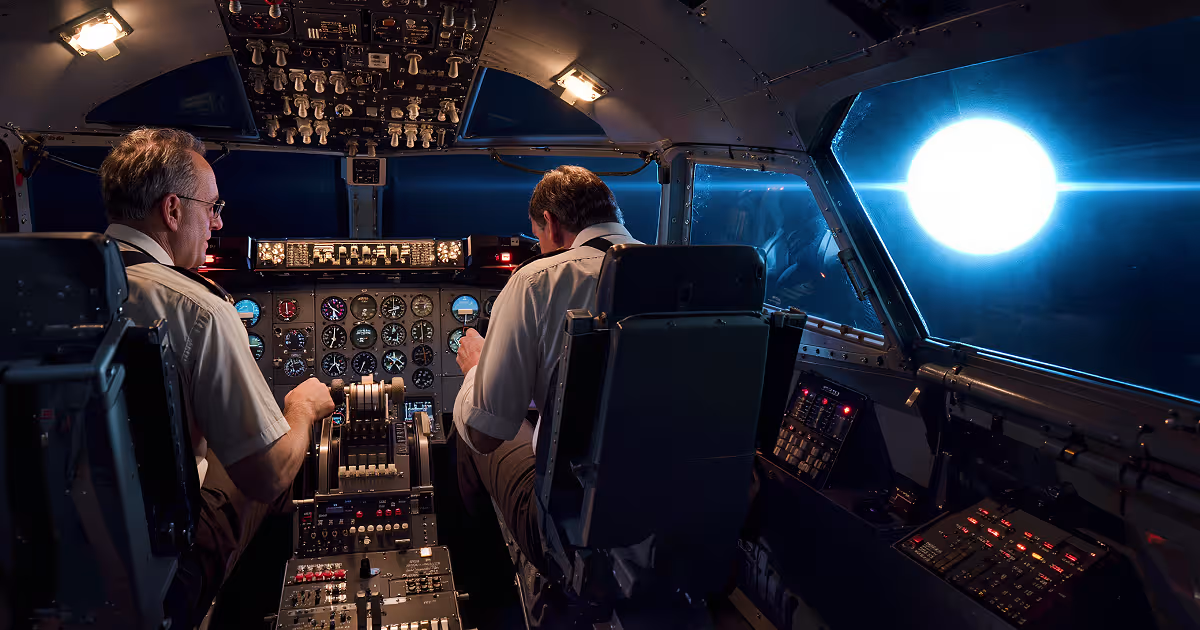
DC-3 cockpit night. Bright pass to starboard.
Illustration, not a period photograph.
Opening
At approximately 2:45 a.m. on 24 July 1948, Eastern Air Lines captain Clarence S. Chiles and co-pilot John B. Whitted, flying a DC-3 twenty miles southwest of Montgomery, Alabama, watched a wingless, cigar-shaped object with a lit row of windows shoot past their aircraft at close range before climbing into cloud in a burst of flame. It was the closest, best-witnessed sighting the U.S. Air Force's fledgling UFO investigation had yet received, and it did more than any single case to push that investigation's own analysts toward writing down, on paper, that the objects might be interplanetary.
That document, the so-called "Estimate of the Situation," was rejected by the Air Force's chief of staff, and Edward Ruppelt, the officer who later ran Project Blue Book and who said he personally read it, reported it was ordered destroyed. Whether that destruction happened for the dramatic reasons later writers gave it, or as routine records disposal, is itself part of the case.
Timeline
20 July 1948. Observers in The Hague, Netherlands, report a rocket-shaped object with two rows of windows moving through broken clouds. Project Sign, the Air Force's first UFO study group, later treats this as a related, earlier sighting of comparable description.
24 July 1948, roughly an hour before the main event. Walter Massey, a ground-crew chief at Robins Air Force Base in Georgia, about 150 miles from Montgomery, reports seeing a similar cylindrical, wingless object two to three times the size of a B-29, trailing fire from its tail, with a faint glow on its underside. Massey states plainly he did not believe it was a meteor.
24 July 1948, approximately 2:45 a.m. Chiles and Whitted, flying an Eastern Air Lines DC-3 from Houston to Atlanta with twenty passengers aboard, see a light closing on their aircraft near Montgomery. Chiles banks the plane hard left; the object passes an estimated few hundred feet to the right before pulling up into a steep climb and vanishing into cloud around 6,000 feet. One awake passenger, C. L. McKelvie, independently reports a bright streak of light past his window at the same moment.
Same night, shortly after. A separate pilot flying near the Virginia-North Carolina line reports a bright shooting star in the direction of Montgomery at roughly the same time.
Shortly after landing in Atlanta. Chiles and Whitted report the sighting to Air Force personnel and are interviewed by Project Sign investigators, who plot a trajectory suggesting the object's path would have carried it near Macon, Georgia, consistent with the Robins Air Force Base sighting an hour earlier.
Following days. An Air Force spokesman initially floats a weather balloon explanation, then withdraws it within days, stating plainly that the country had no aircraft resembling a double-decked, jet-propelled, wingless transport shooting a forty-foot flame from its tail.
Late July-August 1948. Project Sign personnel, weighing the Chiles-Whitted case alongside the Mantell incident and the Gorman dogfight as one of three cases that most convinced them UFOs were physically real, draft the "Estimate of the Situation," a formal intelligence document concluding the extraterrestrial hypothesis was the best explanation on the evidence available. It is forwarded up the chain to Air Force Chief of Staff General Hoyt S. Vandenberg, who rejects it, chiefly for lack of physical proof.
1959. Project Blue Book formally closes the case, attributing the sighting to a meteor or bolide, an explanation astronomer J. Allen Hynek had floated as early as 1948 while acknowledging it was, in his own words, "far fetched" given the described maneuvering.
1968. Physicist James E. McDonald interviews Chiles and Whitted roughly twenty years after the event; both men maintain their original account without significant alteration.
Key figures
Chiles and Whitted are the case's central witnesses, both decorated World War II airmen and established Eastern Air Lines employees, a professional profile that gave the report unusual weight with investigators at the time. Notably, their accounts disagreed on real details: Chiles described a lit cockpit, a boom on the nose, and a transparent center section; Whitted did not see a cockpit or boom and instead described a row of rectangular windows. Both agreed the object made no sound and that the DC-3 itself was undisturbed by turbulence, a detail later popular retellings sometimes got wrong by claiming the plane was buffeted.
Massey is the case's independent corroborating witness, reporting a matching object an hour earlier and considerably closer to where Project Sign's trajectory plot placed the object's path, and stating unprompted that he did not believe it was a meteor.
Ruppelt is the source for the "Estimate of the Situation" story as it's generally told; he wrote that he personally saw a copy and summarized its content bluntly: "the situation was the UFOs, the estimate was that they were interplanetary." His account is also the primary source for the document's rejection and destruction, meaning the most dramatic part of this case's later life rests substantially on one credible but singular institutional insider's testimony.
Hynek is the case's most consequential skeptical voice, a Project Sign astronomical consultant who considered no ordinary astronomical explanation adequate to the reported behavior, yet proposed an extraordinary meteor as the least implausible option available, an assessment that became the Air Force's final 1959 classification over a decade later.
McDonald is the physicist whose 1968 re-interview kept the case active in serious UFO research circles well past its original Air Force closure, establishing that the witnesses' testimony held up under a second, independent round of questioning decades on.
Physical and documentary trail
On the paper, this file has an unusually well-corroborated witness cluster for a 1948 case: two professional pilots with disagreeing but overlapping detail, one awake passenger, one independent ground witness an hour earlier along a plausible flight path, and a second pilot's report of a related light the same night. It also has real institutional paper: Project Sign's own trajectory analysis, the Air Force's public statements (including the withdrawn balloon explanation and the blunt admission no such American aircraft existed), and Ruppelt's own later published account referencing a document he says he personally read.
What it does not have is the "Estimate of the Situation" itself. No copy has ever surfaced publicly; its existence and content are known only through Ruppelt's book and secondhand historical accounts building on it. There is no photograph, no radar return, and no physical trace, consistent with either a genuine unconventional object or with a bright meteor fireball, since neither leaves recoverable material in a case like this.
This country has no plane resembling a double-decked, jet-propelled, wingless transport shooting a 40-foot flame out of its back end.
Competing explanations
A bright meteor or bolide. This became the official 1959 Air Force classification and remains the position of most subsequent Blue Book skeptics: fragmenting meteor debris, seen edge-on and misjudged for distance and speed by pilots startled at 2:45 a.m., could plausibly be misread as a windowed fuselage, a pattern sometimes called the "airship effect," where separate light sources are perceived as parts of one structured craft. Proponents of this reading note it requires no unconventional aircraft or extraterrestrial hypothesis and fits a known, common aerial phenomenon.
Hynek's own contemporaneous doubt about that explanation is the strongest argument against it: he called the meteor reading far-fetched at the time, specifically because it required an unusually cooperative set of coincidences, sustained apparent maneuvering, matching descriptions from an independent ground witness on a plausible flight path an hour before, and a passenger's simultaneous but separately worded corroboration, to all be produced by one bright but ultimately unremarkable fireball.
A secret American or Soviet aircraft. Raised by contemporaries and later writers, this reading is weakened by the Air Force's own public admission within days that no such aircraft existed in the American inventory, and by the total absence of any confirmed Soviet program from the period capable of anything resembling the described object.
A genuine unconventional aerial object. This was Project Sign's own internal conclusion, formalized in the unrecovered "Estimate of the Situation," and it rests on taking the witness cluster, two professional pilots, an independent ground witness, and a passenger, at close to face value. Its weakness is the same as every case built entirely on testimony: no physical evidence exists to move it from "unexplained" to "confirmed."
Later life of the case
The Chiles-Whitted case, alongside the Mantell incident and the Gorman dogfight, is repeatedly cited by Ruppelt and later historians as one of three cases that shifted Project Sign's internal thinking in 1948, making it a genuine hinge point in the institutional history of American UFO investigation rather than merely one report among thousands. The "Estimate of the Situation" story, its drafting, its rejection by Vandenberg, and its reported destruction, has become one of the most frequently retold episodes in UFO history precisely because it describes an internal government document reaching a conclusion the government itself suppressed, a narrative structure that fits comfortably into both serious historical accounts and cover-up-oriented retellings alike.
McDonald's 1968 re-interview and continued scholarly attention (including detailed case reconstructions by researchers such as Michael Swords and Brad Sparks) have kept this case active in serious UFO historiography well past most other 1948-era reports, largely because the witness quality has held up to repeated scrutiny even as the explanation debate has not resolved.
Finding
Two experienced, professionally regarded pilots, one independent ground witness on a plausible flight path an hour earlier, and one awake passenger together produced one of the best-corroborated close-range UFO witness clusters of the entire early Blue Book era. The Air Force's own internal analysts found it compelling enough to draft a document favoring an extraterrestrial explanation, and its own astronomical consultant found the eventual official meteor explanation reluctant and far-fetched even as he proposed it.
What still will not resolve: a surviving copy of the "Estimate of the Situation," and a Robins Air Force Base witness account detailed enough to fully confirm the trajectory match Project Sign proposed. Until either surfaces, this stays a case where the institutional reaction is almost as well documented as the sighting itself, and where the meteor explanation carries the Air Force's final word without ever fully satisfying the man who first suggested it.