MAURY ISLAND
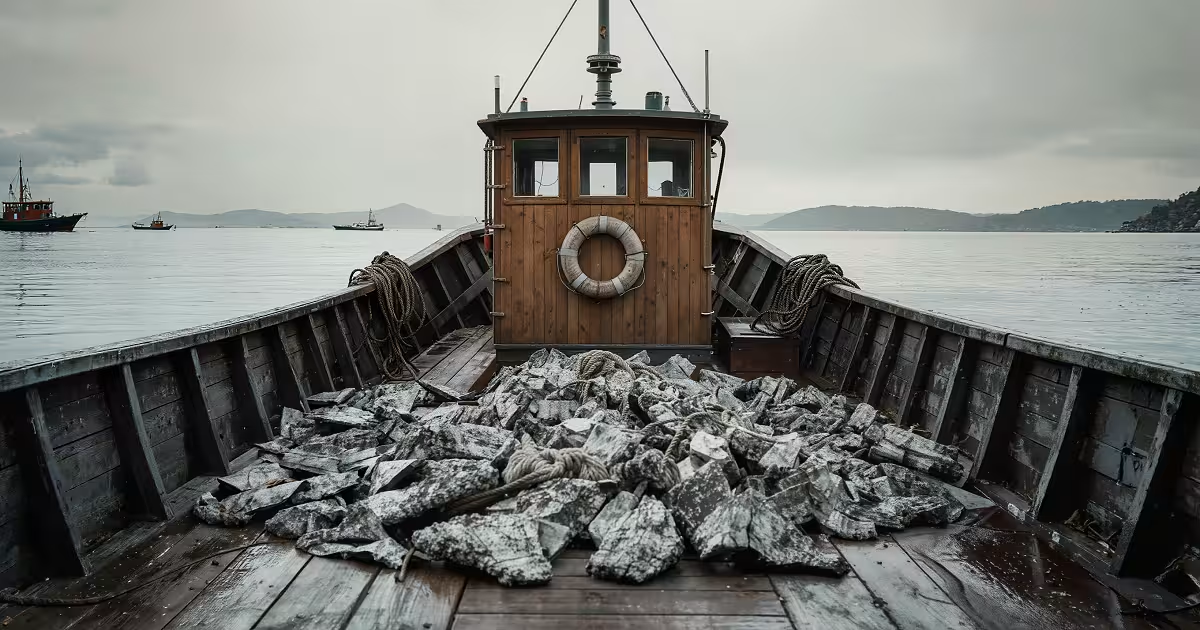
Puget Sound boat. Grey slag on wet deck.
Illustration, not a period photograph.
Opening
On 21 June 1947, three days before Kenneth Arnold's famous Mount Rainier sighting, a lumber salvage worker named Harold Dahl claimed that while on his boat near Maury Island in Puget Sound, six enormous doughnut-shaped objects appeared overhead, one apparently in distress, before it began dropping hot metallic slag and lighter debris onto his boat, injuring his son and killing his dog. What followed drew in Arnold himself, two Army Air Force intelligence officers who died in a plane crash while carrying evidence samples, an early and consequential appearance of the "man in black" archetype, and, decades later, a tenuous but real thread connecting one of the story's central figures to the Jim Garrison investigation into the assassination of President Kennedy.
This case is almost universally regarded, even by committed believers in other UFO cases, as a hoax. What makes it worth a serious file anyway is that the hoax itself produced two genuine, documented deaths, and the specific mechanics of how a fabricated story acquired that much institutional momentum are worth examining directly.
Timeline
21 June 1947. Dahl claims the sighting and debris-shedding event occurred while he was salvaging logs near Maury Island with his son, two crewmen, and a dog aboard.
Following weeks. Dahl reports the incident to his purported superior, Fred Crisman, who claims to have gone to the island himself, found the described slag material, and separately witnessed one of the objects.
Same period. Dahl claims he is visited the following morning by a man in a dark suit who tells him "I know a great deal more about this experience of yours than you will want to believe" and warns him not to discuss it further, an account now widely cited as one of the earliest documented instances of the "Men in Black" motif in American UFO folklore.
31 July 1947. Fred Crisman contacts Raymond Palmer, editor of the pulp magazine Amazing Stories, claiming to have physical evidence of the incident. Palmer, already corresponding with Kenneth Arnold about Arnold's own recent sighting, wires Arnold $200 to fly to Tacoma and investigate.
29 July 1947 (dates in various retellings vary slightly). Arnold arrives in Tacoma and hears Dahl's account directly in his hotel room at the Winthrop Hotel. Feeling out of his depth, he recruits Captain E. J. Smith of United Airlines, who had separately reported his own UFO sighting on 4 July, to help assess the material.
Following day. Crisman shows Arnold and Smith samples of the metal debris; both men judge it unremarkable and inconsistent with Dahl's dramatic description, though they do not say so directly to Crisman at the time to avoid embarrassing him.
Same period. Arnold, uncertain how to proceed, contacts Lieutenant Frank Brown of Fourth Air Force military intelligence at Hamilton Field, California. Brown arrives in Tacoma along with Captain William L. Davidson; the two officers interview Dahl and Crisman, collect fragments of the material, and immediately recognize it, privately, as ordinary industrial slag rather than anything unconventional.
1 August 1947. Flying back to Hamilton Field with the collected samples, Brown and Davidson's B-25 catches fire and crashes near Kelso, Washington. Both officers are killed.
Following the crash. The FBI opens a formal investigation into Dahl and Crisman's claims, given the deaths now directly connected to the case. Dahl and Crisman subsequently confess to fabricating the story, reportedly for financial gain, though both men later partially recant or complicate that confession in different ways over subsequent years.
1953. Early UFO researcher Albert K. Bender, who had printed Dahl's story in his own newsletter, claims to be visited by three men in black warning him to stop his UFO research, extending the "Men in Black" motif this case is credited with originating into a second, independently reported case.
1968. Jim Garrison, the New Orleans district attorney investigating the Kennedy assassination, subpoenas Fred Crisman as a witness, based on claims connecting Crisman to figures in Garrison's broader (and largely discredited) conspiracy theory. Crisman himself later claims to have worked for the CIA, a claim never independently confirmed.
Later, before his death. Crisman offers yet another version of events, suggesting the actual underlying incident involved an American military aircraft accidentally dropping radioactive waste near the island rather than any UFO, a claim itself unconfirmed and inconsistent with his and Dahl's earlier confessed fabrication.
Key figures
Dahl is the case's originating witness, whose claimed harbor-patrolman credentials were themselves false, an early tell that later investigators point to as evidence of fabrication built into the story from its first telling.
Crisman is the case's central and most consequential figure, a self-described "superior officer" to Dahl whose later documented life, connections claimed to the CIA, a subpoenaed appearance in the Garrison investigation, and a final, shifting version of the Maury Island story itself, makes him one of the more genuinely mysterious real people attached to any UFO case on this list, regardless of what actually happened at Maury Island.
Arnold is a peripheral but pivotal figure, drawn in only because of his own, entirely separate and far more credible Mount Rainier sighting days later, a connection that has confused casual retellings of both cases for decades since.
Brown and Davidson are the case's tragic, entirely innocent casualties, professional intelligence officers who correctly and immediately identified the debris as mundane and died in an apparently unrelated air crash while simply doing their job of collecting and transporting evidence for further review.
Bender is a secondary figure whose own, later and independently reported "Men in Black" experience helped cement the archetype this case is credited with introducing into American UFO culture.
Physical and documentary trail
On the paper, this file has a formal FBI investigation record, Dahl and Crisman's own confessed fabrication, professional military assessment of the debris as ordinary industrial slag, and a genuine, documented aircraft crash with two verified fatalities. It also has Crisman's later life connecting him, however tenuously, to a separate and far more consequential piece of American history.
What it lacks is any confirmed link between the plane crash and the Maury Island materials themselves. Contemporary and later analysis treats the crash as most likely an unrelated mechanical failure, coincidental in timing to the case rather than caused by anything the officers were carrying, though the coincidence itself, two men dying while transporting evidence in a case now confirmed to be fabricated, is precisely the kind of detail that has kept the story circulating long after its central claim was formally admitted false.
I know a great deal more about this experience of yours than you will want to believe.
Competing explanations
A deliberate hoax for financial gain. This is the explanation Dahl and Crisman themselves confessed to, and it remains the best-supported reading: Dahl's false harbor-patrolman credentials, the men's approach to a paying pulp-magazine editor rather than any official channel first, and their own later admission all point in this direction.
Foundry slag mistaken for or deliberately misrepresented as UFO debris, unrelated to the plane crash. This is the position of most formal skeptical analysis, including later organized skeptic review, which dates and classifies the case plainly as an admitted hoax with an unrelated aircraft accident.
A cover story for an accidental military radioactive waste drop, per Crisman's own late-life final account. This version is unconfirmed by any independent document and directly contradicts his and Dahl's earlier confessed fabrication, making it difficult to weigh as anything more than one more shifting layer in a story that changed shape repeatedly across its teller's lifetime.
A genuine UFO event later covered up via a manufactured hoax confession. This reading requires dismissing Dahl and Crisman's own direct confession as itself coerced or false, a position held by very few serious UFO researchers of any persuasion, given how comprehensively the case's central claims were undermined by the participants' own statements.
Later life of the case
Maury Island is widely credited as the origin point of the "Men in Black" figure in American UFO folklore, an archetype that would recur across decades of subsequent UFO literature and eventually popular film, regardless of the originating case's own thoroughly discredited status. Crisman's documented later life, his CIA claims, his subpoenaed appearance in the Garrison investigation, keeps this case a recurring footnote in broader American conspiracy-culture history well beyond its narrow UFO origins.
Finding
This case is confessed, by its own two originating witnesses, to have been a fabrication, and professional military assessment independently and immediately identified the physical evidence as ordinary slag rather than anything unconventional. What survives beyond the hoax itself is real: two Air Force officers genuinely died transporting the fabricated case's evidence, and one of its central figures went on to a documented, still partly mysterious later life connecting him to one of the most significant investigations in American political history.
What still will not resolve: the precise nature of Fred Crisman himself, whose shifting later accounts, claimed intelligence connections, and unexplained appearance in an entirely separate historical investigation make him a more genuinely unresolved figure than anything he ever claimed to have seen over Puget Sound.