ELLSWORTH 1977
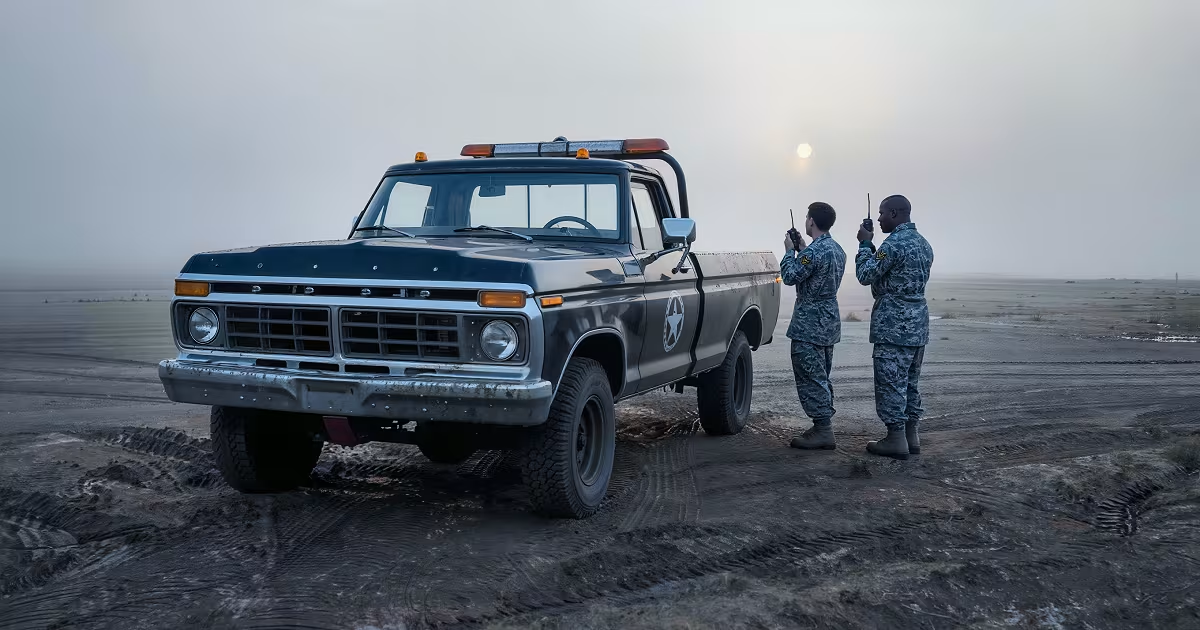
Two airmen with a pickup truck on a missile field, one on a radio.
Illustration, not a period photograph.

Opening
On 9 February 1978 the National Enquirer, at its Florida offices, opened an anonymous letter mailed from Rapid City, South Dakota. Inside was what appeared to be a carbon copy of an official incident report, stamped FOR OFFICIAL USE ONLY at top and bottom, and a short unsigned note. The carbon presented itself as a report from the commander of the 44th Missile Security Squadron at Ellsworth Air Force Base. Bob Pratt, then a staff reporter, described it as a Helping Hand that became a Covered Wagon at Lima 9, in the 68th Strategic Missile Squadron area, seven miles southwest of Nisland, at 2100 on 16 November 1977.
Pratt published the investigation in the January 1984 MUFON UFO Journal, during the year he edited that journal, not as an Enquirer article. Jerome Clark, in the February 2001 exchange posted on the NICAP page for this date, cited it as "The Truth About the 'Ellsworth Case.'"
Timeline
16 November 1977 is the night on the carbonIt is not a night confirmed by the logs the base later showed the reporters. In the text Pratt reproduced, A1C Samuel A. Phillips, at Lima Security Control, telephones Wing Security Control at 2059: an Outer Zone alarm at L-9. Security Alert Team 1, A1C Kenneth C. Jenkins and A1C Wayne E. Raeke, goes out as Trip 62, with an ETA of 2135, and the carbon puts them on the site at 2132. Pratt's summary of the same report put the incident at 2100. The body he retyped starts the alarm at 2059.
What that body claims, and only claims: Raeke leaves the truck to check a bright light shining up from behind the fence. The carbon puts a small hill about 50 yards behind L-9. At the crest he sees one figure in a glowing green metallic uniform and a helmet with a visor, challenges him, and aims an M-16 when the figure keeps walking. The figure aims an object. A flash disintegrates the rifle and burns Raeke's hands, second and third degree. Jenkins carries him to the vehicle, goes back, and sees two figures in the same uniform walk through the rear fence. He fires two rounds, one into a back and one into a helmet. Both fall, and about fifteen seconds later both stand, fire flashes of light, and move to the east side of the hill. Jenkins follows them to a saucer the carbon describes as about 30 feet across and 20 feet thick, glowing green. It climbs and disappears over the western horizon.
The same text upgrades the alarm at 2147 to Covered Wagon, at the request of Capt. Larry D. Stokes, whom it calls the flight security officer. Security Option II is started by Wing Security Control and by base Central Security Control. A backup force is numbered 1672 when it is formed, and numbered 1 when it arrives at 2330. At 2340 the carbon says the fence-line story was learned, then goes on narrating events it dates later, including a site survey at 0120 with readings of 1.7 to 2.9 roentgens. Missile maintenance finds the nuclear component missing from the warhead. Col. Spraker, named as wing commander, declares a national defense area and orders non-essential personnel out. The carbon says the follow-up will be classified by his order. A last note: Capt. Sanders, medical officer of the day, treats Raeke, Raeke is air-evacuated to an unspecified place, and the rifle cannot be found.
29 January 1978The note is dated that day and opens "Dear Enquirer." It says: "The incident stated in the attached report actually occurred." The writer says he was on the special team, and that he cannot give his name because he is still on active duty. The Air Force, he writes, ordered silence on 1 December 1977, and the report was classified Top Secret on 2 December, which is when he says he copied it. "There were 16 pictures taken at the scene. I do not have access to the pictures at this time."
9 February 1978Bill Dick, the articles editor who handled most of the Enquirer's UFO stories, gets the envelope. Pratt thought the form looked authentic and the report itself sounded like a hoax, and that it still had to be checked. They did not start with an official query. They expected a denial either way. Calls to the base and to Rapid City found that the named men existed and were on duty, except Raeke. The locator number for him did not answer. By the end of the day they thought there might be something to it, and they decided to go look.
10 February, the next morningDick, Pratt, and senior reporter Tony Brenna fly to Rapid City. Only two or three other people on the staff know where they are for the next ten days. For a day and a half they look for any sign the incident happened. Roads to Lima 9 are blocked by snowdrifts. Late Saturday they reach Jenkins. They do not tell him exactly what they are asking about. He is suspicious and will not come into town.
Sunday. Pratt visits SSgt Paul D. Hinzman at home. Brenna visits Stokes. Hinzman has never heard of the incident. He is not the communications plotter the carbon says received the report. His work is missile maintenance. He says Sgt. Stewart's first name is Roderick, not Robert, and that Stokes is not the flight security officer the carbon names. Stokes is in charge of the flight security officers for the flights under Ellsworth. Stokes tells Brenna the same sort of thing, and says he was in a hospital on 16 November. He calls the base. Before Brenna leaves the house, Security headquarters phones him there, asks him to stop questioning Air Force personnel off base, and says the reporters can come to Security headquarters on Monday. Brenna agrees.
Sunday afternoon. Eric Mishara arrives from an assignment in California, rents a four-wheel-drive, and spends most of the following week with ranchers around Lima 9. None of them has heard of it.
Monday. Dick, Brenna, and Pratt go to the base. They are not taken to Security headquarters. They are taken to Maj. Arthur Jungwirth, the base information officer. He makes calls and tells them nothing of that sort had happened. Over the next five days he brings the key names from the carbon into his office, Raeke included. Raeke had been in the field. The phone in his quarters was out of order. The reporters tape the interviews. One sergeant declines to discuss his personal life. Everyone else answers. Jungwirth also hands over Security Police desk blotters for Lima Launch Control and for Wing Security Control, the minute-by-minute logs for 16 and 17 November, and the hospital papers for when Stokes was admitted and discharged.
Thursday. Raeke comes in from the field, sits for questions again, and rolls his sleeves up. His hands and arms show no burns. During the same week the reporters get a look at Lima 9 itself.
Saturday, after nine days in Rapid City. Dick, Mishara, and Pratt fly back to Florida. Brenna flies to Raeke's hometown in Indiana.
In Florida, Pratt takes the cassettes to C.R. McQuiston for psychological stress analysis. McQuiston finds no reason to think anyone interviewed in Jungwirth's office was lying. He does mark stress on a tape of one man who is not named in the carbon, enough to suspect him of writing the hoax. Brenna returns to Rapid City and confronts that man. He denies it. The lead is dropped.
Pratt counted more than twenty errors: wrong names, identity numbers, jobs, and the physical layout.
Key figures
Pratt was the Enquirer reporter on the mailing, and for one year the editor of the journal that printed the account. Dick was the articles editor on the trip. Brenna was the senior reporter. Mishara joined from California on the Sunday. Jungwirth, a major, was the information officer between the reporters and the security squadron.
On the carbon, Phillips phones in the alarm, Jenkins and Raeke are the alert team, Stokes requests the upgrade, Hinzman is the addressee, Spraker is the wing commander, and Sanders is the doctor. Stewart is the sergeant whose first name Hinzman corrected. The note's writer, and the man Brenna confronted on the second trip, are both unnamed. Pratt does not say they are the same person.
Physical and documentary trail
The record: the carbon and the note, not a released Covered Wagon message. Pratt wrote that photos of both illustrated the January 1984 article. On the later MUFON page that carries the same story, he says he no longer had the document or the note and had retyped them. The night in the timeline is that retyping, not a scan of the sheet opened in Florida.
A transcription on the NICAP page for this date does not match his retyping. That page has Col. Speaker, a backup force on site at 2230, an object leaving to the east, and a saucer about 20 feet across and 20 feet thick. Pratt's text has Spraker, 2330, the western horizon, and about 30 feet by 20 feet thick. NICAP presents its copy as alleged FOIA material. Pratt's account of the arrival is the anonymous Rapid City mailing. Neither public wording can be treated as the photographed sheet.
The marking he reports on the carbon is FOR OFFICIAL USE ONLY. Top Secret on 2 December 1977 is a sentence in the note, not a stamp he describes.
Malmstrom, F.E. Warren, Loring, Wurtsmith in 1975, and Minot have released message traffic. This carbon does not. Other accounts of Ellsworth security alerts that month are not this carbon, and Pratt did not check them.
Things you might not know
- Raeke was at a funeral. The director of a funeral home in his Indiana hometown told Brenna that Raeke was home on leave on 16 November 1977, for his grandfather's funeral. Brenna also matched him to the high school yearbook.
- Stokes was in the hospital. He said so that Sunday. Jungwirth then gave the reporters the admission and discharge record.
- The hill is a quarter mile off. The carbon uses a hill about 50 yards behind L-9 as the cover. Pratt, once the snow let them in, found the compound flat, with a hill about a quarter mile west, and wrote that nobody there could have taken cover from a shooter.
- The blotters are ordinary. Jungwirth's copies cover Lima Launch Control and Wing Security Control for 16 and 17 November. Pratt's line was that everything in them was routine.
- Sixteen pictures, and no pictures. The note claims sixteen photographs and says the writer cannot get at them. Pratt's description of the envelope is the carbon and the note.
- Forty-four man-days. That is what the Enquirer spent chasing one anonymous letter: more than $15,000, salaries and expenses included, and the paper never ran the story.
- Jenkins and Raeke had not met. Pratt became convinced of that on the trip. A security policeman's tour was seventy-two hours at a minimum, and longer when snow closed the roads. Raeke's silent phone was that tour, plus a line that was out of order.
- Rapid City was supposed to notice. Pratt's glossary calls Security Option II a recall of off-duty security police and extra manning at the sites. He put the city at 45,000 plus and wrote that a call at that level would have been known on the base and in town.
Competing explanations
The intrusion happened, and the Air Force denied it. This reading has the real names, the real site, and the real terms: Helping Hand, Covered Wagon, Outer Zone, Security Option II, a 10-13. The phone checks, which found those names were real people, are why the Enquirer flew the next morning. It would be easy, Pratt wrote, to say the Air Force falsified documents, muzzled the base and the city, and "published a phony high school yearbook." He called that highly unlikely. Against it he had Raeke's unmarked arms, the hospital papers, and a funeral director placing Raeke in Indiana that night.
A hoax, written by someone who knew the wing's names and its security language, and mailed to the National Enquirer. The wrong jobs, the wrong first name, the hospital, the funeral, the flat ground, and the routine blotters are the evidence on this side. It still does not name the typist. McQuiston's suspect denied the confrontation, and Pratt dropped him.
An official fake, either a distraction or a security test that got out. On 4 February 2002, in a comment attached to the web text and not part of the 1984 article, Pratt said some researchers believed the Air Force engineered the hoax to draw attention off something else. He did not know what that something would be, and he did not see why a service hiding an event would invite Enquirer reporters onto it. Dick, he added, had died a few years earlier still convinced the Air Force was covering something up. Tom Deuley, in an email of 26 February 2001 posted on the NICAP page, remembered the paper later being called a "security breach test message." He then wrote that he had never seen, used, or heard of that method of testing people, in seven years as a communications officer at a secure facility or as a COMSEC analyst for the NSA. His objection to the text as a real alert was the tone. A missing nuclear-warhead component, he wrote, would not have been handled in a message this calm. "All in all, this message reads like a news report not a nuclear incident report." He remembered the ranks and names as messed up, which is what Hinzman had already told Pratt, and he remembered one listed person as not having been on the base. Pratt reported the named men as real people in the wrong jobs, interviewed in Jungwirth's office that February. On that one point the two accounts do not agree, and the 1978 interviews are the closer record.
Later life of the case
Pratt thought the carbon's later circulation was partly his doing. He had described the trip to UFO researchers as a hoax example, and he wrote that he probably passed on a copy. "From there, the report gained a life of its own." Questions at a MUFON symposium in Lincoln, Nebraska, several months before he wrote, were what showed him the mailing was already moving among researchers. Until that symposium he had thought only a few people knew.
The June before publication, a national weekly carried the "Ellsworth Case" and quoted a UFO author, with several books, saying it had happened and that the Air Force "had snowed the investigators." Pratt names neither the magazine nor the author. He allows that the line might be a misquote. If it was not, he wrote, that author's credibility was in question.
The same article says one researcher was told by an Air Force Office of Special Investigations agent that the incident really did happen, "and that is all some people needed." Pratt did not know the agent's motive. He had lately been told that the agent admitted it never occurred. He names neither man.
On 26 February 2001 Brad Sparks, on the NICAP thread, wrote that the paper was strongly suspected to be a Richard Doty fabrication, and that Doty was at Ellsworth in 1977-78. That is Sparks's suspicion, not a confession in Pratt's piece, and not a name Pratt used. Sparks also objected to "1.7 to 2.9 roentgens": a survey meter, as he read it, would not have been logged to those tenths, and the figure is a rate, roentgens per hour, not a dose. Pratt's retyping does not say per hour. Clark, in that exchange, called the case an exposed hoax, sent readers to the 1984 article, and said he discussed it on pages 302-03 of the second edition of his UFO Encyclopedia. Deuley added that when he raised the paper at SAC offices at Vandenberg, while he was still in that work, it was treated as a joke.
Finding
The night described in the carbon did not happen. That is Pratt's finding in the January 1984 article, from a reporter who made the trip and interviewed the men named in it, not a label added later. The strongest reading is a hoax. The carbon uses real names, a real site, and real security terms, and the blotters, the hospital record, the funeral home, and the ground at Lima 9 do not support the night it narrates.
What still will not resolve: who typed the carbon and the note. The man McQuiston flagged denied it, and that lead was dropped. The AFOSI agent is unnamed, and Pratt only reports being told both that the agent vouched for the incident and that the agent later took it back. Which public wording matches the sheet is still open. Pratt said photographs of it ran with the 1984 article, and he later did not have them.
Evidence signature
3/9 Thin
- Witnesses
- one person, or a tradition
- Instruments
- nothing on record
- Paper
- official records at the time
How well documented the case is, not whether it's true. A strong record can still have an ordinary answer, and a thin one can still be real.
You decide · ELLSWORTH 1977
What do you think happened?
One vote per case, anonymous. You'll see how other readers voted once you've voted.