NULLARBOR
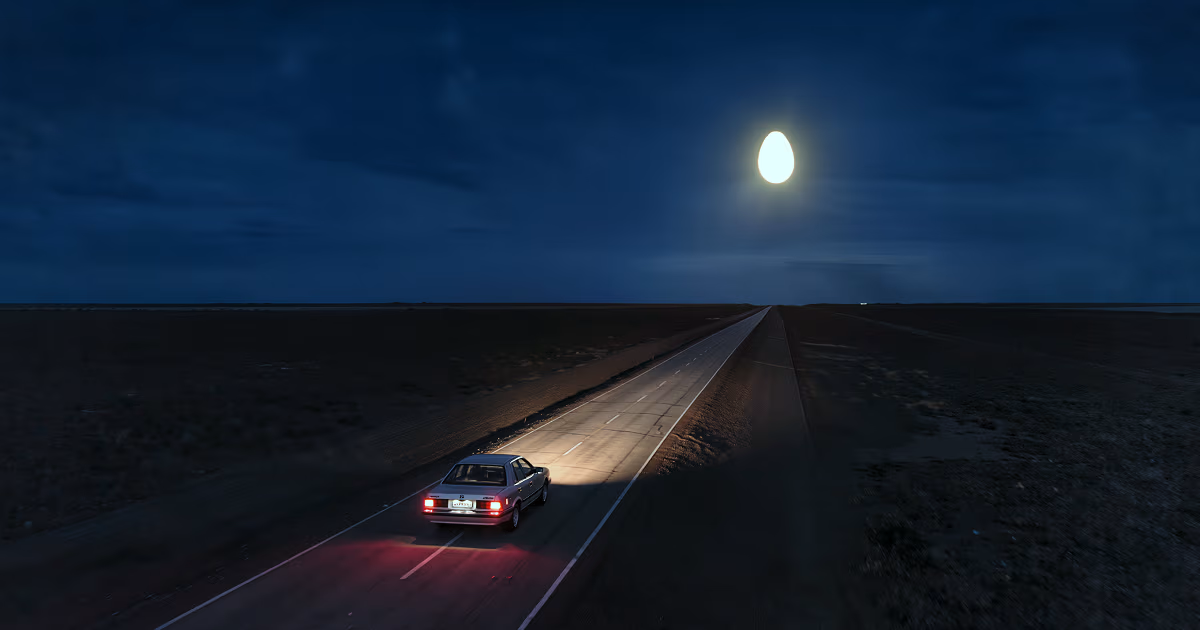
A lone car on a desert highway at night, an egg-shaped light above.
Illustration, not a period photograph.

Opening
At about 4 a.m. on 20 January 1988, Faye Knowles and her sons Patrick, Sean, and Wayne were driving east across the Nullarbor on the Eyre Highway, about 40 km west of the Mundrabilla Roadhouse in Western Australia. They said a glowing, egg-shaped light on the road chased their Ford, landed on the roof, lifted the car, and dropped it, bursting a tyre.
When they reached Ceduna in South Australia, about 600 km further east, police took their report and described black ash on the car and slight roof damage. Later inspections found no ash and nothing unusual. A meteorologist explained the light as distorted truck headlights. What the family went through that night is still disputed.
Timeline
20 January 1988, about 04:00The family, travelling from Perth to Melbourne with two dogs, see a bright light ahead between Madura and Mundrabilla. By the UFO Research Queensland account, Sean is driving and asks his brother whether it's a spaceship; a contemporary UPI report says Mrs Knowles was driving. The light is described as about a metre wide, white with a yellow centre, shaped "like an egg in an eggcup". Swerving to avoid it, they nearly hit a station wagon towing a caravan; its occupants never came forward.
Minutes laterThe family say they turned back towards the light, then turned again and fled, and that it came down on the roof with a thump. They describe the car being lifted, their voices becoming slow and distorted, a foul smell, and a black dust. Mrs Knowles says she reached out of a window and touched something soft, warm, and spongy on the roof. When the car came down, the rear right tyre burst. They hid in roadside bushes for about 15 minutes, changed the tyre, and drove on.
Same morningTruck driver Graham Henley, also eastbound, reports a light in his mirror that he likened to "a big fried egg hung upside down". At Mundrabilla he meets the Knowles family and later says he saw black ash in and on the car and four dents in the roof.
20 to 21 JanuaryAt Ceduna, about 600 km away, Sergeant James Fennell inspects the car. Police also note three other reports that night: Henley, a tuna-spotting aircraft that saw a bright light near the highway, and a fishing trawler in the Great Australian Bight that reported a hovering light.
Following daysThe family go on to Adelaide, where UFO Research South Australia, including Keith Basterfield, try to investigate. A television station's deal with the family complicates access. A laboratory commissioned by the station reports that "no significant dust was observed on the vehicle as presented for inspection".
17 October 1988A coach driver, Peter Chapman, with 25 passengers aboard, reports a bright light following the bus about 20 km west of Mundrabilla. Basterfield identifies it as the planet Jupiter.
December 1989A. T. Brunt, former Regional Director of the Bureau of Meteorology in South Australia, publishes his analysis in The Skeptic.
Key figures
Faye Knowles, then 48, and her sons Patrick, 24, Sean, 21, and Wayne, 18, are the witnesses. Police described them on arrival as extremely distraught.
Sergeant James Fennell and Constable Bob Hagen of Ceduna police gave the first official statements to the press. Hagen said reports of this kind usually didn't hold much water with them, but that after seeing the car and the family they thought "there could be something in this".
Graham Henley is the only independent witness to a light in the same area at the same time.
A. T. Brunt, a retired meteorologist, wrote the main sceptical analysis at the request of Popular Astronomy's editor, Ian Ridpath.
Physical and documentary trail
The record holds the UPI wire report of 21 January 1988 quoting Ceduna police, Basterfield and Brooke's April 1988 report for UFO Research Australia, the TV station's laboratory finding, dust samples taken by UFO researchers, and Brunt's 1989 paper.
The physical evidence pulled in two directions. Fennell and Henley described a thick coating of black ash and roof dents. Brunt reports that later inspections by police and several UFO groups found no ash inside or out, only a black deposit on the front wheel rims consistent with brake lining, a rear tyre that had burst normally for a car driven fast, and roof dents that were insignificant and not proven to be new.
Something happened out there.
The "two dusts" in the case are real but modest: samples sent to Richard Haines, then a NASA scientist, showed dust from the inside of the car differed from dust on the outside. Later analyses found nothing alien or unusual in either.
Things you might not know
- The spaceship question came from inside the car. By the family's account, it was Sean who first asked his brother whether the light was a spaceship.
- Brunt blamed a truck about 100 km away. He suggested a westbound vehicle coming down into Eucla, on high ground, whose headlights a temperature inversion could have bent into a dazzling image.
- Nullarbor train lights arrive early. Brunt notes that people at railway sidings on clear, calm nights report seeing an approaching train's headlight for an hour before it arrives.
- The weather was unusual. A ridge of high pressure over 1,000 km long ran along the southern coast that morning, with a marked temperature inversion recorded at Forrest.
- The highway has a UFO warning sign. Brunt mentions a roadside sign near the WA/SA border telling travellers to beware of UFOs.
Competing explanations
An object that lifted the car. This is the family's account, supported in part by Henley's sighting of a light and his description of ash and dents, and by the police's first impressions. Against it: no inspection after Ceduna found the ash, the dents were not shown to be new, and no one else saw the car lifted.
A refracted light plus panic. Brunt's reading: the family's first thought, a truck coming from the east, was right, and the inversion turned its headlights into a large, jumping image. The burst tyre and the rest follow from fear and fast driving. It explains the light well. It explains the reported lift, voices, and smell only by assuming they were produced by terror, which no one can test.
A story that grew. Chequebook journalism entered within days, which UFO researchers themselves said obstructed investigation. That doesn't make the family's account false, but it does mean later versions can't be treated as independent of the media deal.
Later life of the case
The Mundrabilla encounter is one of Australia's best-known UFO cases and turns up regularly in local media retrospectives, including an ABC Curious Adelaide feature in 2018. The October 1988 bus sighting shows how quickly the stretch of highway became associated with lights.
Finding
Settled: on 20 January 1988 the Knowles family reported a terrifying encounter on the Eyre Highway, a truck driver saw a light in the same area, and Ceduna police found the family deeply shaken. The physical evidence did not hold up: later inspections found no ash and nothing unusual about the car. The best explanation for the light is a refracted distant headlight under a strong inversion.
What still will not resolve: what the family experienced inside the car. A mirage accounts for what they saw on the road, but not, on any record that can be checked, for what they say they felt.
Evidence signature
5/9 Solid
- Witnesses
- several people
- Instruments
- photo, film or physical traces
- Paper
- official records at the time
How well documented the case is, not whether it's true. A strong record can still have an ordinary answer, and a thin one can still be real.
You decide · NULLARBOR
What do you think happened?
One vote per case, anonymous. You'll see how other readers voted once you've voted.