AVELEY INCIDENT
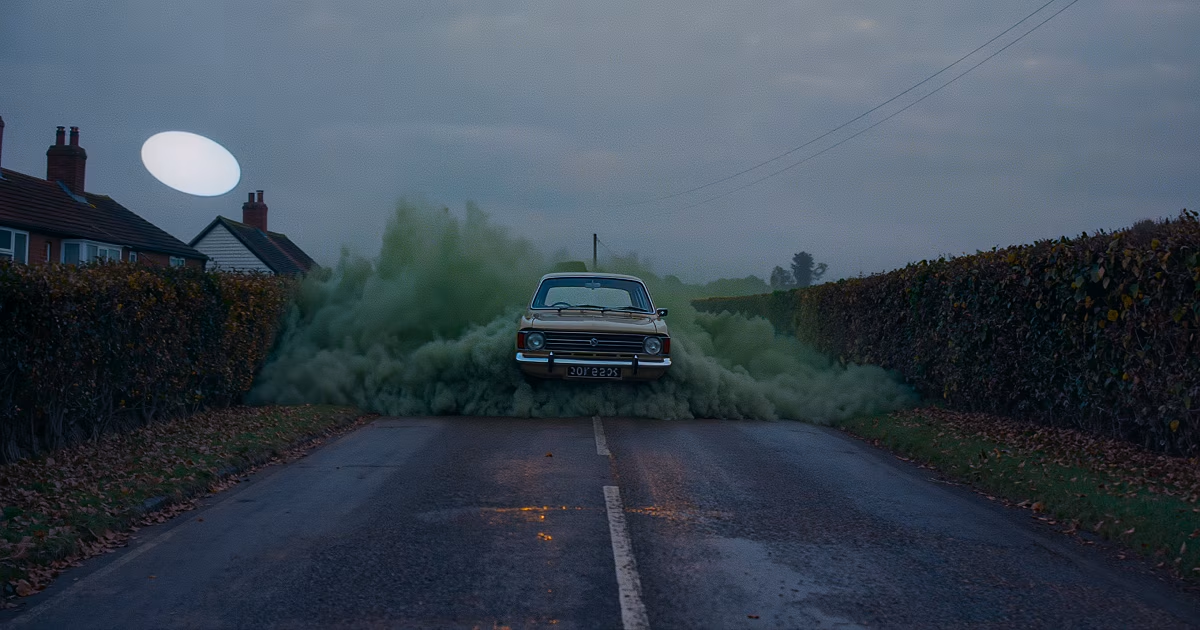
Aveley Road in Essex. Night approach.
Illustration, not a period photograph.
Opening
On the night of 27 October 1974 a family of five driving home through Essex said their car entered a bank of green mist on the road into Aveley. John and Sue Day were in the front. Three children were in the back. The radio crackled and smoked. The engine and tyre noise dropped away. When they came out the other side the clock and their bodies no longer agreed about the hour.
That missing stretch is the British hinge. Later regression gave both adults matching rooms, figures, and a tour they had not told in October. Those sessions are after-action. The 1974 paper is a family, a lane, a green bank, and three hours that will not sit on the dashboard.
The spine of the file is the mist on Aveley Road. Everything after it is argument about whether the car only lost time, or left the road.
Timeline
27 October 1974, about 22:00. The Days are returning from relatives, Harold Hill toward Aveley. Kevin, the child still awake, points out a pale blue oval light over houses. John and Sue see it too, off to the left, like a large star that is not behaving as one.
On the lanes near Upminster the engine note and the tyres go quiet. The radio is the sound that remains, then it crackles and smokes and John pulls the wires. Ahead, no more than thirty yards, a dense green bank stands across the road, eight or nine feet high. They go into it at about thirty miles an hour. Inside it is light and cold. Sue feels the car jerk.
They come out onto ordinary tarmac. Home is closer in clock time than the drive should allow, or later, depending on which reconstruction you read. The usable fact is a gap the family cannot fill from waking memory that night. The car still runs. The radio is dead.
In the months after, Andrew Collins takes the case. The family first appear in print under the name Avis. Hypnosis and interviews in 1975 produce the craft narrative: white beam through the green, a hangar space, pale figures, a lesson about seed and future. That material is 1975 speech about 1974. It is not the mist itself.
Key figures
John Day drives. He is the one who kills the smoking radio and who later gives the fullest onboard account. The 1974 driver and the 1975 witness under regression are not automatically the same exhibit. Keep them in that order.
Sue Day is the second adult set of eyes on the bank. Her jerk of the car and the cold inside the green are the first-night texture. Later she and John separate. That is later life, not the lane.
Kevin, Karen, and Stuart are in the car. Kevin sees the blue light first. A child who points at a light is not a co-author of a hangar tour. The three hours belong to the whole vehicle.
Andrew Collins is the investigator who makes Aveley a British set piece. He calls it a first-rank case. His reports are why the green bank has a map. They are also why the later rooms are now welded to the mist in public memory.
Physical and documentary trail
On the paper, 27 October 1974 gives you four hard objects and no beam photograph.
One: the family's same-night account of the blue light, the dead engine note, the smoking radio, and the green bank on Aveley Road. That sequence is the originating claim.
Two: the time gap. Three hours is the figure that stuck. Whatever the exact minutes, the family could not account for the stretch from waking memory on the night. No second car logged the same bank.
Three: Collins's first write-ups, including the version in Flying Saucer Review, which fix the height and colour of the mist and the silence of the car. Those pages are the nearest thing to a 1974-75 field record.
Four: the 1975 regression material. Matching adult stories of a craft. Useful as a later layer. Not a 27 October exhibit. There is no independent instrument on the lane that night.
There is no photograph of the green bank. There is no burned verge with a measured mark. There is no third adult standing on the verge with a watch.
Dense green and banked about 8-9 feet high.
Competing explanations
Abduction through the mist. This reading takes the later rooms as recovered memory of what the green hid. It has two adult voices in agreement after hypnosis. It has no 1974 object on the road.
Missing time without a craft. Fatigue, an odd fog, a radio failure, and a family that later filled the gap with the available genre. The green bank can be real weather and still not be a door. The silence of the engine is the part this reading has to work for.
Confabulation after a scare. Collins arrives, questions begin, hypnosis does what hypnosis often does. The Days have always sounded grounded about other parts of their lives. That does not freeze a 1975 session into a 1974 hangar.
Hybrid caution. A family car hit something on Aveley Road that took time off the clock. The rooms came later. Both sentences can sit in the folder.
Later life of the case
Aveley becomes Britain's primary missing-time card. The Avis pseudonym drops. John lives a quieter life. Sue takes another path. Collins keeps the case in print. Television borrows the green bank and skips the radio wires.
I keep the onboard tours and the later psychic framing on the later-life shelf. I do not treat them as incoming 27 October field notes. The mist stays first.
Finding
John and Sue Day drove into a green bank on Aveley Road, the radio died in John's hands, and when they came out the hour no longer fitted the drive. Kevin had already pointed at a blue light. That is the night, and there is no kindness in talking a family out of their own lane. The rooms and the pale figures came later, when they tried to live with the gap. The mist is first.
What still will not resolve: a third adult with a watch on that verge, or a photograph of the bank. Either one would pin the missing hours to the road instead of to memory. Until then the Days have a night the dashboard will not explain, and the rest of us have their word.