SOCORRO INCIDENT
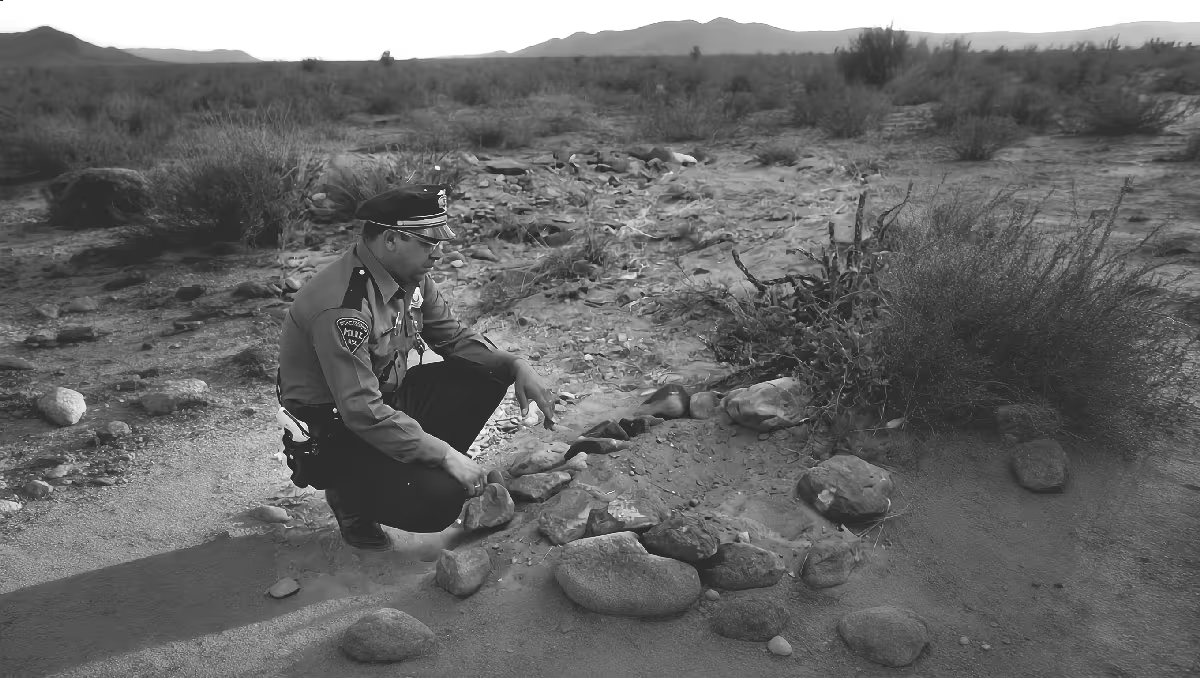
Socorro landing site and trace marks.
Illustration, not a period photograph.
Opening
At about 5:45 p.m. on 24 April 1964, Socorro, New Mexico, police sergeant Lonnie Zamora broke off a routine speeding chase after hearing a loud roar and seeing a rising flame he assumed came from a nearby dynamite shack. Driving toward the sound over rough dirt roads, he instead came upon an elliptical, whitish object resting on four thin extended legs in a gully, with two small figures in white coveralls standing beside it. As he approached on foot, the figures vanished from view; the object then emitted a roar and a blue-orange flame and lifted off, departing rapidly to the southwest. Officers arriving within minutes found smoldering brush and four fresh, symmetrical indentations in the soil.
This is widely regarded as one of the best-documented UFO close encounters on record, not because the physical evidence is conclusive, it is not, but because the witness himself was independently and repeatedly assessed by every agency that investigated him, the FBI, the Air Force, and Project Blue Book's own scientific consultant, as unusually credible and specifically not prone to fantasy or fabrication.
Timeline
24 April 1964, approximately 5:45 p.m. Zamora, five years on the Socorro force, breaks off pursuit of a speeding car after hearing a roar and seeing a flame to the southwest, radioing his dispatcher, Nep Lopez, that he is investigating what he believes may be an exploding dynamite shack.
Same time, minutes later. Navigating rough, unpaved roads toward the arroyo, Zamora sees a shiny, oval object resting on four legs, and two small humanoid figures in white coveralls standing near it, one appearing to react to his presence.
Same encounter. As Zamora exits his vehicle and approaches on foot, the figures are no longer visible. The object then produces a loud, pitch-shifting roar and a blue-orange flame from its underside and lifts off, departing rapidly and disappearing to the southwest within seconds.
Same evening, within minutes. Sergeant Sam Chavez and other officers arrive at Zamora's radioed location and find burning brush and four fresh, roughly rectangular ground indentations arranged in a symmetrical pattern, along with smaller burn marks consistent with a searing heat source rather than a chemical fire.
Following days. The FBI, U.S. Army, and Project Blue Book all investigate independently. Geiger counter surveys from Kirtland Air Force Base find no abnormal radiation; soil samples sent to Air Force laboratories show no foreign substances or rocket propellant residue.
Same period. Every investigating body separately and consistently assesses Zamora's own credibility as strong; the FBI's report describes him as "well regarded as a sober, industrious, and conscientious officer and not given to fantasy." J. Allen Hynek, Blue Book's scientific consultant, personally travels to Socorro, examines the landing marks and burn patterns closely, and finds Zamora "unimaginative" in the specific, favorable sense of a witness unlikely to embellish, initially reluctant to discuss the event at all.
Same period. A local unnamed tourist separately tells the El Defensor Chieftain newspaper he saw low-flying aircraft in the area and described a "funny-looking helicopter, if that's what it was," a secondary account later investigators, including UFO skeptic Philip Klass, argue could not plausibly have observed both the object and Zamora's own police car from the position described.
Blue Book's formal investigation. Major Hector Quintanilla, the case's Air Force investigator, specifically checks whether the object could have been a prototype Apollo-program Lunar Excursion Module test vehicle, given the described leg configuration, and finds no such prototype was operational anywhere in April 1964, ruling out that specific candidate on documentary grounds.
Final classification. Project Blue Book lists the case as "unknown," one of a small number of cases the project never resolved to its own satisfaction across its entire run.
Later years. Ray Stanford, a UFO researcher who was in Socorro shortly after the event, publishes a full-length book on the case, Socorro Saucer in a Pentagon Pantry, arguing for a genuine extraterrestrial visit and government interest in covering up its full details.
Later skeptical work. British UFO skeptic Steuart Campbell proposes the sighting was most likely a mirage of the star Canopus under unusual atmospheric refraction, an explanation critics note does not address the separately documented, physically measured ground traces. Klass separately argues the entire event was staged with the knowledge or involvement of Socorro's mayor as a publicity stunt for the town, a theory that requires dismissing both Zamora's own extensively vetted credibility and the independently observed physical evidence.
Ongoing speculation. A rumored New Mexico Tech student prank theory persists, including one former university president's claim to have suspected a specific student, and one later self-identified former student's account of using dynamite-shack explosives to launch 55-gallon drums into the air near the site, though no confirmed hoaxer has ever come forward and the physical evidence's specific characteristics, precise, symmetrical, weight-consistent ground indentations rather than impact damage, have not been convincingly replicated by any proposed prank scenario.
Key figures
Zamora is the case's central and, by wide agreement across every investigating body, unusually strong witness: a working police officer with no history of UFO interest, evaluated independently by the FBI, the Air Force, and Hynek himself, all of whom concluded he was not the kind of person likely to fabricate or embellish such an account.
Hynek is the case's most significant scientific investigator, whose personal, hands-on examination of the physical traces and direct, extended assessment of Zamora's demeanor lends the case unusual weight within Blue Book's own institutional record, an investigator broadly willing to offer conventional explanations for other cases finding none satisfying here.
Quintanilla is the case's formal Air Force investigator, whose specific, documentary rejection of the lunar-lander-prototype theory (based on confirmed program timelines rather than speculation) represents a genuine, checkable piece of due diligence within the official file.
Stanford and Klass represent the case's two most developed opposing narratives, a believer's book-length case for genuine extraterrestrial contact and a skeptic's publicity-stunt theory implicating local officials, neither of which has achieved the kind of consensus support that would close the file in either direction.
Physical and documentary trail
On the paper, this file has a signed police report, official 1964 photographs of the landing site and ground marks, FBI memoranda independently assessing Zamora's credibility, detailed Project Blue Book case files (including previously unreleased handwritten notes surfacing as recently as 2018), radiation surveys, and laboratory soil analysis, an unusually thick, multi-agency documentary record for a single witness encounter.
The physical trace evidence is the case's strongest and most argued-over element: four symmetrical ground indentations investigators judged consistent with a significant weight settling gently rather than an impact, isolated intense burn patterns with untouched vegetation immediately adjacent, and small metal scrapings found on one broken rock within an indentation, all independently observed by multiple investigators from different agencies rather than reported solely by Zamora himself.
Well regarded as a sober, industrious, and conscientious officer and not given to fantasy.
Competing explanations
A mirage of Canopus under unusual atmospheric refraction. Campbell's proposed explanation, while grounded in a real, if unusual, optical phenomenon, does not address the independently observed and measured physical ground traces at all, a significant gap given that those traces were documented by multiple investigators rather than reported by Zamora alone.
A prototype lunar lander test vehicle from nearby White Sands. This explanation has intuitive appeal given the described leg configuration and regional proximity to missile-range testing, but Quintanilla's own contemporary investigation found no such prototype operational anywhere at the time, a specific documentary rejection rather than mere skeptical dismissal.
A staged publicity stunt involving local officials, per Klass. This theory requires dismissing the FBI's, the Air Force's, and Hynek's independent and converging assessments of Zamora's own credibility, and rests significantly on disputing the secondary tourist witness's account rather than on any direct evidence of official involvement.
A New Mexico Tech student prank. Persistent but never confirmed by an actual named, come-forward hoaxer, and the specific physical characteristics of the ground traces, precisely, symmetrically weight-settled rather than impact-damaged, have not been convincingly reproduced by any of the proposed prank mechanisms (balloons, drums propelled by dynamite) offered over the decades.
A genuine unconventional craft and occupants. This remains the reading best supported by the convergence of an unusually well-vetted witness, independently observed and measured physical ground evidence, and Blue Book's own formal, never-revised "unknown" classification, arrived at by an investigating body that resolved the great majority of its caseload to conventional explanations.
Later life of the case
Socorro remains a landmark case specifically because of how thoroughly its central witness was independently vetted by multiple institutional bodies with no particular motive to protect him, a level of formal credibility assessment few UFO cases receive. The 2018 surfacing of previously unreleased Blue Book investigator notes shows the case continues to generate new primary documentation even six decades on, an unusual longevity for a single-witness encounter.
Finding
A police officer independently and repeatedly assessed as unusually credible by the FBI, the Air Force, and Blue Book's own scientific consultant reported a close-range encounter with a landed object and two humanoid figures, and multiple investigators from different agencies independently documented physical ground traces consistent with that account rather than reliant on his testimony alone. Every specific proposed conventional explanation, mirage, lunar lander, publicity stunt, student prank, has been directly challenged either by documentary evidence or by a failure to account for the full physical evidentiary record.
What still will not resolve: a confirmed hoaxer, a confirmed prosaic craft matching the described configuration, or a mechanism producing the specific, symmetrical, weight-consistent ground traces investigators documented. Until one of those appears, Socorro stays exactly where Project Blue Book itself left it: formally, and by its own admission, unknown.