CASH-LANDRUM
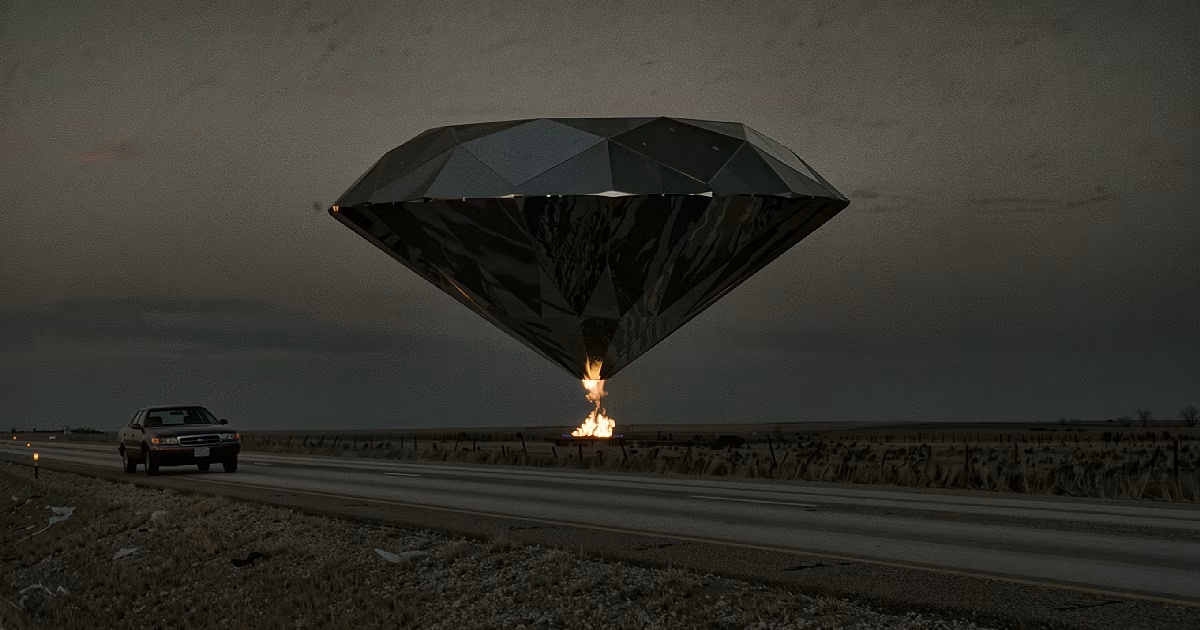
Cash-Landrum encounter scene.
Illustration, not a period photograph.
Opening
On the night of 29 December 1980 three people in a car on Farm to Market Road 1485, between New Caney and Huffman, Texas, said a bright object stopped them. Betty Cash was driving. Vickie Landrum sat with her grandson Colby. They described a diamond-shaped mass that threw heat and flame toward the road, then a sky full of helicopters.
In the days that followed Cash went into hospital. All three reported burns, sickness, and eye trouble. The case left the ordinary UFO file because it acquired medical charts, a claim against the United States, and a federal lawsuit seeking twenty million dollars. The government answered that it owned no such craft and had flown no such helicopter armada. In 1986 a district judge dismissed the action.
The spine of the file is that collision: a close approach story, a medical aftermath real enough to put a woman in a ward, and a paper trail in which the United States refused, in court, to accept the helicopters as its own.
Timeline
29 December 1980, about 21:00 to 21:30. Cash is taking Landrum and Colby home to Dayton after an outing. On the narrow road through pine they say the object is ahead of them, large, bright, throwing fire or a glow toward the pavement. Cash stops. They get out or lean into the heat. Colby is frightened. After some minutes the object rises. Helicopters arrive in number. The witnesses later count more than twenty and identify tandem-rotor machines of the CH-47 Chinook type. Cash says some carry United States Air Force markings. They drive on, still seeing the formation, and reach home late and unwell.
Symptoms begin that night: nausea, weakness, burning skin and eyes. On 3 January 1981 Betty Cash is admitted to Parkway General Hospital in Houston. She cannot walk. Doctors treat swelling and skin trouble. She stays nearly two weeks, goes home, and returns for another stay. Hair loss and scarring become part of her later account. Vickie Landrum reports sores, hair change, and in April 1981 a cataract. Colby has milder complaints.
January 1981. John F. Schuessler, a NASA contractor and Mutual UFO Network investigator, enters the case, inspects the car and the reported stretch of road with a Geiger counter, and finds no residual radioactivity. The Texas Department of Health later walks the road and also finds no leftover radiation.
August 1981. The three witnesses go to Bergstrom Air Force Base and give recorded statements. Senators Lloyd Bentsen and John Tower have pointed them toward a military claims office. They file administrative claims. On 2 September 1983 the Air Force denies those claims. Attorney Peter Gersten then takes a civil action against the United States in the Southern District of Texas. Army, Air Force, Navy, and NASA officials say they have no diamond craft and no record of the helicopter operation. Lieutenant Colonel George Sarran of the Army Inspector General's office looks for the helicopters and does not find a unit that owns the night. On 21 August 1986 the suit is dismissed.
Key figures
Betty Cash is fifty-one, a restaurant owner from Dayton, and the most injured of the three on her own telling. She drives. She stands nearest the object in the standard reconstruction. She spends the longest time in hospital. Her later years include cancer. The medical file is hers more than anyone else's. It shows illness. It does not, by itself, show a beam from a craft.
Vickie Landrum is fifty-seven and Colby's caretaker. She is the second adult voice. Her description of the object and the helicopters tracks Cash's on the main points and diverges on counts and emphasis, as close witnesses often do. She lives with eye damage and skin trouble and keeps the story when the lawsuit dies.
Colby Landrum is seven. His fear in the car is consistent across tellings. A child of that age is not a technical observer of rotor types. He is a third body in the same place at the same time, which is why the case is not a single-witness road story.
John F. Schuessler builds the investigative dossier. He tapes interviews, gathers medical paper, hunts helicopters, and writes the book that fixes the public narrative. He believes the witnesses and treats the object as unknown. His work is the reason the file is thick. It is also the reason later critics say the case was shaped by an advocate before it was tested.
Peter Gersten brings the lawsuit. Lieutenant Colonel George Sarran brings the Army's search for the Chinooks. The judge who dismisses Civil Action H-84-348 brings the legal ending. Those three men turn a roadside night into a question the United States has to answer on paper, and then into an answer the United States declines to fund.
Physical and documentary trail
On the paper, 1980 and the years just after give you four hard objects.
One: the August 1981 Bergstrom Air Force Base interview tapes and sketches. The witnesses sit with Air Force personnel, describe a flaming diamond, and place CH-47 type helicopters over East Texas. The session is the first institutional recording of the story, made months after the night and after hospital time.
Two: Betty Cash's hospital and physician records from January 1981 onward, including notes associated with Parkway General and with her cardiologist, Dr. V. B. Shenoy. The charts document treatment for severe skin and systemic complaints. They do not contain a laboratory proof of ionizing radiation delivered on 29 December. Later reviewers have pointed to diagnoses such as cellulitis and to the timing of hair loss, which complicates a simple radiation reading.
Three: the helicopter hunt. Schuessler and others canvass Guard and active units. Dayton officer Lamar Walker and his wife Marie later say they saw a group of Chinook-type helicopters and a bright light that same period, without confirming the diamond craft. Sarran finds witnesses credible and finds no operational match. No flight log has been produced that puts more than twenty military tandem-rotor machines over FM 1485 at that hour.
Four: the claims and the lawsuit. Department of the Air Force letter denying the Cash, Landrum and Landrum personal injury claims, 2 September 1983, states that investigation found no evidence of involvement by military personnel, equipment, or aircraft. Cash v. United States, Southern District of Texas, Civil Action H-84-348, dismissed 21 August 1986, is the court end of that road.
There is no 29 December photograph of the diamond. There is no recovered fragment. There is no residual radiation on the road when health officers walk it. The Geiger reading on the car is clean.
Our investigation has revealed no evidence of involvement by any military personnel, equipment or aircraft in this alleged incident.
Competing explanations
Secret craft with a military escort. This is the witnesses' explanation. A vehicle, possibly experimental, injures them with heat or radiation, then Chinooks take it away. The reading requires the United States to have flown a formation it later denied under oath, and to have possessed a vehicle no service would admit. The court did not find that fingerprint.
Misperception plus separate illness. This reading treats the night as a stressful drive over-read as a craft, and the hospital chapter as real medicine with another cause. Hair loss can be autoimmune. Skin trouble can be infection. A bright source on a dark road can be a flare, an industrial fire, or an aircraft. Philip J. Klass stressed the clean Geiger reading and the missing baseline of pre-1980 health paper.
Unknown vehicle, unproven owner. This middle keeps the witnesses sincere, keeps the hospital real, and drops both the non-human craft and the proven Chinook armada. Chemical exposure or an unidentified machine not owned by the defendants would fit. Brad Sparks noted that the speed of onset is a poor match for classic ionizing radiation survival. The middle is unsatisfying. It may still be the one the paper can carry.
Hybrid caution. Three people were on that road. One of them was soon in a ward. The helicopters remain a claim without a logbook.
Later life of the case
Television finds Cash-Landrum early. That's Incredible, Unsolved Mysteries, and later series keep the diamond and the Chinooks in circulation. Schuessler's book becomes the reference text. After the dismissal the legal road is closed. The cultural road stays open.
Betty Cash dies in 1998. Vickie Landrum dies in 2007. Colby speaks as an adult. Researchers such as Curt Collins go back to the raw medical and helicopter files and separate what was said in January 1981 from what accumulated in retellings.
I keep Schuessler's later narrative and the television enlargements on the later-life shelf. I do not treat them as incoming 29 December field notes.
Finding
Betty Cash, Vickie Landrum, and Colby met something on FM 1485 that threw heat into the car and then filled the sky with helicopters. They were not looking for a case. They were driving home. The burns were treated. The night stayed with Betty until it killed the rest of her ordinary health. That is the witness file, and it is enough to believe they were under an object that did not belong on a farm road.
What still will not resolve: a tail number. A flight log for those helicopters, or a unit that will own the diamond of fire, would take the case out of the civil docket and put it on a hangar floor. A court can decline. Skin cannot.