VARGINHA
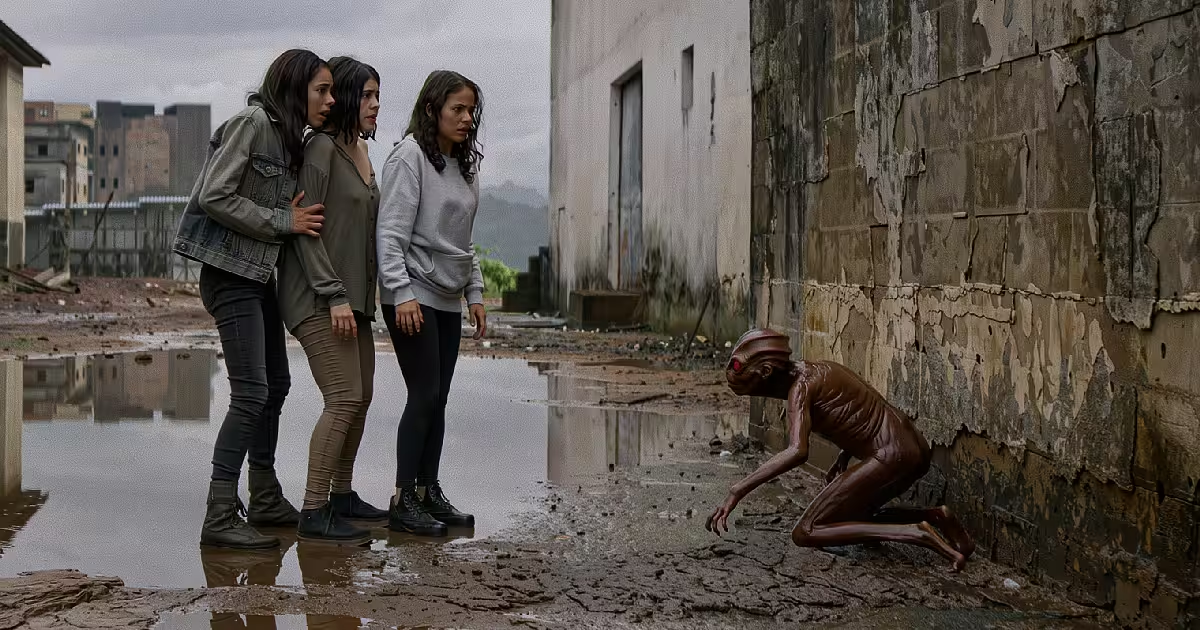
Varginha encounter and recovery.
Illustration, not a period photograph.
Opening
On 20 January 1996 three young women walking in Jardim Andere, Varginha, Minas Gerais, said they saw a creature crouched by a wall on vacant ground. Liliane and Valquiria Silva and their friend Katia Andrade Xavier described a biped with brown oily skin, a large head, red eyes, and a smell that drove them home. That afternoon report is the first hard civilian layer.
Within days the story grew into a crash, a firefighter capture, Army trucks, a hospital commotion, and bodies leaving the country. Ufologists Ubirajara Franco Rodrigues and Vitorio Pacaccini collected statements. A 1996 book named soldiers. In 1997 the Escola de Sargentos das Armas opened Military Police Inquiry No. 18 and closed it by saying the Army had not transported extraordinary cargo and that the women had probably seen a local man known as Mudinho in rain and poor light.
The spine of the file is that split. The girls' daylight encounter sits in one tray. The recovery epic sits in another. Official paper answers the second tray and only glances at the first.
Timeline
13-20 January 1996. Later crash-retrieval tellings place an object down in the days before the girls' walk. Those dates are not in a stamped military recovery log. They are in later speech.
20 January, late afternoon. Liliane, Valquiria, and Katia see the figure on the vacant lot. They run. Family and neighbors hear the story the same evening. No photograph of the figure is taken.
21 January and the days after. Talk of hospital activity, firefighters in Jardim Andere, and Army vehicles spreads through town. Rodrigues tracks a nurse who describes commotion at the Regional Hospital involving outside doctors, Military Police, and Army vehicles. The nurse's account is second-hand heat, not a signed intake sheet for a non-human patient.
4 February 1996. Fantastico airs interviews with the witnesses and with Rodrigues. The national desk arrives. On 28 February Estado de Minas reports ufologists' claim that an anonymous soldier described a firefighter capture and military transport.
1996 book. Pacaccini's Incidente em Varginha names soldiers as participants. That naming is what opens the Army's own paper.
13 February to 19 June 1997. EsSA produces IPM No. 18/1997, 357 folios in two volumes. Named soldiers deny extraordinary transport. Vehicle movements are given ordinary maintenance explanations. Lieutenant Colonel Lucio Carlos Finholdt Pereira signs a close that treats the ET narrative as fiction without scientific basis. The file is archived in August 1997. The Superior Military Court later makes the volumes available.
The girls keep their version. Some later military voices enlarge, then retract. Thirty years on, the civilian sighting and the official denial are both still on the table.
Key figures
Liliane Silva, Valquiria Silva, and Katia Andrade Xavier are the first witnesses. They are not soldiers and they are not authors. Their 1996 description is the only part of the case that does not depend on a later capture chain. They have kept the figure. They have not produced a photograph of it.
Ubirajara Franco Rodrigues is the local lawyer-investigator who gets to the girls early and stays with them. Vitorio Pacaccini writes the book that forces the Army to open an inquiry by putting names on paper. Their dossiers are why the case is thick. They are also why the official file reads like a rebuttal to a book rather than a field study of a vacant lot.
Luís Antonio de Paula, known as Mudinho, is the official substitute. The inquiry says a local man with mental health problems, crouched and dirty in rain, could match the girls' outline. He is a person, not a laboratory result. The girls have rejected the substitution.
Lieutenant Colonel Lucio Carlos Finholdt Pereira signs the Army close. Named soldiers in IPM 18/1997 deny the transport story. Corporal Kleber dos Reis Domingues, in the same paper, admits he knows Pacaccini because the investigator came to his house asking about an alleged ET. That admission is contact with an investigator, not a confession of a capture.
Physical and documentary trail
On the paper, 1996-1997 gives you four hard objects and no body.
One: the 20 January statements of the three women, taken up by local press and then by Fantastico. The vacant-lot figure is the originating claim. There is no contemporaneous photograph of that figure.
Two: hospital and street rumor collected in late January and February, including Rodrigues's nurse interview about 21 January commotion. Vehicles and uniforms are easier to prove than cargo. The cargo remains speech.
Three: Pacaccini's 1996 book naming soldiers. Without those names the Army has less reason to open a 357-folio inquiry. The book is a source and a target at the same time.
Four: Inquerito Policial Militar No. 18/1997, Escola de Sargentos das Armas, archived August 1997 and later released through the Superior Military Court. The close denies extraordinary military transport, offers Mudinho for the lot, and calls the ET narrative fiction. That is the official Brazilian paper. It is not a laboratory analysis of a recovered organism.
There is no released photograph of a body. There is no chain-of-custody tag from a crash site. There is no U.S. flight manifest that lists Varginha cargo. Those absences are why the recovery epic cannot be filed as fact.
Nao restou comprovada a existencia de qualquer fato que indique a queda de objeto voador nao identificado ou a captura de seres extraterrestres.
Competing explanations
Non-human entity and military recovery. This reading takes the girls at their word and then accepts the later capture chain: firefighters, Army trucks, hospital, transfer out of the country. It has many voices and no authenticated physical record of a body. Some military tellings have been withdrawn or paid-for in later Brazilian coverage. The girls' consistency does not automatically vouch for the trucks.
Mudinho in the rain. This is the official reading of the lot. A known local man, crouched and dirty, misread by frightened witnesses after weather. It can be offered for the figure. It does not, by itself, explain why a book about soldiers produced a 357-folio Army inquiry. The inquiry exists because names were printed, not because Mudinho walked into a courtroom.
Ordinary vehicles, extraordinary stitching. Fire trucks, Army motors at a dealer, EsSA traffic: real movements sewn into a capture by rumor and by investigators already holding a thesis. This reading can be true even if the girls saw something they could not name. It is the reading IPM 18/1997 prefers for the trucks.
Hybrid caution. Three civilians reported a figure. The Army denied a recovery. Both sentences can sit in the same folder without promoting either to a hangar inventory.
Later life of the case
Varginha becomes Brazil's household ET. Documentaries, a statue, anniversary cycles, and English-language treatments keep the oily skin and the red eyes in circulation. Rodrigues remains with the girls. Later soldiers give interviews that do not match the 1997 signed denials, then some of those interviews are walked back.
The Superior Military Court's release of IPM 18/1997 puts the official close in public reach. It does not end the argument. It gives the argument a document number.
I keep the later capture memoirs and the paid-interview fights on the later-life shelf. I do not treat them as incoming 20 January field notes.
Finding
Three young women in Jardim Andere saw a crouched biped with brown oily skin and red eyes and ran home carrying the smell. That afternoon is the first clean civilian layer in Varginha, and there is no good reason to talk them out of their own street. The later hospital and captured-creature stories are a thicker, louder file. The wall on vacant ground is where the case begins, and it begins with them.
What still will not resolve: a body on a slab with a chain of custody. A named ward, a named doctor, a photograph taken before the story became a city myth, would turn three frightened women into a recovered animal. Varginha has the scream. It does not have the specimen.