ARIEL SCHOOL
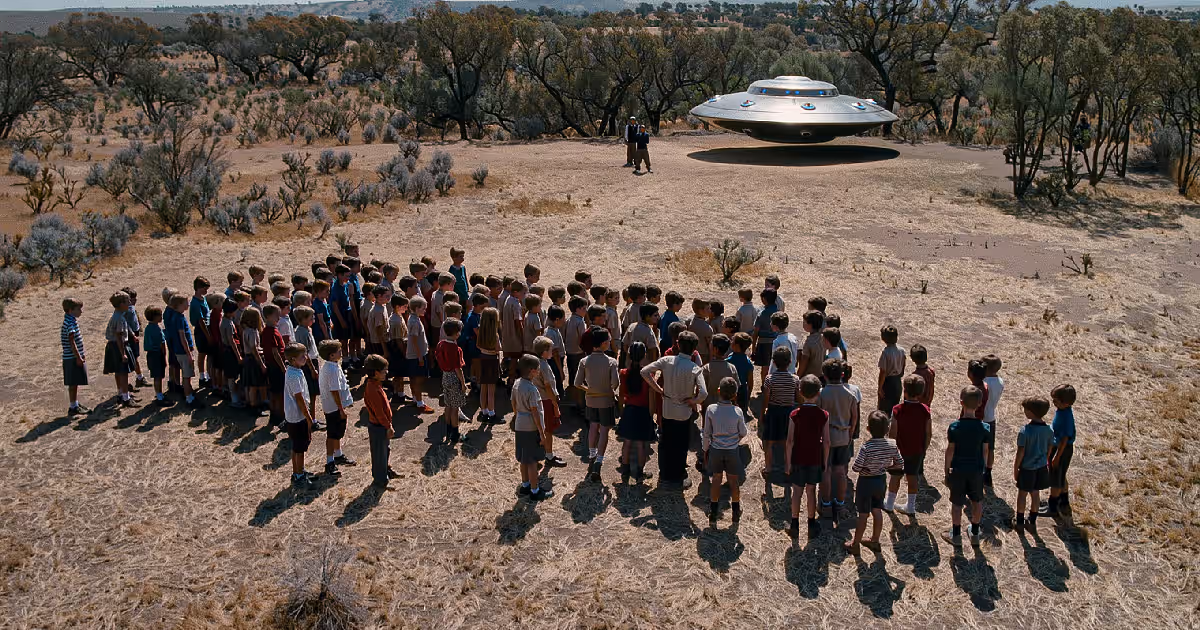
Ariel School children and craft sighting.
Illustration, not a period photograph.
Opening
On the morning of 16 September 1994, during break at Ariel School in Ruwa, Zimbabwe, children came in from the scrub talking about silver objects and small figures just off the grounds. Teachers were in a staff meeting. No adult faculty member saw the landing. Dozens of pupils, ages six to twelve, later said they had.
The next day Cynthia Hind, a local UFO investigator, sat with them and had them draw. In November John E. Mack of Harvard sat with a smaller group on video. Drawings clustered: disc, black-clad figure, large eyes. Mack's sessions added a telepathic environmental warning that Hind's first notes did not carry in the same form. That addition is later speech inside the same year, not 16 September paper.
The spine of the file is a mass of child witnesses with no adult visual and no recovered object. The schoolyard is the scene. The drawings are the closest thing to a contemporaneous exhibit. The message in the eyes belongs to the interview rooms that followed.
Timeline
14 September 1994. A bright fireball is reported across southern Africa. Hind already has other Zimbabwe cases on her desk. The fireball is not the school break. It is weather in the week around it.
16 September, mid-morning. Break at Ariel. Children look toward the bush beyond the playground. Accounts converge on one or more silver discs that drop or hover low, and on one to four small dark figures. Younger children run. Older ones stay. Some later say a figure sits on a craft. Some say it runs in the grass with a bounce. Teachers inside do not see it. Classes resume. Parents call the next day because children will not drop the story.
17 September. Hind arrives, interviews, and collects drawings. Gunter Hofer films. The drawings are the first physical product of the event. They are not photographs of a craft.
November 1994. Mack and Dominique Callimanopulos interview a set of the children on tape. Eyes, fear, and in several sessions a warning about pollution and technology enter the record through Mack's questions. Those tapes become the international object. They are two months after the break, not the break itself.
No government inquiry with a recovered fragment follows. The case lives on drawings, Hind's notes, Mack's videos, and later adult memory of the same childhood morning.
Key figures
The children are the only visual witnesses to the objects and figures. Counts run from dozens to the mid-sixties depending on who is counting. They are not a single voice. Some saw a disc only. Some saw a figure. Some later added the stare that carried a sentence. Their 16-17 September drawings are the layer to keep first.
Cynthia Hind is the first adult investigator on the grounds. She is already in the UFO trade. She treats the children's consistency and their limited film diet as reasons to take the morning seriously. She does not produce a craft.
John E. Mack is the later amplifier. He is a Harvard psychiatrist already committed to abduction research. His November interviews make Ariel an international file. The environmental message that now travels with the case is concentrated in his sessions. That is a fact about the paper, not a verdict on the children.
The teachers are the missing adult eyes. They were in a meeting. Their absence is why the case is a child-only visual with adult paperwork after the fact.
Physical and documentary trail
On the paper, 1994 gives you four hard objects and no hull.
One: the 16 September break itself as a dated school event. Staff were indoors. Children were outdoors. That scheduling fact is not in dispute.
Two: the drawings Hind collected from 17 September onward. Discs, figures in black, large eyes. They are the nearest thing to a contemporary exhibit. They are still pictures made after the thing had gone.
Three: Hind's interviews and Hofer's film from the days immediately after the break. These are the first adult records of what the children said before Mack arrived.
Four: Mack's November 1994 taped interviews at the school. They are the most watched paper in the file. They are also the layer where the telepathic warning thickens. John Mack Institute account of the Ariel interviews, 1995, preserves lines from those sessions.
There is no photograph of a disc on the ground. There is no soil cast. There is no adult faculty statement that says I saw it too.
Like all the trees will go down and there will be no air. People will be dying. Those thoughts came from the man, the man's eyes.
Competing explanations
Landed craft and figures. This reading takes the cluster of drawings and the fear in the first interviews as a single event in the bush. It has many child voices and no metal. It must also explain why no teacher looked out of a window at the right minute.
Social contagion after a fireball week. Children share a scare, draw what the first talkers drew, and then meet investigators who already know the genre. The fireball of the 14th is real sky traffic. It is not a disc on the Ariel fence line. Contagion can enlarge a light. It is harder to invent, in lockstep, a figure in a shiny black suit unless someone starts that sentence.
Folklore overlay. Some Black children named tokoloshe or zvikwambo. That naming is local language for a wrong thing in the bush. It does not cancel the silver disc drawings. It does show that the same morning could be filed under more than one shelf.
Hybrid caution. Many children reported the same break. Adults built two different stories on it, Hind's and Mack's. The drawings survive both.
Later life of the case
Documentaries return to the tapes. Adult former pupils give interviews that lengthen the morning. Some keep the craft. Some keep the fear and drop the message. Mack dies in 2004. The videos outlive him.
Skeptical treatments lean on the staff meeting, the fireball week, and Mack's prior commitments. Believing treatments lean on the number of children and the drawings. Both treatments are later. The 16 September ground still has no object on it.
I keep the later adult memoirs and the film packages on the later-life shelf. I do not treat them as incoming break-time notes.
Finding
The children at Ariel School looked up from the playground and saw a craft in the trees and figures in black that did not belong to any lesson. They drew what they saw before the world arrived to explain it to them. A playground full of the same shape is not a single tall tale. Something landed at the edge of that field, and the children have been consistent enough to deserve the simple courtesy of being believed.
What still will not resolve: an adult photograph from that morning, or a measured trace in the grass taken the same day. Interviews twenty years later cannot do that work. A 1994 frame from the tree line would end the argument about whether the drawings were of a machine or of each other.