WESTALL
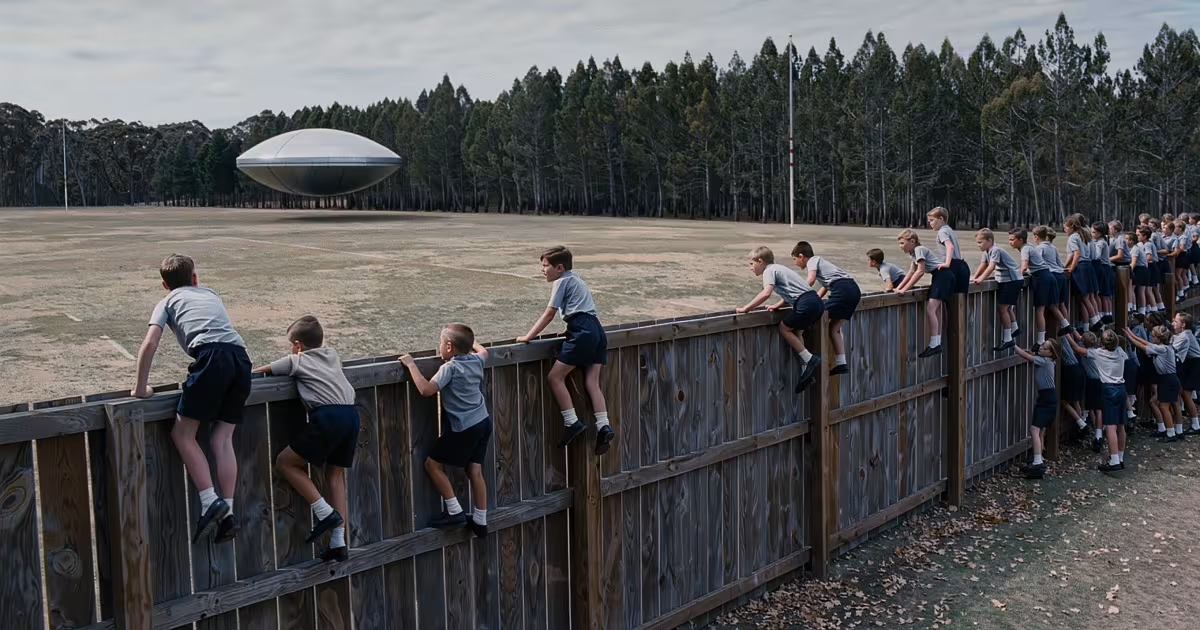
Westall High School oval and The Grange pines.
Illustration, not a period photograph.
Opening
Around 11 a.m. on 6 April 1966, students and a teacher at Westall High School in Clayton South, a Melbourne suburb, watched a grey or silvery, saucer-shaped object, described by some as roughly twice the size of a car, descend, hover, and appear to land in a grassy paddock known as The Grange, adjacent to the school. Estimates of the total number of witnesses, drawn from two nearby schools and surrounding residents, range from around 100 to as many as 200, making this one of the largest daylight mass-witness UFO sightings on record anywhere in the world.
What sets Westall apart from a simple crowd-sighting case is what came after: local press coverage the same day, a same-day newspaper theory of a misidentified weather balloon, persistent witness accounts of a rapid, unexplained military and "men in suits" presence at the school discouraging discussion, and, six decades on, an ongoing, still-unresolved argument among named skeptics themselves over whether the weather that day even supports the leading conventional explanation.
Timeline
6 April 1966, approximately 11 a.m. Students on the Westall High School oval, joined shortly after by a teacher and students from a second nearby school, watch a shiny, grey or silvery object with a slight purple hue maneuver in the sky, descend, and appear to land briefly in The Grange, a grassed paddock bordering the school.
Same morning, within minutes. Several students, at least one teacher (later identified in press accounts as Andrew Greenwood, who described the object appearing to play "cat and mouse" with pursuing light aircraft), and a local resident approach the landing area. Witnesses report finding a large circular area of flattened grass at the site.
Same day, shortly after. The story reaches the local press; Dandenong Journal reporter Des Carroll is tipped off by a local stringer and visits the site, later recalling the flattened grass circle looked "bloody impressive" despite his own studied neutrality on the object's identity.
Same day, evening. The sighting airs on Melbourne's Channel Nine news and receives coverage in The Age and the Dandenong Journal.
Following day, in print. A newspaper report floats a weather balloon explanation, noting the Bureau of Meteorology had released a balloon from Laverton at 8:30 a.m. and that a westerly wind blowing at the time could plausibly have carried it into the Clayton-Moorabbin area by late morning; the same report notes witnesses described several small aircraft circling the object, though a subsequent check found no commercial, private, or RAAF pilot had reported anything unusual in the area that day.
Same period. Numerous witnesses report a rapid, notable arrival of Department of Defence or military personnel at the school and site, along with "men in suits" who reportedly cautioned witnesses not to discuss what they had seen, details that recur with unusual consistency across independently collected accounts decades later.
Following decades. The story recedes from broader public attention but persists locally, sustained by periodic press retrospectives, until Canberra-based teacher and amateur investigator Shane Ryan begins a sustained investigation in 2005, eventually collecting more than 140 individual witness accounts.
2010. Ryan's documentary Westall '66: A Suburban UFO Mystery, co-produced with director Rosie Jones, brings the case to a much wider national and international audience, featuring adult interviews with former student witnesses including Joy Clarke, Terry Peck, and Sue Savage.
Researcher Keith Basterfield's investigation. Basterfield locates documents in the National Archives and the former Department of Supply indicating a high-altitude balloon from the HIBAL project, used to monitor radiation levels following British nuclear tests at Maralinga, was launched from Mildura and may have blown off course, coming down in a paddock near Westall High School. Basterfield notes HIBAL balloons had a white-silver appearance with a trailing parachute and gas tube, features he argues are consistent with witness descriptions, and separately notes Department of External Affairs files discussing the real possibility of property or personal damage from an errant HIBAL balloon.
Skeptic Brian Dunning's assessment. Dunning proposes a two-part explanation: the weather balloon accounting for the first phase of the sighting, followed by a nylon target drogue, a windsock-like towed target used in aerial gunnery or radar-tracking exercises, towed by a separate aircraft, potentially accounting for the object's later, more maneuverable-seeming behavior.
Direct skeptic-versus-skeptic dispute. Fellow Australian Skeptics representative Richard Saunders, appearing on ABC's Australian Story to discuss the weather balloon and HIBAL theories, is directly challenged on air by Ryan, who states that his own review of the actual published weather data for that day found strong, gusty westerly to southwesterly winds, a detail Ryan and other critics argue does not "stack up" cleanly with the specific balloon-drift trajectory the conventional explanation requires.
Ongoing. No official Australian government inquiry into the incident has ever been conducted, a gap witnesses and researchers including Ryan continue to cite as unusual given the event's scale and documented, if unexplained, contemporary Defence Department presence.
Key figures
Greenwood, the teacher whose account of the object's apparent "cat and mouse" maneuvering with pursuing aircraft is among the case's more specific and frequently cited witness details, lending adult, professional corroboration to what might otherwise be dismissed as excitable schoolchildren's testimony alone.
Ryan is the case's central modern investigator, whose sustained, decade-plus effort collecting over 140 individual accounts represents one of the most thorough amateur witness-documentation projects behind any single UFO case, and whose direct on-air challenge to a professional skeptic's weather-data claim is a rare instance of a UFO researcher contesting a specific factual claim rather than the broader interpretive framework.
Basterfield is the case's leading conventional-explanation researcher, whose HIBAL balloon theory is grounded in actual archival documentation of a real, contemporaneous, radiation-monitoring balloon program with documented internal government concern about exactly the kind of off-course incident he proposes occurred.
Saunders and Dunning represent the case's mainstream skeptical position, though notably their own specific proposed mechanisms, weather balloon plus separate target drogue, differ from each other and from Basterfield's HIBAL-specific theory, showing genuine internal disagreement among skeptics about the exact conventional explanation even while broadly agreeing the answer is conventional.
The unnamed "men in suits" are the case's most contested and least documented actors: consistently reported across many independent witness accounts collected decades apart, but never identified, confirmed, or explained by any surfaced official document.
Physical and documentary trail
On the paper, this file has same-day newspaper coverage, over 140 individually collected witness accounts gathered by Ryan across more than a decade, archival government documents confirming the real existence and documented risk profile of the HIBAL balloon program Basterfield cites, and a contemporary newspaper weather report whose specific wind-direction data Ryan disputes as inconsistent with the proposed balloon drift path.
There is no confirmed official Australian government report on the incident, no surfaced Defence Department internal document explaining the reported military presence, and no photograph or physical sample from the flattened-grass landing site beyond witness description and press photographs of the pressed-down grass itself.
So many of us saw it... large, easily visible, circular, silver and clearly under some form of control.
Competing explanations
A stray HIBAL radiation-monitoring balloon. This is the most archivally grounded conventional explanation, resting on real documents confirming both the balloon program's existence and internal government awareness of exactly the off-course risk being proposed, and it accounts reasonably well for the object's described silver-white appearance and trailing components. Its central weakness is the specific wind-direction dispute Ryan has raised directly against Saunders and Dunning's presentations of it, a factual disagreement about that day's actual weather data that has not been definitively settled by either side in public.
A weather balloon plus a separately towed target drogue. Dunning's two-part theory attempts to account for both phases of the sighting with two independently real, if unconnected, conventional sources, an economical reading in principle but one requiring two separate misidentified objects to coincide closely enough in time and location to be merged into one witness narrative.
A classified military exercise or experimental aircraft test. This reading is supported by the persistent, independently corroborated witness accounts of a rapid, unusual Defence Department presence and warnings to stay silent, details that would be somewhat unusual as a response to an ordinary misidentified weather balloon, but it remains unconfirmed by any surfaced classified document.
A genuine unidentified craft. This reading is supported by the case's sheer witness scale, the specific "cat and mouse" maneuvering description from an adult professional witness, and the persistent gap between the conventional explanations offered and the specific behavioral and meteorological details witnesses and researchers like Ryan continue to argue those explanations do not fully match.
Later life of the case
Westall has become one of Australia's most enduring UFO cases specifically because of its scale and its unusual, still-unresolved internal skeptical dispute, a genuine disagreement among people broadly committed to a conventional explanation about which conventional explanation actually fits. A commemorative playground was later built at the site partly in recognition of the incident's lasting local significance, and the case has continued to draw fresh documentary attention on major anniversaries, including a 2026 ABC Australian Story revisiting the case on its sixtieth anniversary.
Finding
A very large number of independent witnesses across two schools and the surrounding area reported the same basic sighting on a single morning, an unusual scale of daylight corroboration for any UFO case. The most archivally grounded conventional explanation, a stray HIBAL radiation-monitoring balloon, is directly disputed on specific factual weather-data grounds by the case's own leading modern investigator, and the reported, persistent military presence and instruction to stay silent remains entirely unexplained by any surfaced official document regardless of which object explanation one favors.
What still will not resolve: the specific wind-direction dispute between Ryan and the balloon-theory proponents, and any surfaced Defence Department document explaining the reported military response. Until both are settled, Westall stays a case where even the skeptics haven't agreed among themselves.