SHAG HARBOUR
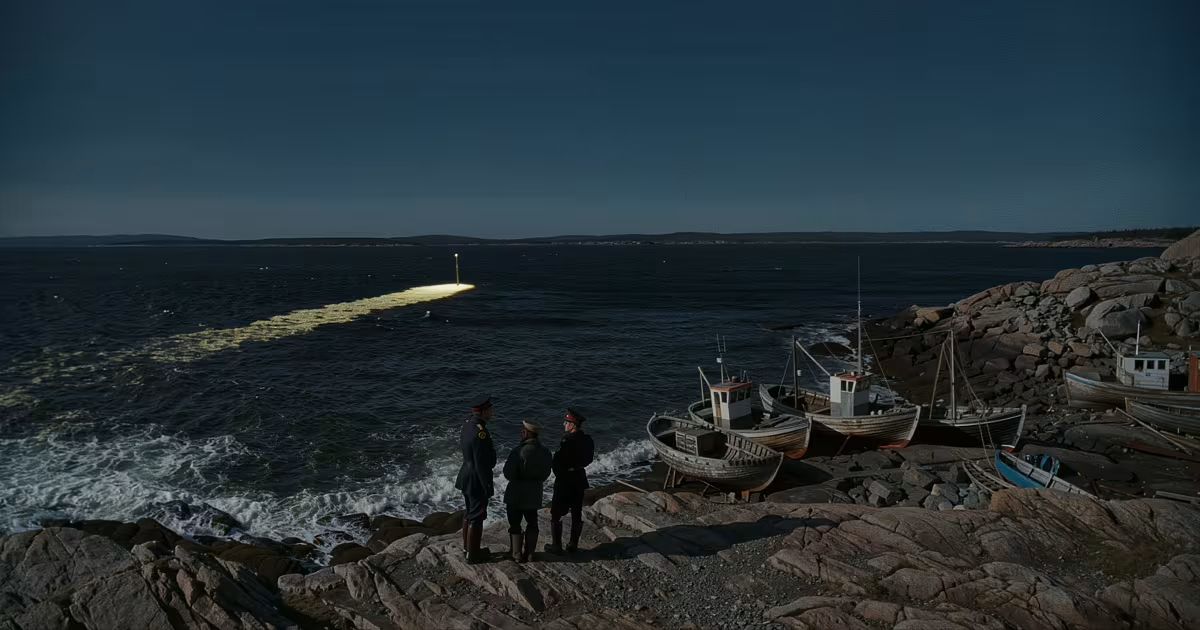
Shag Harbour shoreline. October 1967.
Illustration, not a period photograph.
Opening
At about 11:20 p.m. on 4 October 1967, at least eleven people in and around Shag Harbour, a small fishing village on Nova Scotia's southern tip, watched a large, low-flying, lit object descend at a steep angle toward the water, accompanied by a whistling sound, a whoosh, and a bang, before it struck the surface of the Gulf of Maine and appeared to float, trailing a patch of thick yellow foam, before sinking from view. RCMP officers, fishermen, and the Canadian Coast Guard searched the site within the hour and over the following days; the Royal Canadian Navy sent divers from HMCS Granby. No wreckage, debris, or bodies were ever found, and no aircraft, civilian or military, was reported missing.
What sets Shag Harbour apart from most crash-adjacent UFO cases is the paper trail's cleanliness: the Canadian government filed this as an unidentified object the same night, in writing, through its own Rescue Coordination Centre, and has never retracted that classification.
Timeline
4 October 1967, earlier that evening. Air Canada Flight 305 captain Pierre Charbonneau and first officer Robert Ralph report a brightly lit, rectangular object with trailing lights from 12,000 feet over Quebec at around 7:15 p.m., and Halifax radio and newsroom callers separately report glowing objects in the sky around 10 p.m., suggesting, in later reconstructions, that something had been moving across the region for hours before the main event.
Same night, approximately 11:20 p.m. Laurie Wickens and four friends see four flashing orange lights, apparently attached to a single object roughly 60 feet long, tilt at a 45-degree angle and descend toward Shag Harbour. RCMP Constable Ron Pound, separately driving down Highway 3 toward the harbour, independently sees the same lights and forms the same estimate of a single 60-foot craft.
Same night, minutes later. Pound, joined by Corporal Victor Werbicki, Constable Ron O'Brien, and local residents, reaches the shore and watches a yellow light moving slowly on the water, leaving a yellowish foam trail, before it either moves too far off to track or submerges.
Same night, within the hour. Coast Guard Cutter 101 and local fishing boats reach the site; the light is gone, but the yellow foam remains visible, an 80-foot-wide, half-mile-long patch. No survivors, wreckage, or debris are found. The RCMP checks with the Halifax Rescue Coordination Centre and NORAD radar at Baccaro, confirming no civilian or military aircraft were reported missing.
Same night, into early morning. The surface search continues until it is called off around 3 a.m.
Following day. The Rescue Coordination Centre files a formal report with Canadian Forces Headquarters in Ottawa stating that something of "unknown origin" had struck the water at Shag Harbour, the document later cited as the case's central piece of contemporaneous official corroboration.
2-8 October 1967. HMCS Granby and a team of Royal Canadian Navy divers conduct a several-day underwater search of the site; no wreckage or trace of the object is found, and the search is called off on 9 October due to lack of results.
Less than a week later. The Halifax Chronicle-Herald, which had initially covered the story seriously with a front-page headline stating the Canadian air force believed the object might be a concrete reality, runs a detailed report on a second, separate UFO sighting in the nearby Shelburne area.
1968-1969. The case reaches the Condon Committee, which lists it as Case 34, "North Atlantic, Fall 1967," and concludes in its final report that no further investigation by the project was justified, "particularly in view of the immediate and thorough search that had been carried out by the RCMP and the Maritime Command," treating the Canadian authorities' own response as adequately rigorous without offering a specific identification.
1993 onward. MUFON investigator Chris Styles begins re-examining the case decades after initial press coverage faded, eventually co-authoring, with Don Ledger, the 2001 book Dark Object, marketed as an account of "the world's only government-documented UFO crash."
Styles's expanded claim, developed across his research and book. Styles proposes that the object did not simply sink and vanish, but traveled underwater roughly 70 kilometers northeast to the vicinity of HMCS Shelburne, a facility supporting a NATO anti-submarine sonar detection network, where it was allegedly joined by a second underwater object and jointly monitored by naval forces for close to a week before both departed.
Skeptical review, most notably by Skeptoid host Brian Dunning. Dunning directly challenges the Shelburne-travel claim, noting Styles and Ledger presented no evidence for it and that no one else has ever independently corroborated it, characterizing the addition, introduced a quarter-century after the original event, as best enjoyed as fiction rather than as an established extension of the documented case.
Key figures
Wickens and Pound are the case's most consequential original witnesses, an independent civilian and an on-duty police officer who arrived at the same estimate, a single 60-foot object with four sequentially flashing lights, without having conferred beforehand.
The RCMP officers, Coast Guard crews, and Navy divers together represent the case's genuinely thorough contemporaneous official response, a multi-agency, multi-day search effort that the Condon Committee itself later cited approvingly as adequate grounds to close the case without further federal investigation.
Styles is the figure most responsible for the case's modern popular profile, having personally revived a story that had otherwise faded from public memory by the early 1990s, but his own most dramatic addition, the Shelburne underwater journey and second-craft rendezvous, is also the case's most evidentially unsupported element, resting on his own book's narrative construction rather than on any document, witness statement, or corroborating source he has published.
Dunning represents the case's most direct skeptical challenge to that specific later addition, distinguishing sharply between the well-documented original 4 October event and the unsupported Shelburne expansion built on top of it a generation later.
Physical and documentary trail
On the paper, this file has an unusually clean core for a case of its kind: a same-night RCMP filing, a next-day Rescue Coordination Centre report to Canadian Forces Headquarters explicitly using the phrase "unknown origin," a documented multi-day naval dive search, and formal review and non-dismissive classification by the Condon Committee itself, all traceable to contemporary 1967 documents rather than decades-later reconstruction.
What it lacks, and this is worth stating plainly, is any documentary support at all for the Shelburne-travel and second-craft claim that gives the story much of its modern dramatic shape. That element rests entirely on Styles's own later book and research, not on any surfaced government record, diver testimony under oath, or independent corroboration, a meaningful gap between the case's genuinely solid original core and its most widely repeated later embellishment.
No further investigation by the project was considered justifiable, particularly in view of the immediate and thorough search that had been carried out by the RCMP and the Maritime Command.
Competing explanations
A misidentified conventional object, flare, meteor, or aircraft, striking the water and quickly sinking or dispersing. This reading fits the absence of any recovered wreckage reasonably well, though it does not neatly account for the specific, independently corroborated multi-witness description of a single structured object with four sequentially flashing lights descending at a controlled angle.
A genuine unidentified object that crashed and was never recovered, exactly as the original 1967 documentary record states. This is the reading best supported by the actual contemporaneous evidence: multiple independent witnesses, a same-night official filing using the word "unknown," and a thorough, multi-day, multi-agency search that still found nothing.
The extended Shelburne underwater-journey and second-craft narrative. This reading, entirely Styles's own later construction, has no supporting document or independent witness statement behind it and has been directly and specifically challenged by outside skeptical review as an unsupported later addition rather than an established part of the case.
Classified Cold War military or NATO activity, potentially involving submarine detection exercises genuinely conducted in the region around the same period. This reading is plausible given the real, documented existence of NATO anti-submarine infrastructure near Shelburne, but like the extraterrestrial reading, it remains unconfirmed by any specific surfaced document tying that infrastructure's activity directly to the Shag Harbour event itself.
Later life of the case
Shag Harbour is widely regarded as Canada's most well-documented UFO case specifically because its official record, unlike Roswell's shifting press statements, has never been retracted or revised: the government's own same-night and next-day paperwork still describes an object of unknown origin. Its 50th anniversary in 2017 drew a dedicated commemorative festival to the village, and Styles's books remain the dominant popular account despite the unsupported status of their most dramatic claims.
Finding
Multiple independent witnesses, including an on-duty police officer, corroborated a structured, lit object descending into the water off Shag Harbour on a specific night in 1967, and Canada's own government filed that event in writing, the same night and the following day, as being of unknown origin, a classification that has stood unretracted for over half a century through genuine, thorough, multi-agency search efforts that found nothing. That much is as solid as UFO cases get.
What still will not resolve: any confirmed identity for the object itself, and, separately, any actual evidence for the popular Shelburne underwater-journey narrative that has become attached to the case since the 1990s but was never supported by a single document or corroborating witness beyond its original author's own telling. Those are two different open questions, and this file keeps them that way rather than letting the second borrow credibility from the first.