BELGIAN WAVE
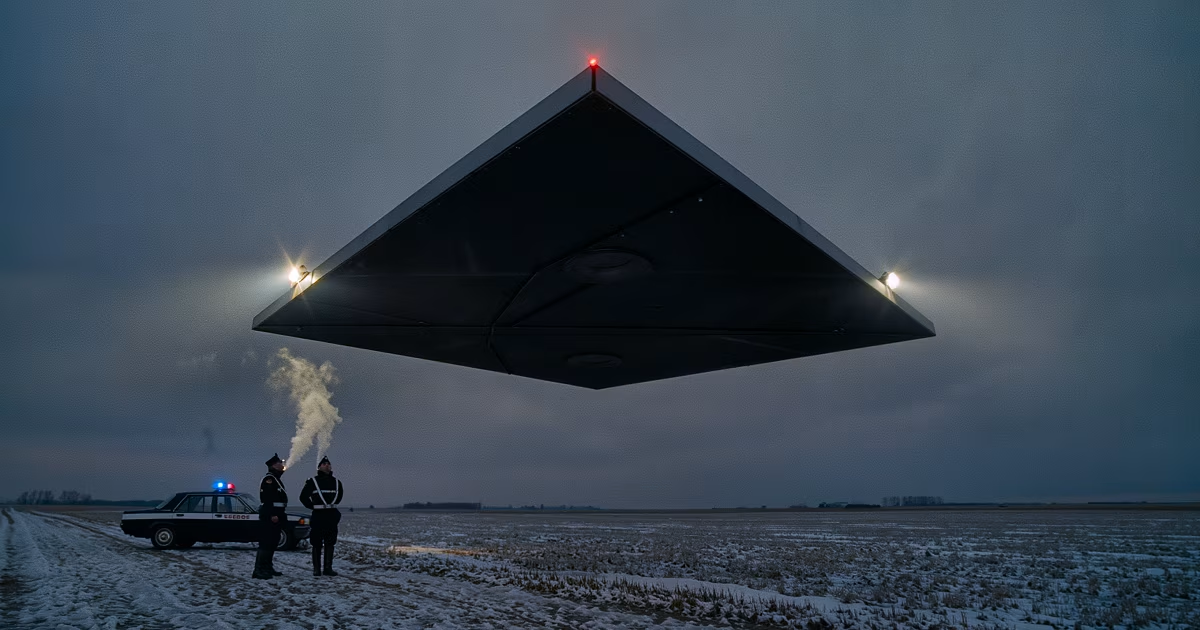
Belgian triangle reports. Wallonia.
Illustration, not a period photograph.
Opening
From November 1989 into 1990, people across Wallonia reported large silent triangles with lights at the corners. Gendarmes logged some of them. On the night of 30-31 March 1990 the Belgian Air Force scrambled two F-16s from Beauvechain after ground radar and police lights lined up. The jets took brief radar locks and no visual.
A photograph from Petit-Rechain became the picture of the wave. Years later the man who held the camera said it was a painted sheet of polystyrene. The picture died. The scramble night did not die with it. Major P. Lambrechts of Air Force staff wrote the locks into a report that went to SOBEPS and into public circulation.
The spine of the file is that March tape, not the ruined still. Belgium is a triangle wave with one official intercept attempt. It is not a recovered airframe.
Timeline
29 November 1989. The first heavy cluster, including a well-known gendarme report at Eupen: a large dark triangle, loud hum in some tellings, lights at the points, low over the eastern cantons. SOBEPS begins to take volume.
Winter 1989-90. Hundreds of calls. Shapes cluster on triangles. Not every call is a triangle. The wave is a weather of reports, not a single machine parked over one town.
30 March 1990, 23:00 onward. A gendarme at Ramillies reports three bright lights in a triangle, colours shifting. Glons Control Reporting Center holds an unidentified contact north of Beauvechain, slow. Semmerzake confirms. At 23:56 two F-16s are ordered up. They launch at 00:05 on the 31st.
00:13 to about 00:41. Brief lock-ons. Lambrechts records speed and height jumps: 150 to 970 knots in a minimum of time, altitude swinging thousands of feet, lock breaking, a jamming indication on one break. Pilots never get a visual. Ground people still see lights while jets pass.
1992. A deeper Air Force look at the F-16 tapes. 2011. The Petit-Rechain maker states the photograph was a model. The wave's most famous frame leaves the evidential pile. The scramble notes stay.
Key figures
The Walloon witnesses and gendarmes are the volume. They give the triangle its public shape. They do not give it a serial number.
The Glons and Semmerzake controllers and the two F-16 crews are the official night. They own the locks and the lack of a visual. That combination is the Belgian peculiarity: a NATO air force willing to say it chased something it could not see.
Major P. Lambrechts writes the staff paper that leaves the Air Force and enters the civilian file. SOBEPS is the civilian collector. The two institutions talk to each other more openly than most countries allowed in 1990.
The Petit-Rechain photographer is later life with a wrecking ball. His admission takes a picture off the wall. It does not unscrew the March radar tape.
Physical and documentary trail
On the paper, 1989-90 give you four hard objects and one dead picture.
One: the November 1989 cluster, including gendarme reports from the Eupen area, which opens the wave on official notebooks rather than only club forms.
Two: the 30-31 March 1990 scramble order, takeoff times, and F-16 lock data as written by Lambrechts. Speed and height changes in seconds are the numbers the case lives on.
Three: Major P. Lambrechts, Belgian Air Force General Staff preliminary report on the 30-31 March 1990 intercept, circulated to SOBEPS. This is the state's first narrative of the locks.
Four: the Petit-Rechain photograph, once treated as the image of the triangle, later withdrawn by its maker as a model. It remains in the file as a warning about stills, not as a craft.
There is no wreckage. There is no pilot visual. There is no released airframe type that the Air Force will put under those locks.
Each time the pilots were able to secure a lock on one of the targets for a few seconds, there resulted a drastic change in the behavior of the detected targets.
Competing explanations
Unknown triangles. This reading takes the volume of reports and the March locks as one class of object the Air Force could paint for seconds and not see. It has no hull.
Radar artifacts plus lights. Ground lights, planets, helicopters, and lock-ons that the F-16 software can throw when the sky is busy. The jamming flag and the speed jumps are the parts this reading must sand down. Later analysts have tried. They have not made the Air Force retract the report.
Secret aircraft. B-2 and F-117 were the 1990 suspects. Lambrechts wrote that those types could be excluded. Exclusion is a staff sentence. It is not a tour of every hangar in NATO.
Hybrid caution. A photograph cheated. A scramble night remains on staff paper. Those two facts are not the same quality.
Later life of the case
SOBEPS volumes, television, and the death of the Petit-Rechain still define the afterlife. Skeptics treat the faked picture as the whole wave. It is not. Believers treat every triangle after 1989 as the March target. That is not safe either.
I keep the model photograph and the later documentary packages on the later-life shelf. I do not treat them as incoming 30 March field notes. The Lambrechts page stays first.
Finding
Wallonia spent a winter looking up at silent triangles, gendarmes logged lights, and on 30-31 March 1990 two F-16s were sent after a target Glons and Semmerzake could paint. The pilots took locks and never got a visual. Major Lambrechts wrote the speed and height jumps into staff paper. That night is not a club story. An air force chased something it could not see.
What still will not resolve: a visual from the cockpit, or a released identity for the traffic those locks were holding. The Petit-Rechain still was a model and should stay off the proving table. A frame from the jet, or a named aircraft that fits the tape, is the only object that would finish the scramble.