AIRSHIP WAVE OF 1896
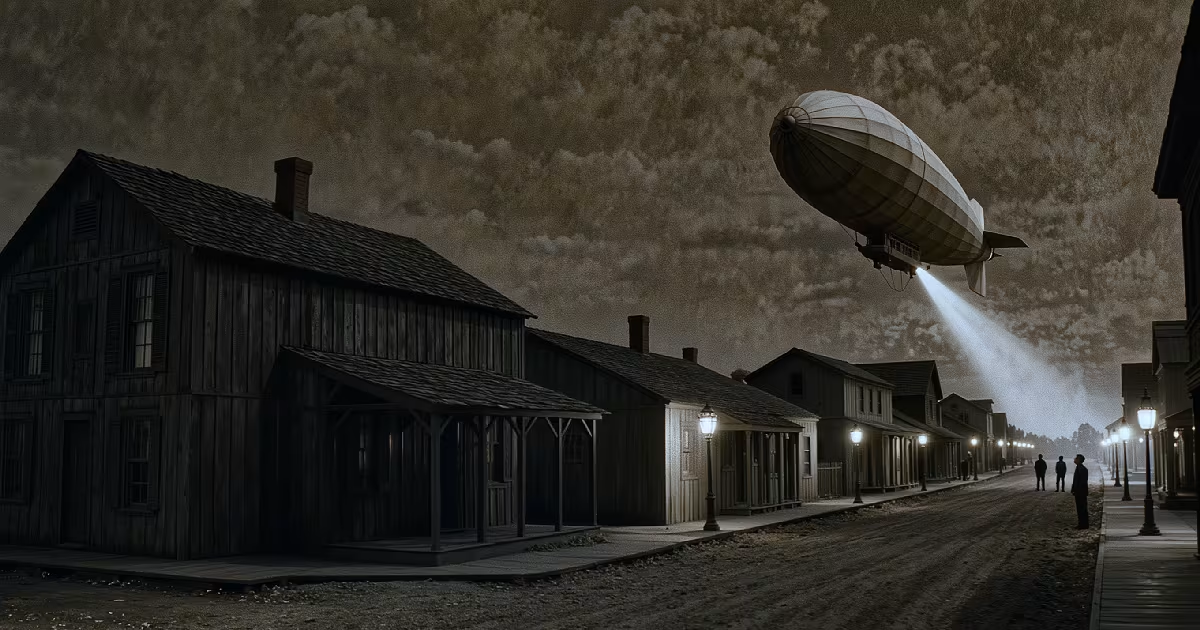
A cigar-shaped airship with a searchlight over a small town at night.
Illustration, not a photograph.

Opening
On the evening of 17 November 1896, a light moved slowly across the sky over Sacramento, California, at about a thousand feet. Within days it was reported from Folsom, San Francisco, Oakland and other towns, and thousands of people said they had seen it. It was an airship, the newspapers said, long before anyone had flown one: a cigar-shaped craft with a searchlight and a crew. By the following spring the sightings had spread across the Midwest and East, and newspaper estimates put the number of witnesses above a hundred thousand.
The 1896 and 1897 airship wave was the first mass UFO flap in the United States, fifty years before Kenneth Arnold. It was also a wave of tall stories, planted rumours and plain hoaxes, written up by competing newspapers that were willing to print almost anything. Most of it was nothing. Historians still describe what remains as a small residuum that has never been convincingly explained.
Timeline
17 November 1896The first sighting, over Sacramento.
21 November 1896The light is reported over Sacramento, Folsom, San Francisco, Oakland and other cities, with thousands of witnesses.
27 November 1896The Stockton Evening Mail publishes Colonel H. G. Shaw's claim that he met three tall beings beside a landed craft near Lodi. It is often cited as an early alien-contact story.
5 December 1896William Randolph Hearst's San Francisco Examiner runs an editorial calling the airship story pure myth.
February 1897A second, larger wave begins in western Nebraska and runs through May, with scattered reports into June.
28 March 1897Topeka, Kansas, where Governor John W. Leedy is reportedly among the witnesses.
9 April 1897Evanston, Illinois, the first Chicago-area sighting.
10 April 1897Springfield, Missouri, where a St. Louis Post-Dispatch account describes a grounded craft and a crew who said "Mars". The same days bring reports from Michigan of an airborne explosion and debris.
15 and 16 April 1897Denton and Corsicana, Texas. In the same week the story of the Aurora, Texas crash appears, with the airship supposedly hitting a windmill and its pilot buried.
June 1897Two airships are reported together in a single Texas sighting, which is described as rare for the wave.
1977The researcher Jerome Clark shows that the Leroy, Kansas tale of an airship lassoing a heifer was an entry in a Liars' Club tall-tale contest.
Key figures
George D. Collins, a California attorney, said his client was building an airship near Oroville. He later recanted, was ridiculed and went into hiding. A dentist whom Collins had implicated, E. H. Benjamin, denied involvement and also disappeared from view. A former California Attorney General, William H. H. Hart, later made more outlandish claims and then stopped talking to the press. Whether any of them really had a client is unknown.
William Randolph Hearst, whose Examiner called the story a myth, was a leading newspaper owner of the time. His paper and its rivals accused each other of fabrication.
Thomas Edison publicly denied any involvement in 1897. The astronomer G. W. Hough argued that many people were looking at the star Betelgeuse.
The historian Mike Dash describes a small residuum of reports that remain perplexing.
Physical and documentary trail
The record: newspaper reports, which are most of it, and a few later affidavits and recollections. There is no craft, no wreckage that has been confirmed and no photograph that is accepted. The Aurora, Texas story, which claimed a crash, received little attention at the time, and by the early 1970s most investigators considered it a probable hoax. The Rice Lake, Wisconsin story of a physician carried off to treat an airship captain was told differently by the local paper, which said he fell through ice.
The wave is mostly a story about newspapers. Some historians argue that many tales came from sensational yellow journalism, and the Examiner and its rival paper in San Francisco each accused the other of invention. The tall tales, such as the heifer story, circulated as news.
Things you might not know
- It came fifty years before Arnold. The first modern flying saucer report is usually dated to 1947, but the airship sightings of 1896 and 1897 were seen by far more people.
- A governor was a witness. Kansas Governor John W. Leedy was reportedly among those who saw it at Topeka.
- Some papers blamed Mars. The Washington Times and the St. Louis Post-Dispatch suggested Martian visitors.
- The heifer story was a joke. It was an entry in a tall-tale contest.
- A lawyer vanished from view. Collins recanted his story, was ridiculed and went into hiding.
- A star was blamed. An astronomer argued that many people were seeing Betelgeuse.
- Edison said no. He denied building it, publicly, in 1897.
Competing explanations
Misidentification and invention. The strongest reading. Stars and planets, such as Betelgeuse, Jupiter, Venus and Mars, meteors, lightning beetles, lanterns on balloons and kites explain many sightings. Competing newspapers manufactured the rest, in an age of yellow journalism.
A real secret airship. Some modern authors argue for real craft. Michael Busby in 2004 argued that three airships were built in Iowa by a group from California, and J. Allan Danelek in 2009 that a prototype from one inventor was flown in short tests, possibly ending in disaster in April 1897. Both are speculative and are not accepted by mainstream historians.
Visitors from elsewhere. Some papers suggested Martians at the time. There is no evidence for it, and the stories that supported it were mostly hoaxes.
Later life of the case
The wave is a standard reference for historians of the UFO phenomenon because it shows how a mystery spreads through the press. Two related reports are Aurora 1897, the best-known crash story of the wave, and the British scareships, which followed a decade later.
Finding
The airship wave was real as a wave of reports, and the reports were largely made of stars, lights, pranks and newspaper fiction. A small number of sightings have no ordinary explanation, and they are too thinly recorded to test. The secret-inventor theory has no documents behind it.
What still will not resolve: which, if any, of the sightings in the early weeks, before the newspapers joined in, were of a real object, and what that object was.
Evidence signature
2/9 Thin
- Witnesses
- several people
- Instruments
- nothing on record
- Paper
- nothing on record
How well documented the case is, not whether it's true. A strong record can still have an ordinary answer, and a thin one can still be real.
You decide · AIRSHIP WAVE OF 1896
What do you think happened?
One vote per case, anonymous. You'll see how other readers voted once you've voted.