GRAY BARKER
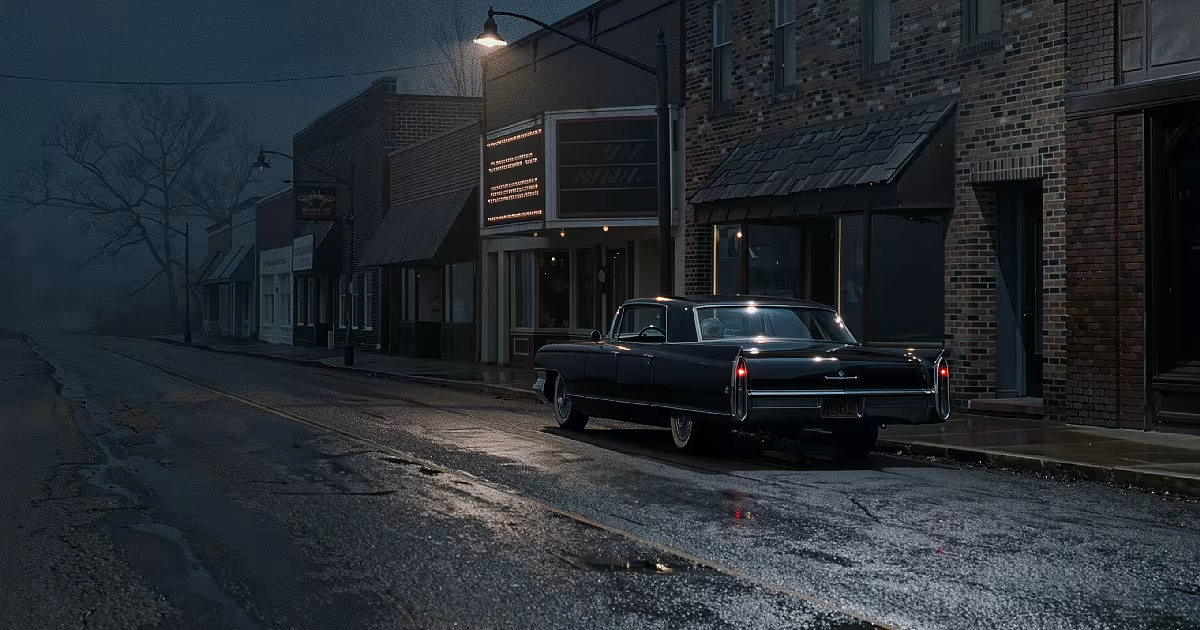
A black Cadillac parked on a dark small-town street at night.
Illustration, not a photograph.

Opening
Gray Barker was a theatre booker from Clarksburg, West Virginia, who became one of the most influential and least reliable figures in the history of UFO writing. In 1952 he began collecting stories about the Flatwoods Monster, a creature reported by residents of Braxton County, and went on to write, publish and sell the books that created the modern idea of the Men in Black. He edited a newsletter, ran a small press of his own, and corresponded with most of the people in the field.
His friends said, after he died, that he had never really believed any of it. His sister said he wrote for the money. The researcher James Moseley said he pretty much took all of ufology as a joke. Barker invented, embroidered and sold stories to people who wanted to believe them, and some of his inventions are now part of popular culture. It makes him a difficult subject for a UFO profile, and a revealing one.
Timeline
2 May 1925Barker is born in Riffle, Braxton County, West Virginia.
1947He graduates from Glenville State College.
1952Working as a theatre booker in Clarksburg, he starts to collect accounts of the Flatwoods Monster and submits an article on it to FATE. He then writes regularly for Space Review, a magazine put out by Albert K. Bender's International Flying Saucer Bureau.
1953Bender dissolves his organisation, citing orders from a higher source. Barker presses him for details.
1956University Books publishes They Knew Too Much About Flying Saucers, Barker's first book. It is credited with being the first to describe the Men in Black.
1957Barker and James Moseley write a fake letter to George Adamski, signed R. E. Straith and written on State Department stationery.
1962Flying Saucers and the Three Men, co-written with Bender and published by Barker's own imprint, Saucerian Books, proposes that the Men in Black were extraterrestrials.
1967Barker's Book of Adamski calls the Straith letter one of the great unsolved mysteries of the UFO field.
1970The Silver Bridge, Barker's book linking the collapse of the Silver Bridge at Point Pleasant to the Mothman sightings, is published, five years before John Keel's The Mothman Prophecies.
Late 1960sBarker and John C. Sherwood invent a notice describing "blackmen" who silence witnesses, with Sherwood writing as Dr Richard H. Pratt.
6 December 1984Barker dies.
Key figures
Albert K. Bender ran the International Flying Saucer Bureau and said in 1953 that three men in dark suits had ordered him to stop. Barker's first book was built on his account, and Bender co-wrote the second.
James W. Moseley was a fellow UFO figure, the editor of Saucer News, which he restarted in 1976 and which survives as Saucer Smear. He was Barker's friend and partner in the Straith hoax.
John C. Sherwood co-wrote the invented notice about the blackmen and later explained the hoax in a 1998 article in Skeptical Inquirer. He also said the government did discourage UFO interest in the 1950s, so there was a grain of truth in the Men in Black stories, though Barker embellished it.
Barker's sister Blanch said he wrote for the money. In a letter to Sherwood, Barker himself called his paranormal books "kookie books".
Physical and documentary trail
The record: Barker's books, his publications and his correspondence, much of which is held in the Gray Barker Room at the Clarksburg-Harrison Public Library, with letters from Adamski, Howard Menger and Moseley, from the 1950s to the early 1980s. The Straith letter and the blackmen notice are documented hoaxes, and Barker described them himself.
The Men in Black as a story rests on very little. In the 1956 book they are three men in black suits, driving large black cars, usually Cadillacs, who visit and warn people. One critic argues that the whole of the Men in Black folklore is based on the imagination of Barker, from a single rambling report by a man who was probably mentally ill. It is also suspected, though not established, that Barker once dressed in black with two friends to warn Bender off. The notice about the blackmen was printed as fact by some publications, and Barker later wrote that the fans swallowed this one with a gulp.
Things you might not know
- He wrote about Mothman first. The Silver Bridge appeared five years before Keel's famous book.
- He faked a government letter. The Straith letter fooled Adamski, who showed it around as proof of State Department support.
- He started with a monster. It was the Flatwoods Monster in 1952 that drew him into the field.
- He published his own books. Saucerian Books was his own imprint.
- The Men in Black became a film. A comic by Lowell Cunningham, inspired by the Men in Black concept, led to the 1997 film and an animated series.
- He is the subject of films. Whispers from Space (1995) and Shades of Gray (2008) are documentaries about him.
- He called them kooky. His own word for his paranormal books was "kookie".
Competing explanations
A showman and hoaxer. The strongest reading. Barker wrote for money, enjoyed the effect on believers, and invented or embroidered stories, as his friends and he himself said.
A believer who was sceptical in private. Some of his friends thought he half believed some of it. The evidence suggests he was sceptical of most claims.
A real experience. Bender may have had something happen to him in 1953. The only account is his own, and one critic argues that he was probably mentally ill.
Later life of the case
The Men in Black are now a fixture of popular culture, and their origin in one man's book is still little known. Barker's legacy is also a warning to researchers about how a field can be shaped by one writer's inventions. See also Men in Black, George Adamski and the Flatwoods report.
Finding
Barker was a real and important figure in UFO publishing, and his own friends said he did not take it seriously. The Men in Black as a story began with Bender and was shaped, probably more than anyone else, by Barker. Whether anything underlay Bender's first claim has never been shown.
What still will not resolve: what Albert Bender really experienced in 1953, since the only account of it is his own, filtered through Barker.
You decide · GRAY BARKER
What do you think happened?
One vote per case, anonymous. You'll see how other readers voted once you've voted.