MEN IN BLACK
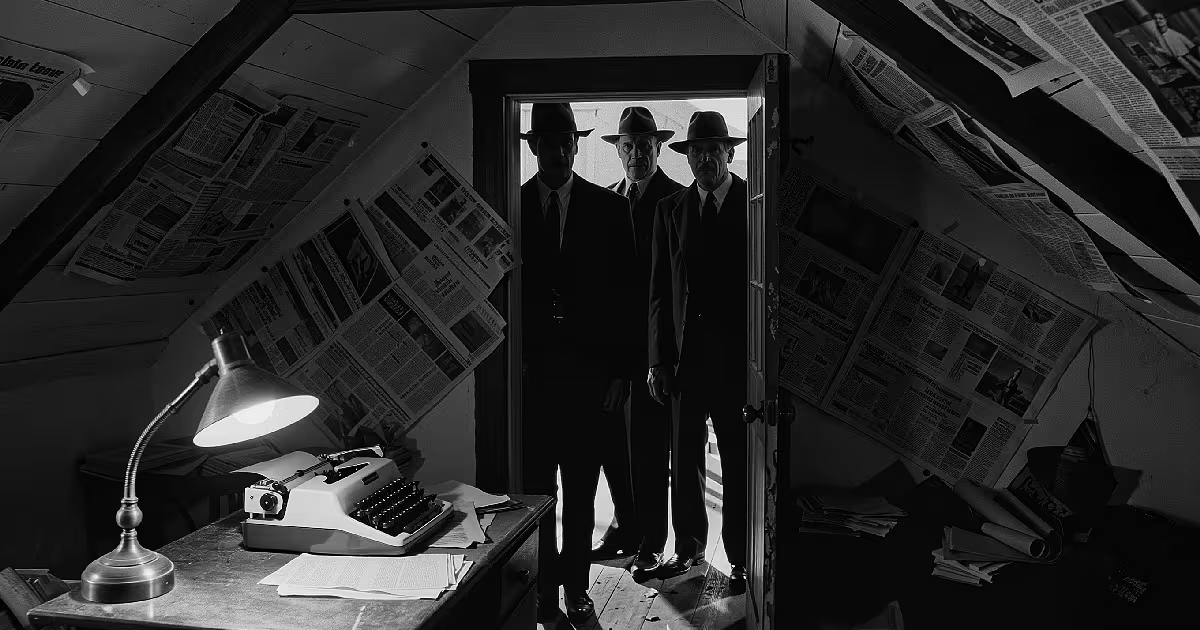
Three men in dark suits and hats standing in the doorway of a cluttered attic room, with a typewriter and a desk lamp in the foreground.
Illustration, not a period photograph.
Opening
In 1952, a young Connecticut man named Albert K. Bender founded the International Flying Saucer Bureau from his attic room in Bridgeport, Connecticut. It grew into one of the first large civilian UFO groups in the world. Then in 1953 he shut it down, told members to be very cautious, and said three men dressed in black had visited him and told him to stop. His story is the origin of the Men in Black.
Timeline
1952. Bender, then about 31, founds the International Flying Saucer Bureau from his room at 784 Broad Street, Bridgeport. The group publishes a journal, Space Review, and gathers members in several countries.
15 March 1953. The bureau holds “World Contact Day”, asking members everywhere to send a telepathic message to the saucers at the same time.
July 1953. According to Bender’s later account, three men in dark suits visit him at home and warn him to stop his research. He tells friends he was scared and could not eat for days.
October 1953. The last issue of Space Review appears. It says the saucer mystery is no longer a mystery, that the answer is being withheld on orders from a higher source, and that saucer researchers should be very cautious. The bureau closes.
1956. Bender’s friend Gray Barker, a cinema booker from Clarksburg, West Virginia, who had made his name writing up the Flatwoods Monster in 1952, publishes They Knew Too Much About Flying Saucers. It tells Bender’s story and makes “men in black” a fixture of UFO lore.
1957. Barker and his friend James Moseley forge a letter on State Department paper, signed by a non-existent “R. E. Straith”, and send it to the contactee George Adamski. They keep the joke to themselves for years.
1962. Barker’s own Saucerian Books publishes Bender’s Flying Saucers and the Three Men. The visitors are now aliens from a planet called Kazik who took him to a base in Antarctica.
1965 onward. Bender moves to California, runs a motel and founds a society for the film composer Max Steiner.
29 March 2016. Bender dies in Los Angeles, aged 94.
Key figures
Albert K. Bender, the source of the story. Gray Barker, who turned it into a book and a legend and was later known for his hoaxes. The bureau’s members, who were told to be cautious and never got the full story. John Keel and other writers who later spread the Men in Black idea.
Physical and documentary trail
On the paper: the issues of Space Review, the October 1953 closing notice, Barker’s 1956 book and Bender’s 1962 book. What is missing is any evidence of the visit besides Bender’s word. He named no one, and the 1953 version and the 1962 version differ completely. The house on Broad Street was demolished for Interstate 95 by 1957.
We advise those engaged in saucer work to please be very cautious.
Competing explanations
Government agents. Early readers assumed the visitors were FBI or Air Force officers. The FBI did keep an eye on some UFO groups in the 1950s. No record shows anyone visited Bender.
A frightening experience of his own. Bender described the visitors appearing in his room, and some researchers have suggested a nightmare or an episode of sleep paralysis, which can involve dark figures in the bedroom. This fits the fear he described.
A way out. Running a large international group was expensive and demanding. A dramatic warning may have been a way to close it without admitting that.
Aliens from Kazik. Bender’s own final version. It has no support outside his book, and it did not appear until nine years after the event.
Later life of the case
The Men in Black became a permanent part of UFO culture, turning up in later cases, in John Keel’s writing, and in the Men in Black comics and films. Barker, who did more than anyone to spread the story, was later found to have faked other UFO material, the Straith letter among them. His sister said he wrote his books for the money, and Moseley said Barker took ufology as a joke. He died in 1984. That record has made many researchers doubt how much of Bender’s tale he shaped.
Finding
Albert Bender really did shut down a thriving UFO group in 1953 and really did tell its members to be cautious. What made him do it can’t be tested. His own account kept changing, it reached the world through a friend who is known to have faked other UFO material, and no document places anyone at his door. The strongest reading is a real fright, of whatever cause, that his friend turned into a legend.
What still will not resolve: what Bender saw in his attic room in July 1953, and why he never gave the same answer twice.