BLACK KNIGHT SATELLITE
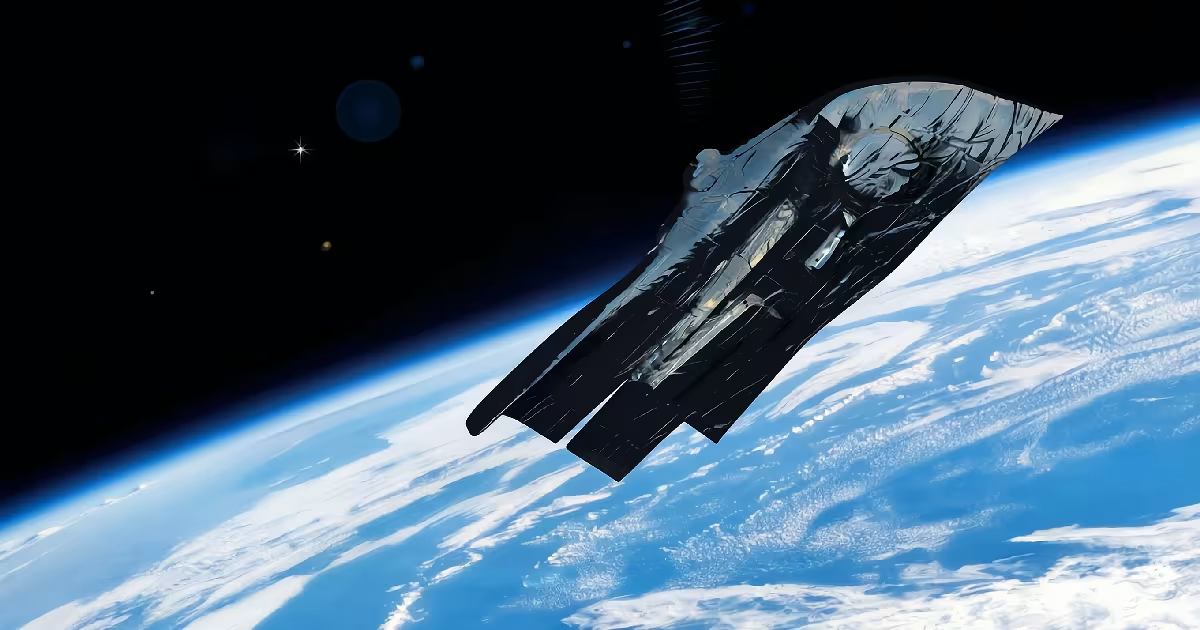
A black, jagged shape drifts above the curve of the Earth.
Illustration, not a photograph.
Opening
Somewhere above us, the story goes, a dark, angular object has been circling the Earth for 13,000 years. Tesla heard its signals. The military tracked it before anyone had launched a satellite. Astronauts photographed it in 1998. It is called the Black Knight, and photographs of it, a black, jagged shape against the blue curve of the Earth, have been shared millions of times. The truth is in some ways more interesting: the Black Knight is not one mystery but five or six real stories from different decades, each with its own explanation, stitched together under a borrowed name.
Timeline
1899. At his laboratory in Colorado Springs, while tracking thunderstorms hundreds of miles away with his receivers, Nikola Tesla hears a regular pattern of three faint beats. He comes to believe they are signals from another planet, possibly Mars. Nobody yet knows that natural objects in space, such as pulsars and Jupiter, give off radio signals.
9 February 1901. Tesla goes public in Collier's Weekly, in an article called "Talking with the Planets". He writes that it was not immediately clear to him he was hearing intelligently controlled signals, and that later study convinced him.
1927 to 1928. Norwegian radio amateur Jørgen Hals in Oslo hears "long delayed echoes": his transmissions coming back several seconds after they were sent, far too late to have simply bounced off the upper atmosphere. Physicists Carl Størmer and Balthasar van der Pol investigate. The cause is still debated, but it is thought to be natural.
1954. Retired Marine Corps major and UFO author Donald Keyhoe tells newspapers, including the San Francisco Examiner and the St. Louis Post-Dispatch, that the Air Force has detected two artificial satellites orbiting Earth. No nation can launch one yet. Sputnik is three years away.
20 November 1959. The US launches Discoverer VIII, secretly part of the Corona spy satellite programme. Its rocket burns too long and throws it into a higher, more stretched orbit than planned. The camera fails, and the film capsule is lost on re-entry the next day. The rest of the spacecraft stays up.
February 1960. Time magazine reports that the US Navy has detected a dark object in a near-polar orbit, suspected to be a Soviet spy satellite. It is later identified as the remains of the US Air Force's own Discoverer VIII, a secret reconnaissance satellite that had gone into the wrong orbit.
1958 to 1965. Britain test-fires the Black Knight rocket from Woomera in South Australia, to study warheads re-entering the atmosphere. The name is later borrowed for the legend.
1963. A story spreads that astronaut Gordon Cooper saw a UFO on his final Mercury orbit. Neither NASA's mission transcripts nor Cooper's own copies record any such report.
April 1973. Scottish writer Duncan Lunan publishes "Space Probe from Epsilon Boötis" in the British Interplanetary Society's magazine Spaceflight. Plotting the delays of the 1920s echoes as a star map, he suggests they come from a 13,000-year-old alien probe, sent from the double star Epsilon Boötis and orbiting near the Moon. The New York Times, Time magazine and CBS Evening News all cover it.
1976. Lunan withdraws his conclusions. Some of the 1920s records he relied on turn out to be inaccurate, and what he had deduced about Epsilon Boötis is wrong. He has since returned to the idea more than once, without claiming the original decoding stands.
December 1998. On mission STS-88, the first to assemble the International Space Station, the crew of the shuttle Endeavour photograph an object drifting against the Earth. These are the pictures now shared as the Black Knight.
2000s onward. The internet joins all of the above into one story, under one name.
Key figures
Nikola Tesla, the brilliant inventor, is the legend's starting point. Donald Keyhoe, the most widely read UFO author of the 1950s, supplied the "satellites before Sputnik" claim. Duncan Lunan supplied the 13,000 years and the star of origin, and later took them back. Astronauts Jerry Ross and James Newman were the spacewalkers on STS-88. James Oberg, a former NASA engineer and space historian, identified what was in the photographs.
Physical and documentary trail
Each strand has its own record. Tesla described his signals in his own writing and interviews in 1899 and 1901. The long delayed echoes are in radio journals of the 1920s, and still turn up occasionally in amateur radio reports today. Keyhoe's claim is in the newspapers of 1954. The Discoverer VIII explanation was published in the follow-up to Time's 1960 report. Lunan's paper and his later corrections are in the published record.
NASA's photographs from STS-88 are public, with catalogue numbers, and NASA lists the object in them as a thermal blanket, a piece of insulation lost during a spacewalk while the astronauts were attaching the Unity module to the Russian-built Zarya. According to Oberg, the blanket was seen drifting away and burned up in the atmosphere within days.
Things you might not know
- Black Knight was a British rocket. The name comes from a real research rocket flown from Woomera in Australia between 1958 and 1965. It had nothing to do with aliens.
- Keyhoe was selling a book. His 1954 claim of two satellites came while he was promoting a UFO book, and some reporters wrote it up with tongue in cheek.
- Somebody was actually looking for little moons. In the 1950s, Clyde Tombaugh, the astronomer who discovered Pluto, led an Army-funded search for small natural satellites of the Earth. He found none.
- The famous photos are from the space station's first day of building. STS-88, in December 1998, was the mission that joined the first two pieces of the International Space Station.
- Tesla may have been hearing Marconi. One theory is that Tesla's three beats in 1899 were Guglielmo Marconi's radio tests in Europe, which used the Morse letter S: three dots.
- The 13,000 years made the evening news. The probe's age and its home star both come from Lunan's single 1973 article, which was covered by the New York Times, Time and CBS before he withdrew it in 1976.
- The 1960 mystery satellite was American, and broken. The Navy's "dark object", feared to be Soviet, was Discoverer VIII. It had gone into the wrong orbit, its camera never worked and its film capsule was lost. What the Navy tracked was the dead shell of America's own secret spy programme.
- The long delayed echoes are real. Radio amateurs still occasionally report hearing their own signals come back seconds later. The leading theories involve the Earth's magnetic field and the ionosphere, not a probe.
Competing explanations
An alien probe. The believers' case is that so many separate clues, from Tesla to the shuttle photographs, point the same way. A probe watching Earth for thousands of years would be exactly the kind of thing a government might not admit to.
Five stories wearing one name. Every strand has its own explanation. Tesla's signals were most likely natural radio sources, unknown in 1899. The echoes are a natural radio effect. Keyhoe's satellites were never confirmed. The 1960 object was Discoverer VIII. The Cooper story is not in the transcripts. The 1998 photographs show a lost thermal blanket. The 13,000 years come from a paper its own author withdrew. Martina Redpath of Armagh Planetarium put it neatly: a jumble of unrelated stories stirred together on the internet.
Later life of the case
The Black Knight is now one of the internet's most popular space legends, with countless videos, memes and claims that NASA is hiding the truth. Each new generation rediscovers the 1998 photographs. In fairness to the legend, real interest in "lurkers", alien probes that might be parked in our solar system watching us, is a serious subject in SETI research, and astronomers have proposed searching for them. They just have not found one.
Finding
The Black Knight, as one object, does not hold up. Its pieces are real: Tesla really did hear strange signals, the echoes really happen, the Navy really did track a dark object in 1960, and the astronauts really did photograph something black against the Earth. Each has an explanation, and none of those explanations is a 13,000-year-old probe.
What still will not resolve: the long delayed echoes. Radio amateurs have heard them for nearly a century, and there is still no single agreed explanation for every one.